The clearest signs a growth consultant is not delivering are no written baseline, no single named metric, and status reports full of activity (decks, audits, workshops) with nothing moving in revenue, pipeline or margin by the end of month two. Slow revenue alone proves little. A working consultant shows leading numbers, such as qualified pipeline, moving against a starting figure you both wrote down.
TL;DR:
- The earliest warning sign shows up in week two: if there is no written baseline for the target metric, nothing the consultant reports later can be verified.
- Activity is not progress. Decks, audits and workshop counts are effort. Pipeline, conversion rate, margin and cash are results.
- Slow revenue is not proof of failure. Check leading indicators first, and check whether your own team is blocking the work.
- A struggling business and a failing consultant look alike from the inside, so separate the two before you fire anyone.
- Give a stalled engagement one written 30-day cure plan with a single metric. If that misses, end it or move the fee to results.
Table of Contents
- Signs a Growth Consultant Is Not Delivering, Sorted by How Early You Can See Them
- Week One to Four: The Setup Tells You Everything
- Months Two and Three: Activity Without Movement
- What Makes an Ineffective Project Manager, and Why It Matters Here
- The Three Most Common Reasons Projects Fail, and Who Owns Each
- Signs a Business Is Struggling, and Why That Is Not Automatically the Consultant's Fault
- What to Do When You Suspect a Consultant Is Not Delivering
- Pay for Results So You Never Have to Wonder Whether They Are Coming
- Frequently Asked Questions
- Sources
Signs a Growth Consultant Is Not Delivering, Sorted by How Early You Can See Them
Most owners judge a consultant at month six, when the money is spent and the argument is emotional. The signs show up much earlier, and they mostly concern measurement. This page assumes you have already signed. If you are still choosing, our guide to picking a business growth consulting firm covers selection.
The table below lists the six signs we see most often, what each looks like in practice, and the fastest test you can run yourself.
| Sign | What it looks like | Fastest test |
|---|---|---|
| No written baseline | "We'll track improvements as we go" | Ask for the starting number, its source and its date |
| Effort reported as results | Slide counts, audits, workshop attendance | Ask which metric moved since the last report |
| Metric drift | Target shifts from revenue to "engagement" or "awareness" | Compare the metric in the contract to this month's report |
| Disappearing seniority | The pitch came from a partner, the work comes from a junior | Ask who did the work this week, by name |
| Lift bought with discounts | Revenue rises while gross margin falls | Read revenue and gross margin side by side |
| Every miss is your fault | Delays always trace to your team | Ask what they would change if the blocker never clears |
Week One to Four: The Setup Tells You Everything
A consultant who is going to deliver has already committed to a number by day 14. One who is not is still "discovering."
If there is no written baseline by day 14, every improvement reported after that is a claim, not a measurement.
Discovery is legitimate for a week or two. Past that, look for these:
- No named metric. "Grow the business" is not a target. "Raise qualified pipeline from $400,000 to $650,000 by month four" is. Our guide to measuring ROI on a growth consultant walks through setting the baseline before any work starts.
- No owner on your side. If nobody inside your company is accountable for the metric, the consultant cannot deliver and you cannot assess them.
- Vague scope. If you cannot state the engagement in one sentence, neither can they, and scope arguments in month three will cost you more than the fee.
- Unverifiable proof. Case studies without client names, dates or numbers cannot be checked. The U.S. Federal Trade Commission's advertising substantiation policy expects a reasonable basis for objective claims before they are made, so asking a consultant for the basis behind theirs is fair.
Months Two and Three: Activity Without Movement
By month two, a working engagement produces changes you can see in your own systems: new campaigns live, a revised sales process in use, price tests running. A stalled one produces documents.
Watch the weekly report. If it lists tasks completed and never states what is at risk, what decision is needed from you, or which number moved, the consultant is managing your impression of progress. Pull the data directly from your CRM, billing system or bank feed and compare it with what they present. The two should match.
Also check where the lift came from. A consultant can raise revenue 15 percent in a quarter by discounting, and you pay for it in margin and in a customer base trained to wait for sales. Revenue up with gross margin down is not delivery.
Pro Tip: At kickoff, ask the consultant to write down the result at day 60 that would make them recommend stopping the engagement. A consultant who delivers will name a number quickly. One who hesitates is telling you they cannot be wrong, which means they cannot be right in a way you can verify.
What Makes an Ineffective Project Manager, and Why It Matters Here
Many growth engagements run like projects, so project management failures show up as consulting failures. An ineffective project manager reports tasks completed and never says what is at risk. Other habits come with it:
- Silent date changes. Deadlines slide without a conversation or a stated reason.
- Late escalation. Problems reach you after they have already cost two weeks.
- Blurry ownership. Action items carry a team name, not a person's name.
- No decision log. Nobody can say why the pricing test was dropped or who approved it.
- Scope absorbed without comment. New requests are accepted with no trade-off stated, so the original goal quietly shrinks.
If your consultant also manages the work, you can grade them on these five. If they do not, one of these gaps usually belongs to your side, which leads to the next point.
The Three Most Common Reasons Projects Fail, and Who Owns Each
The Project Management Institute's Pulse of the Profession research has repeatedly named shifting organizational priorities, unclear or inaccurate requirements, and weak communication among the leading causes of project failure. Each maps to a growth engagement, and each has an owner.
- Unclear goals. The target was never written down or kept changing. Owner: shared, but the consultant should have forced the issue in week one.
- Changing priorities. Leadership redirected the team to a new product, a hire or a fire. Owner: you. A consultant cannot grow a pipeline your sales team stopped working.
- Poor communication and sponsorship. Nobody senior attends the review, so decisions stall. Owner: you, almost always.
If two of those three are true on your side, firing the consultant changes nothing, and the next one will fail the same way.
Signs a Business Is Struggling, and Why That Is Not Automatically the Consultant's Fault
Owners often hire a consultant because the company is under strain, then read continued strain as proof the consultant failed. Separate the two. These are the signs a company is struggling, and in most cases the signs of business failure ahead of it:
- Cash runway under six months. Cash is the first thing to run out, and no marketing change fixes a payroll gap in 30 days.
- Gross margin shrinking while revenue grows. You are buying growth at a loss.
- Customer concentration. My rule of thumb: when one customer is more than 30 percent of revenue, you have a dependency problem, not a growth problem.
- Rising acquisition cost. Each new customer costs more than the last, and payback periods lengthen.
- The founder is still the only salesperson. Revenue stops when you stop.
- Stretching payables. You are paying suppliers late to cover payroll.
The U.S. Bureau of Labor Statistics Business Employment Dynamics data shows that roughly one in five new employer businesses closes within its first year and about half are gone by year five.
Roughly half of new U.S. employer businesses do not reach their fifth year, per the Bureau of Labor Statistics. A consultant hired late in that decline is being asked to repair, not grow.
Ask which of the six signs above a consultant could realistically move in 90 days. Acquisition cost, conversion and pricing: yes. Cash runway and customer concentration: only partly, and only if you act on the advice. If your problem is the second kind, a fair consultant should have told you at the start. If they did not, that silence is itself one of the signs.
What to Do When You Suspect a Consultant Is Not Delivering

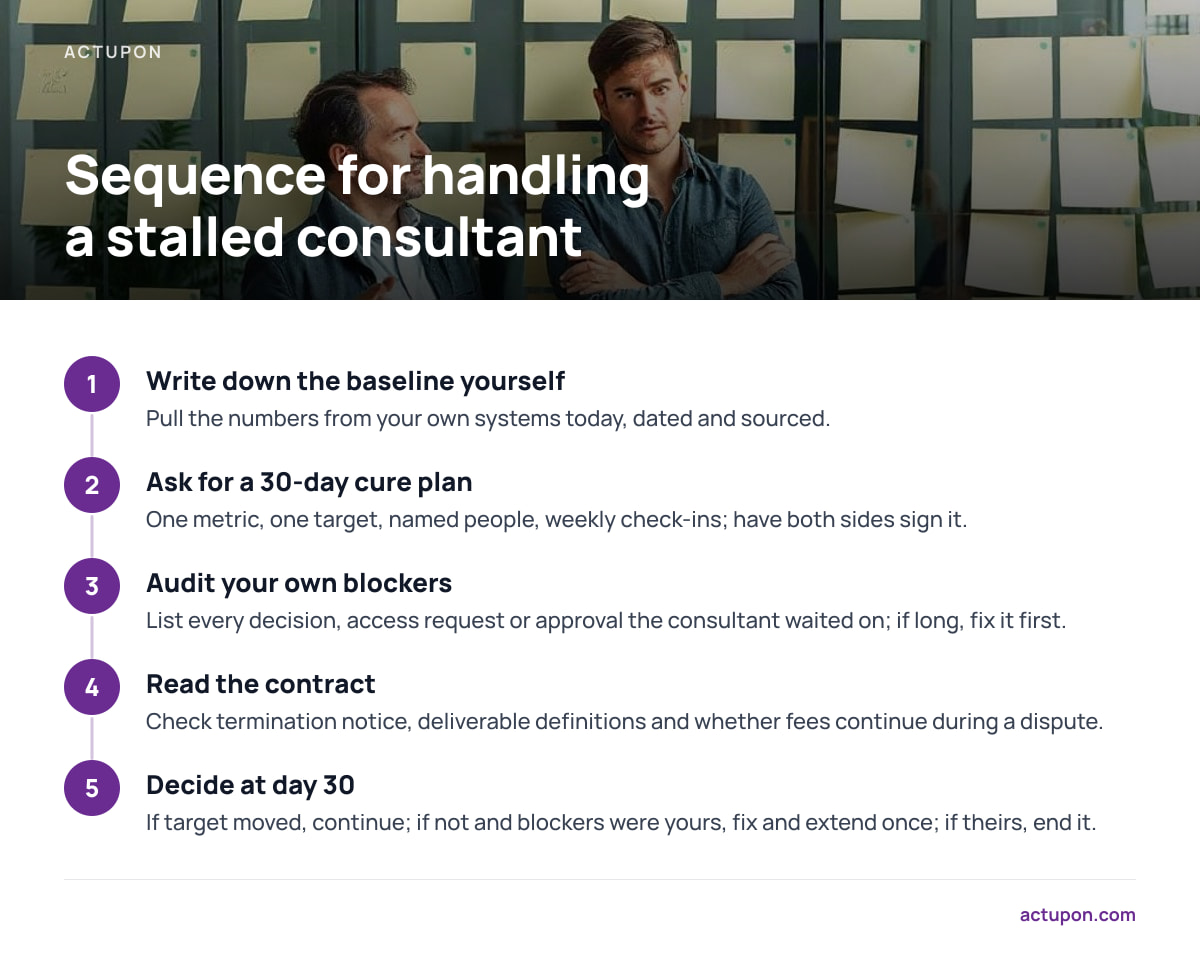
Do not fire in anger and do not drift for another quarter. Work through this sequence:
- Write down the baseline yourself. Pull the numbers from your own systems today, dated and sourced.
- Ask for a 30-day cure plan. One metric, one target, named people, weekly check-ins. Put it in writing and have both sides sign it.
- Audit your own blockers. List every decision, access request or approval the consultant waited on. If the list is long, fix it first.
- Read the contract. Check termination notice, deliverable definitions and whether fees continue during a dispute. If coaching is part of the deal, our executive coaching contract checklist covers the clauses that matter.
- Decide at day 30. If the target metric moved, continue. If it did not and the blockers were yours, fix them and extend once. If it did not and the blockers were theirs, end the engagement.
My position: one cure period is fair, two is a habit. A consultant who needs a second one is asking you to finance their learning curve.
Pay for Results So You Never Have to Wonder Whether They Are Coming
Every sign above comes back to one problem: you pay for time and then try to judge outcomes afterward. ActUpon works the other way. In performance-based engagements, we agree a baseline and a measurable target with you up front, and our fee is tied to hitting it. If the number does not move, our fee does not either. We require the baseline conversation that most consultants skip on day one.
There is a limit. Results-based fees only work when the outcome can be measured and credibly attributed to the work, so we decline goals that cannot be, and we will tell you if your real problem is cash or concentration instead of growth. We do not publish a fixed price because the fee formula depends on the metric. Ask us for the formula in writing before you sign, as you should with anyone.
Frequently Asked Questions
How long should I wait before deciding a growth consultant is not delivering?
Judge the setup at day 14 (is there a written baseline and a named metric?) and the early results at day 60 to 90. Revenue is a lagging number, so check leading indicators such as qualified pipeline, conversion rate and sales cycle length first. If none of them has moved by day 90, you have enough evidence to act.
What are the signs of business failure I should separate from consultant failure?
Cash runway under six months, shrinking gross margin, heavy dependence on one customer and rising acquisition costs are business problems that exist regardless of who advises you. A consultant can help with some of them, but not by changing a slide deck. Ask whether the consultant diagnosed these at the start.
What are the three most common reasons projects fail?
Research from the Project Management Institute has repeatedly pointed to changing organizational priorities, unclear or inaccurate requirements, and weak communication or sponsor involvement. In a growth engagement, the last two are usually shared between you and the consultant, and the first is usually yours.
What makes an ineffective project manager?
They report completed tasks without saying what is at risk, move deadlines without explanation, escalate problems late and assign actions to teams instead of people. A consultant who manages their own engagement this way is likely to stall it.
Should I fire a growth consultant who is not delivering?
Not before you audit your own blockers and offer one written 30-day cure plan with a single metric. If the metric moves, continue. If it misses and the delays were theirs, end it, and consider a performance-based fee structure next time.
Sources
- Pulse of the Profession | Project Management Institute
- Business Employment Dynamics | U.S. Bureau of Labor Statistics
- Advertising and Marketing Guidance | U.S. Federal Trade Commission