A good executive coaching contract checklist covers who the client is, what will be measured, what stays confidential, what you pay and how you leave. Most agreements handle the first and fourth well and skim the rest. The distinction that matters is between the sponsor, who pays, and the coachee, who talks. If the contract does not say exactly what the sponsor sees, the confidentiality clause is worthless.
TL;DR:
- Name every party and say what each one receives. Most executive coaching has a sponsor and a coachee, and confusion between them causes most disputes.
- Write confidentiality exceptions into the contract, including legal limits, sponsor reports, session recordings and AI note-takers.
- Pay monthly and never more than one quarter ahead. Add a trial exit after the first three sessions.
- Set up to three goals with a baseline and a review date. A coach can promise effort and process but not outcomes.
- Treat any free template (Word or PDF) as a skeleton. The clauses you fill in decide whether it protects you.
Table of Contents
- Who Is the Client? Settle the Three-Party Question First
- The Executive Coaching Contract Checklist: 12 Clauses to Confirm Before You Sign
- Confidentiality: Write the Exceptions, Not Just the Promise
- Fees, Cancellation and Exit: Where the Money Leaks
- Goals and Measures: Write Outcomes a Coach Can Be Held To
- Free Templates in Word, PDF and Checklist Form: How to Use Them
- Red Flags That Should Stop You Signing, and When to Call a Lawyer
- Get a Coaching Agreement With Goals You Can Check
- Frequently Asked Questions
- Sources
Who Is the Client? Settle the Three-Party Question First

Most executive coaching involves three parties: you, the person being coached; the company or board paying the bill; and the coach. Each wants something different from the paperwork. Your contract should name all three and say who can instruct the coach, who can end the engagement and who receives information.
The ICF Code of Ethics expects coaches to explain the nature and limits of confidentiality and the financial arrangements to the client and any sponsor at or before the start of the work. Its core competency on agreements asks coaches to agree the relationship, process, plans and goals with the client and relevant stakeholders. If a coach hands you a one-page agreement that mentions only fees and dates, they have skipped most of what their own professional body asks for.
If you are a CEO paying personally, you are both sponsor and coachee, and the contract is simpler. If your board or chair is paying, say so in writing. For the broader question of whether to hire at all and what the work costs, see coaching for CEOs.
The Executive Coaching Contract Checklist: 12 Clauses to Confirm Before You Sign
Use this table as the checklist. If a clause is missing from your draft, ask for it before you sign.
| # | Clause | What it should say | Red flag |
|---|---|---|---|
| 1 | Parties and roles | Names coach, coachee and sponsor, and who can instruct the coach | "Client" used loosely for both you and the company |
| 2 | Goals and measures | Up to three goals, each with a baseline and a review date | Goals such as "become a better leader" |
| 3 | Scope and length | Number of sessions, session length, format, total months | Open-ended "ongoing support" |
| 4 | Between-session access | Channels, response time, what counts as a billable extra | Unlimited access promised, no limits stated |
| 5 | Confidentiality | What is private, plus the exceptions | A blanket promise with no exceptions listed |
| 6 | Sponsor reporting | The exact content and format the sponsor receives | "Progress updates as needed" |
| 7 | Fees and invoicing | Amount, schedule, expenses, taxes, late-payment terms | Full prepayment of 12 months |
| 8 | Cancellation | Notice window, one free reschedule rule, missed-session treatment | Forfeiture of every missed session, no exceptions |
| 9 | Termination | Either side can leave on written notice, with pay for sessions delivered only | Auto-renewal, or no exit before term ends |
| 10 | Data and recordings | Where notes live, retention period, recording and AI transcription rules | Silence on recordings |
| 11 | Conflicts and credentials | Disclosure of other clients in your sector, code of ethics followed | Coach also advises your competitor, undisclosed |
| 12 | Law and disputes | Governing law, venue, liability cap, how disputes are raised | Foreign jurisdiction you did not choose |
Confidentiality: Write the Exceptions, Not Just the Promise
A coach who says "everything is confidential" is either naive or about to break the promise. Real coaching confidentiality has edges, and the contract should draw them before a problem forces the issue.
A confidentiality clause that does not list what the sponsor receives, and in what form, is a promise nobody can keep.
Cover these points:
- Sponsor reporting. Specify the content. A sensible default is attendance, goal progress on a simple scale and the coach's view of whether the engagement should continue. Session content stays with you.
- Legal limits. Courts, regulators and imminent-harm situations can override confidentiality in most jurisdictions. The agreement should name these cases so you hear them on day one.
- Recordings and AI note-takers. Many executives now join sessions with transcription tools running. Decide whether recordings are allowed, who holds them and when they are deleted. A transcript of you discussing a failing division is a sensitive document.
- Personal data. If you or the coach are in the EU, session notes are personal data under the General Data Protection Regulation. The agreement should say where notes are stored, for how long, and whether any outside service processes them.
- Handover on exit. State what happens to the coach's notes and your assessment results when the engagement ends. Ask for deletion or return within a set number of days.
Fees, Cancellation and Exit: Where the Money Leaks
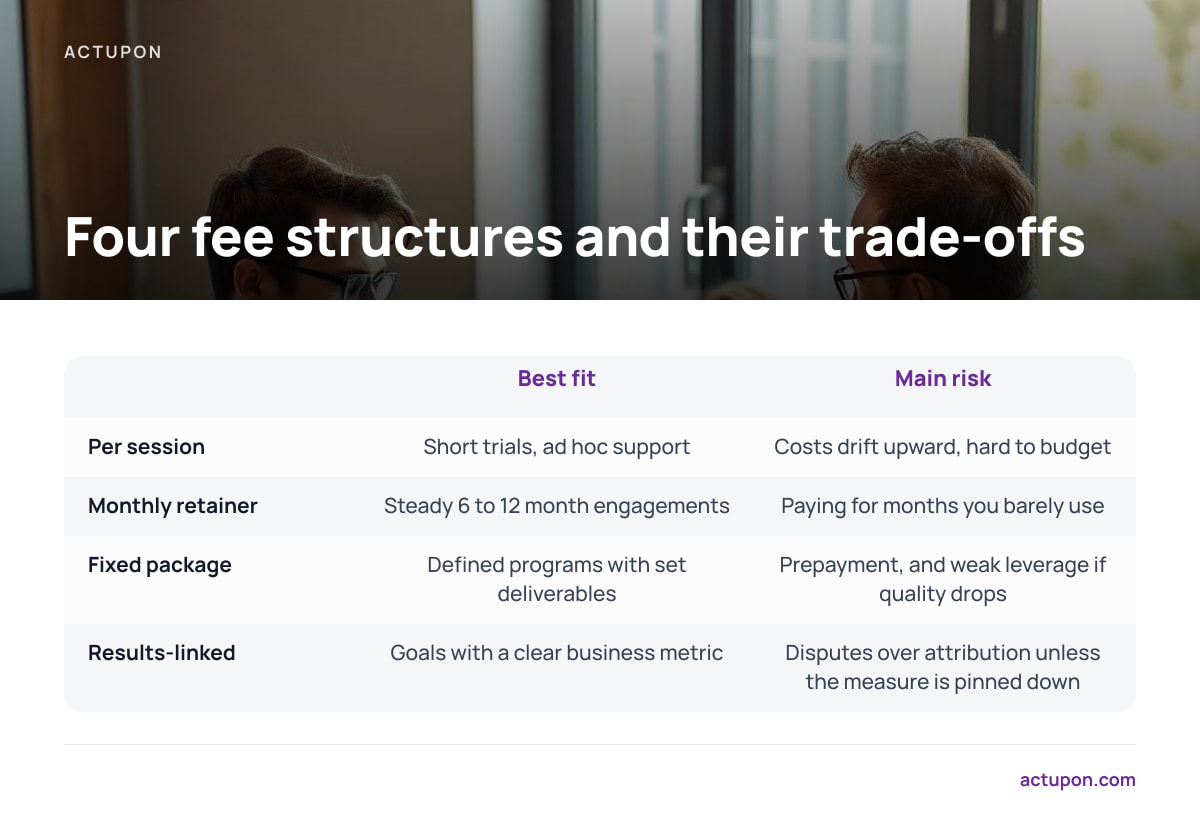
Fee structure shapes behavior on both sides, so pick it deliberately.
| Structure | Best fit | Main risk |
|---|---|---|
| Per session | Short trials, ad hoc support | Costs drift upward, hard to budget |
| Monthly retainer | Steady 6 to 12 month engagements | Paying for months you barely use |
| Fixed package | Defined programs with set deliverables | Prepayment, and weak leverage if quality drops |
| Results-linked | Goals with a clear business metric | Disputes over attribution unless the measure is pinned down |
My pick for most executives is a monthly retainer with a written scope. It keeps cash exposure small and gives both sides a regular point to renegotiate. Fixed packages are fine if you pay in stages. For typical price ranges and how to compare coaches, see executive coaching: what it costs and how to pick one.
Pay monthly, and never more than one quarter ahead. A coach who needs twelve months upfront is financing something with your money.
On cancellation, 24 to 48 hours of notice is a common and reasonable window. A rule that forfeits every missed session is not reasonable when you run a company. Ask for one free reschedule per quarter, and make the rule symmetrical so the coach owes you the same notice.
Pro Tip: Ask for a trial exit. Write the contract so that either side can end it after session three with no further fees beyond sessions delivered. Chemistry between an executive and a coach shows up fast, and a clean early exit costs the coach little if they are any good. A coach who refuses is telling you something about their confidence.
Goals and Measures: Write Outcomes a Coach Can Be Held To
Vague goals produce vague invoices. Limit the contract to three goals, give each a baseline today, and put review dates in the agreement, for example at month three and at the end.
A workable goal reads like this: "Reduce direct reports escalating routine decisions to me, measured by a count from my own calendar, from a baseline taken in week one." A bad goal reads: "Improve executive presence."
A coach can commit to a process, a schedule and honest feedback. They cannot guarantee that you will change, because you do the changing. Be suspicious of any contract that guarantees a business result from coaching alone, and more suspicious of one that offers no measure at all.
If what you need is a deliverable, such as a sales system or a restructured team, you probably want a consultant. Coach or consultant: the real difference explains how to choose.
Free Templates in Word, PDF and Checklist Form: How to Use Them
Searching for a free executive coaching contract checklist template will turn up Word files, PDFs and workbooks, and most are fine as a starting point. Professional bodies such as ICF also circulate sample agreements. None of them know your situation.
Three practical points:
- Take the Word version. You can mark changes with tracked edits and send them back. A PDF forces you to describe changes in an email.
- Fill in the blanks that matter. Templates leave goals, sponsor reporting and exit terms generic. Those are the clauses a template cannot write for you.
- Check the credentials clause. Coaches who follow the ICF code or the EMCC Global code have a published ethics standard you can point to if the relationship goes wrong.
Red Flags That Should Stop You Signing, and When to Call a Lawyer
Walk away or renegotiate if you see any of these:
- Auto-renewal with a long notice period. A 12-month contract that renews unless you cancel 90 days ahead is a trap for a busy executive.
- No sponsor reporting clause. Without one, the company can lean on the coach for information, and you will not know what was shared.
- Unrelated services bundled in. If the coach also sells you assessments, workshops or a "leadership program" inside the same agreement, price each item separately.
- Guaranteed outcomes with no measure. The promise sounds good and cannot be tested.
- Coach conflicts left unstated. Working with your rival or a major supplier is not automatically disqualifying, but you should know before session one.
Call a lawyer when the engagement is large, crosses borders, involves company equity or compensation, or when a company is paying and you are personally exposed. An hour of legal review costs far less than a dispute. Nothing here replaces advice for your jurisdiction.
Get a Coaching Agreement With Goals You Can Check
ActUpon runs executive coaching and mentorship for owners, founders and leadership teams, and the rest of its consulting is built on fees tied to agreed, measurable business results. That carries over to the paperwork: goals with a named measure and a baseline, a sponsor report you approve in advance, and an exit clause that does not trap you. You see the agreement before any money moves and can run it against the twelve clauses above.
Some coaching goals, such as better judgment under pressure, do not reduce to a single number, and we would say so instead of inventing a metric. Fees depend on scope and are set in writing before you sign. Check them, and everything else in our draft, against this checklist and have your own lawyer review anything sizable.
Frequently Asked Questions
What should be included in a coaching agreement before signing?
Name the parties and their roles, set up to three measurable goals, and state session count, length and format. Add confidentiality with its exceptions, what the sponsor receives, fees and payment schedule, cancellation and termination terms, data handling and governing law.
Is an executive coaching contract legally binding?
It can be, if it meets the contract requirements of the governing jurisdiction, such as agreed terms, consideration and capacity. Rules vary by country and state, so have a lawyer review anything with significant fees, cross-border parties or company equity involved.
Should a coaching contract guarantee results?
No. A coach can commit to a process, a schedule and honest feedback, but you control whether behavior changes. Be wary of guarantees with no stated measure. Agree on measurable goals, a baseline and review dates instead.
Who signs the contract when my company pays for the coaching?
Usually the coach and the company sign, and you, as coachee, sign or acknowledge a confidentiality section that describes what the company will and will not see. A three-party agreement makes those boundaries explicit and avoids disputes later.
Can I use a free executive coaching contract template in Word or PDF?
Yes, as a starting point. Choose Word so you can redline changes, and rewrite the goals, sponsor reporting, recording and exit clauses, because templates leave those generic. Treat the template as a skeleton, not a finished protection.
Sources
- ICF Code of Ethics | International Coaching Federation
- ICF Core Competencies | International Coaching Federation
- Regulation (EU) 2016/679 (General Data Protection Regulation) | EUR-Lex, European Union
- EMCC Global | European Mentoring and Coaching Council