To measure ROI on a growth consultant, subtract the growth you would have gotten anyway, convert what remains to gross profit, and divide that net gain by the full cost of the engagement. Most people skip the first step and divide revenue lift by fees, which overstates the return many times over. Fix the baseline and the metric in writing before work starts, and the math takes five minutes.
TL;DR:
- ROI is (gain minus cost) divided by cost. The hard part is the gain: count only growth above your pre-engagement trend, and count it as gross profit, not revenue.
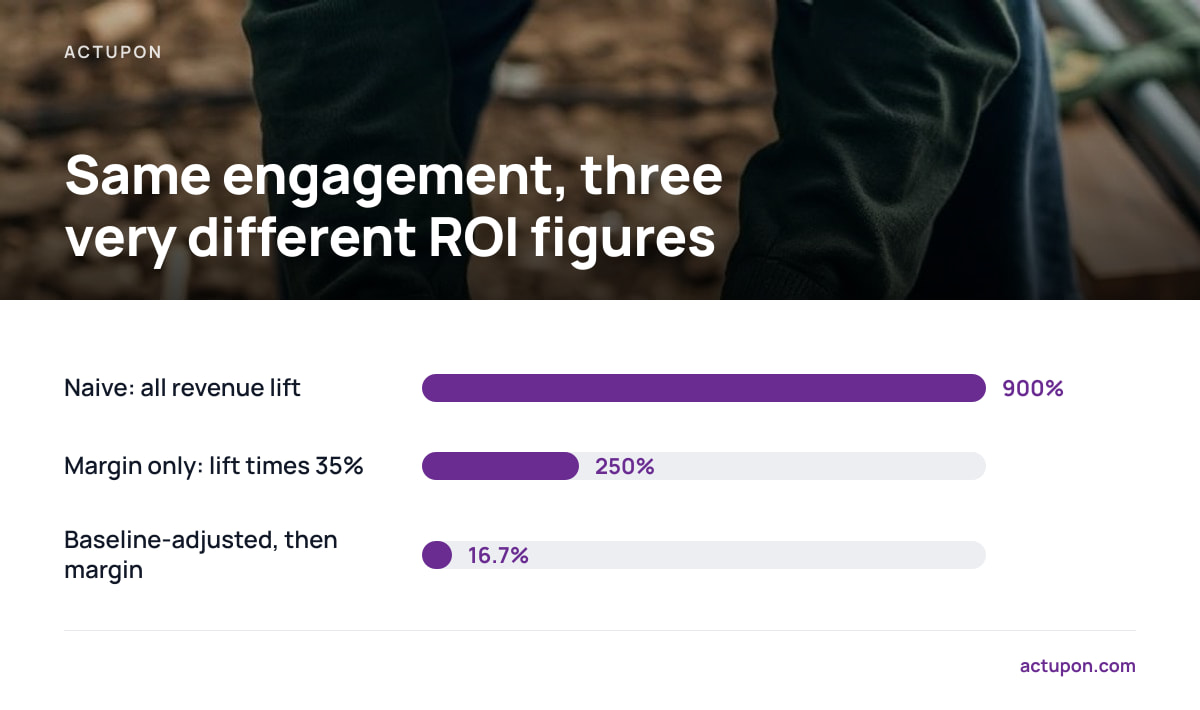
- In our worked example, a $600,000 revenue lift on a $60,000 fee looks like 900% ROI. Adjusted for trend and margin, it is 16.7%.
- A 22% ROI means each $1 spent returned $1.22. Whether that is good depends on the time horizon, the risk and how much of your own team's time the work consumed.
- Write the baseline, the metric and the measurement window into the contract before day one. Reconstructing them afterward is guesswork.
- For HR and other soft outputs, use the Phillips method: isolate the program's effect, convert it to dollars, then compute ROI.
Table of Contents
- How to Measure ROI on a Growth Consultant: The Formula and the Trap
- Set the Baseline Before Day One, or You Will Credit the Consultant for the Tide
- What Is a Good ROI Percentage for Consulting Spend?
- How Business Growth Is Measured, and Which Numbers Belong to the Consultant
- Count the Whole Cost, Including the Hours You Do Not Invoice
- How to Measure ROI in HR and Other Soft-Output Engagements
- Fee Structures That Make ROI Measurement Easy (or Impossible)
- Get a Growth Consultant Whose Fee Is the ROI Calculation
- Frequently Asked Questions
- Sources
How to Measure ROI on a Growth Consultant: The Formula and the Trap
The formula is the same one Investopedia gives for any investment: net gain divided by cost, times 100. If you spend $50,000 and the consultant produces $80,000 in attributable gain, your net gain is $30,000 and your ROI is 60%.
What does 22% ROI mean? For every $100 you spent, you got back your $100 plus $22. Spend $60,000, receive $73,200 in attributable gain, and your ROI is 22%. The percentage says nothing about time, so 22% over six months and 22% over four years are very different results.
The trap is the numerator. Most buyers plug in whatever went up while the consultant was around: revenue, leads, traffic. If you are still deciding who to hire, our guide to choosing a business growth consulting firm covers that. This article assumes you have someone in the door, or are about to, and want to know whether the money worked.
Three adjustments separate a real ROI figure from a flattering one:
- Baseline. Subtract the growth your business was already on track to deliver.
- Margin. Count gross profit, because revenue that cost you 65% of its value to produce is not a 100% gain.
- Full cost. Include the fee, expenses, tools bought on the consultant's advice and the internal hours your team spent.
Set the Baseline Before Day One, or You Will Credit the Consultant for the Tide

If your market is growing 10% a year, a consultant who "delivered" 10% growth delivered nothing. You need a counterfactual: your best estimate of what would have happened without the engagement. The simplest version is your trailing trend. Take the trailing 12 months of the metric you care about, project it forward, and treat the projection as zero.
Here is a worked example. A company with $4.0M in annual revenue hires a consultant for a $60,000 fee. Twelve months later revenue is $4.6M. Its trailing trend was 10% growth, so the baseline is $4.4M. Gross margin is 35%.
| Method | Gain counted | Fee | ROI |
|---|---|---|---|
| Naive: all revenue lift | $600,000 | $60,000 | 900% |
| Margin only: lift times 35% | $210,000 | $60,000 | 250% |
| Baseline-adjusted, then margin | $70,000 | $60,000 | 16.7% |
Revenue up $600,000, fee $60,000, and the true return was 16.7%.
The same engagement looks like a miracle or a mild disappointment depending on one subtraction. Agree the baseline method with the consultant in writing before work begins. If both sides argue about it at month twelve, the consultant's number will be the high one and yours the low one.
Pro Tip: Where you can, hold something out. Leave one region, product line or sales team untouched by the consultant's changes and track it alongside the treated group. A holdout is a better baseline than any trend projection because it experiences the same market, the same season and the same competitor moves. It costs you some upside in the short run, and in return you get a number nobody can argue with.
What Is a Good ROI Percentage for Consulting Spend?
There is no universal answer, but a defensible rule exists. Long-run U.S. large-cap equity returns have averaged roughly 10% a year, according to S&P Dow Jones Indices data on the S&P 500. Consulting is riskier than an index fund, takes your leadership's attention and often delivers nothing. So a consulting ROI near 10% is a loss in practice.
Our position: for a 12-month engagement, demand at least 100% net ROI, meaning attributable gross profit at least double the all-in cost. That sounds steep, but a consultant who cannot clear it is not worth the execution risk and management time. The example above (16.7%) fails this test, even though revenue grew 15%.
Time changes the threshold in two ways:
- Recurring gains. If the consultant built something that keeps paying, such as a repeatable outbound system or a pricing structure, count the gain over 24 months and accept a lower first-year figure. Be honest about decay, because most sales improvements fade without upkeep.
- One-time gains. A cleanup project or a single deal has no tail. Judge it on the first 12 months against the full 100% bar.
What is a good ROI percentage, then? For consulting, 100% or more within a year, or a clear path to it across 24 months with recurring gains. A 22% ROI beats a savings account and loses to the effort you put in.
How Business Growth Is Measured, and Which Numbers Belong to the Consultant
How is business growth measured? The base measure is the period-over-period change in a core figure: (current minus prior) divided by prior. Revenue is the most common, but it is the easiest to inflate with discounts or low-margin work. Statisticians use stricter definitions. The OECD and Eurostat's business demography manual calls an enterprise "high-growth" only if it averages more than 20% annualized growth over three years and had 10 or more employees at the start. One good quarter does not qualify.
For measuring a consultant, pick one primary metric tied to the engagement's actual job and keep the others as guardrails.
| Metric | Formula | Best when the engagement targets |
|---|---|---|
| Gross profit growth | (GP now minus GP prior) / GP prior | Pricing, product mix, margin |
| Net new customers | New logos minus churned | Sales and marketing systems |
| Customer acquisition cost | Sales and marketing spend / new customers | Channel efficiency |
| Net revenue retention | (Start MRR + expansion minus churn) / Start MRR | Account management, upsell |
| Sales cycle length | Days from first contact to close | Process and qualification |
Write the one primary metric into the agreement. A consultant who points to a dashboard of 15 numbers at the end is hunting for the one that went up.
Count the Whole Cost, Including the Hours You Do Not Invoice
The denominator is where honest ROI math quietly breaks. A $60,000 fee is rarely a $60,000 cost. Add these:
- Expenses and tools. Software, ad spend or contractors the consultant told you to buy.
- Internal time. If three managers spend 5 hours a week for six months, that is about 390 hours. At a loaded rate of $80 an hour, it is $31,200 you did not see on an invoice.
- Implementation cost. A new sales process might need a CRM migration, training or a hire.
Rerun the table above with $31,200 of internal time added and the cost becomes $91,200. The baseline-adjusted gain of $70,000 now loses money. This is why we tell founders to track hours from week one. If you are weighing an AI project, common small business AI project mistakes is a good checklist for the hidden costs that tend to show up late.
Timing matters too. Measure at the end of the contract and again six and twelve months later. If the gain vanishes after the consultant leaves, you rented growth instead of buying it.
How to Measure ROI in HR and Other Soft-Output Engagements
How to measure ROI in HR? Use the methodology developed by Jack Phillips and published by the ROI Institute. It extends training evaluation with a fifth level, ROI, and gives a sequence: collect data, isolate the effect of the program, convert the result to money, tabulate full costs, calculate ROI, and list the intangibles separately.
People skip the isolation step. Here is an illustrative case. An HR initiative cuts voluntary exits from 30 a year to 24. If each replacement costs $20,000 (recruiting, onboarding, lost output), the gross saving is $120,000. But a comparison group suggests half the improvement would have happened anyway, so the attributable benefit is $60,000. With a program cost of $50,000, ROI is ($60,000 minus $50,000) / $50,000, or 20%.
The same approach works for a growth consultant whose output is soft: better hiring, a stronger leadership team, faster decisions. Convert the change to a measurable proxy (turnover, time to fill, deals closed per rep), isolate, and price it. For executive coaching, our piece on measuring executive coaching ROI applies the same discipline with coaching-specific proxies. Where something cannot be converted to money honestly, report it as an intangible and leave it out of the ROI figure.
Fee Structures That Make ROI Measurement Easy (or Impossible)
How you pay determines how clean your ROI math can be.
- Hourly or retainer. The cost is certain and the gain is whatever you can prove afterward. You carry all the measurement burden and all the risk.
- Fixed project fee. Better, because scope and deliverables are defined. There is still no link between fee and result.
- Performance-based. The fee depends on an agreed, measurable result, so the baseline and metric must be settled up front or there is no invoice. The ROI calculation becomes the contract.
We would pick performance-based pricing whenever the outcome can be measured cleanly: revenue from a new channel, cost removed from a process, conversion on a defined funnel. It forces the baseline conversation that most engagements avoid. It fits poorly when the result takes years to appear or cannot be separated from other factors, as with brand repositioning. There a fixed fee with staged checkpoints is the more honest choice.
Get a Growth Consultant Whose Fee Is the ROI Calculation
ActUpon does performance-based growth consulting, so the measurement problem in this article gets solved before work starts. We agree the metric, the baseline, the measurement window and the payout with you in writing, and the fee follows the result you both signed off on. The same structure applies across our AI, crypto and blockchain advisory and our coaching work.
There is no rate card, because fees are set per engagement from the agreed result. That is also the limit: we can only work this way when the outcome can be measured with a defensible baseline. If yours cannot, we will say so and suggest a different structure. Check any consultant's terms, ours included, for how the baseline is set and who decides disputes before you sign.
Frequently Asked Questions
How do you calculate the ROI of a growth consultant?
Subtract the cost from the attributable gain, divide by the cost, and multiply by 100. Attributable gain means gross profit above your pre-engagement trend, and cost means the fee plus expenses, tools and internal time. Using revenue lift without those adjustments inflates the result.
What is a good ROI percentage?
For a 12-month consulting engagement, we think 100% net ROI or better is the right bar, because consulting carries execution risk and uses leadership time. Long-run equity index returns of about 10% a year set the floor for any investment. If gains recur for years, you can accept a lower first-year figure.
What does 22% ROI mean?
Every $1 invested returned $1.22, a net gain of $0.22. On a $60,000 engagement, that is $13,200 of net benefit. The figure needs a time frame attached, since 22% in six months is far stronger than 22% over three years.
How is business growth measured?
The basic measure is the percentage change in a core figure such as revenue or gross profit between two periods. Stricter definitions exist: the OECD and Eurostat define high-growth enterprises as those averaging over 20% annualized growth for three years with at least 10 employees at the start. For consultant evaluation, gross profit and retention are harder to game than revenue.
How do you measure ROI in HR?
Use the Phillips ROI methodology: collect outcome data, isolate the effect of the program, convert it to a dollar value, total the full costs, then compute ROI. The isolation step usually requires a comparison group or a trend estimate. Report benefits you cannot price honestly as intangibles.
How long should you wait before judging a consultant's ROI?
Measure at the end of the engagement, then again at six and twelve months. Gains that disappear after the consultant leaves were temporary, and your ROI figure should shrink accordingly.
Sources
- Return on Investment (ROI): How to Calculate It and What It Means | Investopedia
- ROI Methodology | ROI Institute
- S&P 500 Index Overview | S&P Dow Jones Indices
- Eurostat-OECD Manual on Business Demography Statistics | OECD