To measure executive coaching ROI, set a baseline before the first session, convert the improvement into dollars, then subtract the share coaching did not cause. The formula is (benefits minus costs) divided by costs. Executives who estimate their own gains routinely overstate them, so apply an isolation discount and a confidence discount before you trust the percentage.
TL;DR:
- Capture a baseline (business metric, 360 scores, retention) before session one. Without it you are guessing afterward.
- ROI is (benefits minus costs) divided by costs, after you strip out gains caused by something other than coaching.
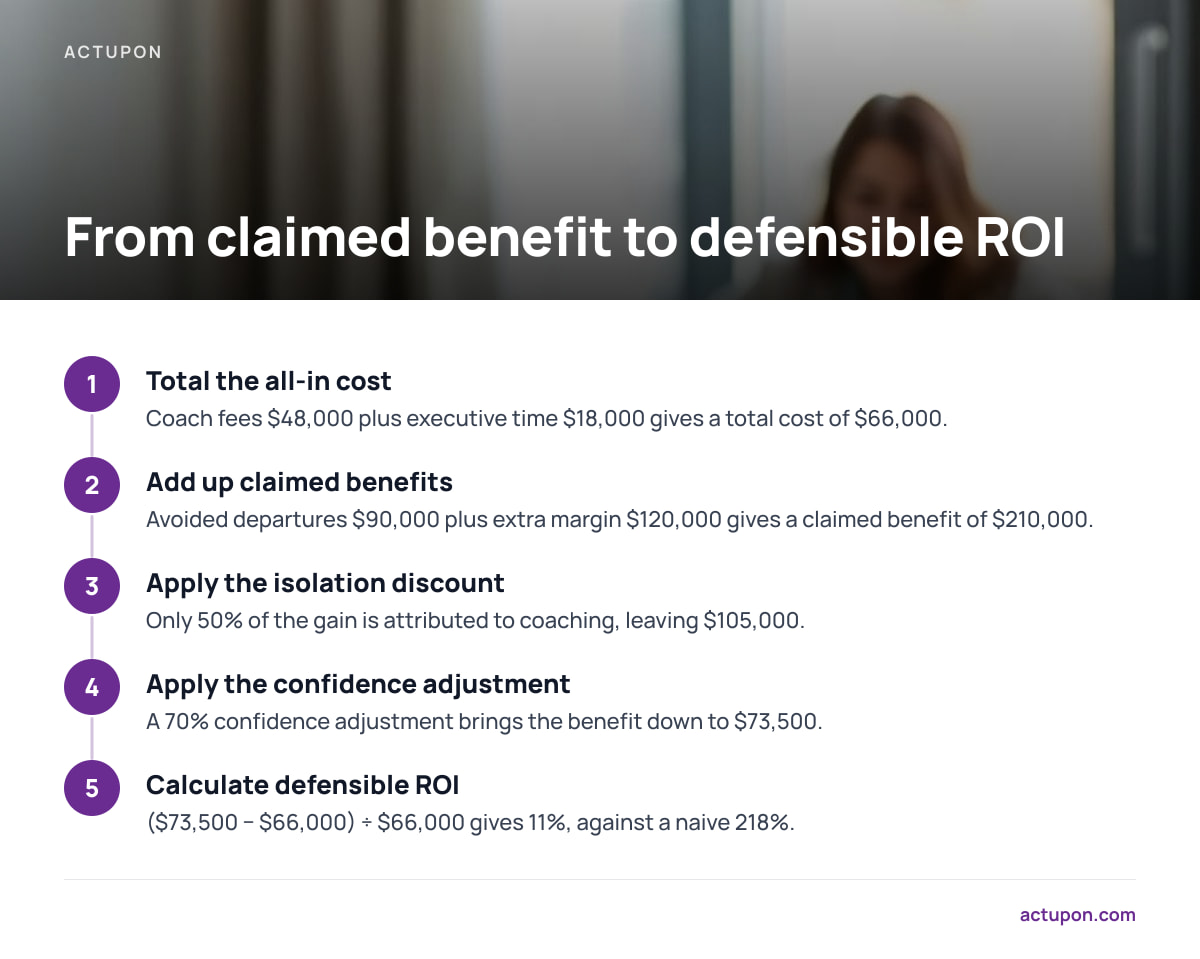
- Our worked example turns a claimed 218% return into a defensible 11% once isolation and confidence discounts are applied.
- Pick one primary metric. A coaching engagement with six goals usually proves nothing about any of them.
- Judge fees against the defensible benefit. Part of the fee can be tied to the result.
Table of Contents
- Set the Baseline First: Where Measuring Executive Coaching ROI Starts
- The ROI Formula, Worked Through With Real Numbers
- Why Headline Coaching Returns Are Inflated, and How to Correct Them
- Coaching Goals That Can Be Measured: Examples by Type
- Measure in Layers: What to Check at 30, 90 and 365 Days
- What to Charge, What to Pay: Fees Against the Return You Can Defend
- The 80/20 Rule in Coaching: Two Meanings, One Practical Use
- Get Coaching Where the Fee Follows the Result
- Frequently Asked Questions
- Sources
Set the Baseline First: Where Measuring Executive Coaching ROI Starts
Most ROI arguments about coaching are lost before coaching begins. Nobody wrote down what the executive's team turnover, sales cycle or 360 scores looked like in month zero, so every "improvement" later is an anecdote.
Before the first session, record three things:
- One business metric. Pick a number the executive influences and finance already tracks: regretted turnover on their team, time to close, margin on their division, project delivery on time.
- One behavior metric. A short 360 on two or three specific behaviors, such as delegating or running meetings, completed by 6 to 10 raters. Re-run it at month 6 or 12.
- One sponsor sign-off. The executive's boss (or the board chair, for a CEO) agrees in writing on what success looks like and what a point of improvement is worth in dollars.
The International Coaching Federation builds this into its professional standards: coach and client agree on goals and how success will be recognized at the start of the engagement. If your coach does not ask for this, ask them to do it. For the broader question of whether coaching suits a chief executive at all, and what it costs, see our main guide to coaching for CEOs.
The ROI Formula, Worked Through With Real Numbers
The formula is simple:
ROI % = (Benefits − Costs) ÷ Costs × 100
The hard part is filling in the two inputs honestly. Costs include more than the coach's invoice. Count the executive's time in sessions and prep at their loaded hourly cost, plus any assessment fees and travel.
Here is an illustrative 12-month engagement for a division head. The figures are invented for the example, but the steps are the ones you would run on real data.
| Step | Calculation | Result |
|---|---|---|
| Coach fees | 12 months at $4,000 | $48,000 |
| Executive time | 60 hours at $300 loaded cost | $18,000 |
| Total cost | $66,000 | |
| Avoided regretted departures | 2 people at $45,000 each (HR's replacement-cost figure) | $90,000 |
| Extra margin from shorter sales cycle | Finance's estimate | $120,000 |
| Claimed benefit | $210,000 | |
| Isolation: share caused by coaching | 50% (agreed by executive and boss) | $105,000 |
| Confidence adjustment | 70% | $73,500 |
| Defensible ROI | ($73,500 − $66,000) ÷ $66,000 | 11% |
The naive version, ($210,000 − $66,000) ÷ $66,000, gives 218%. Same engagement, same data. One number goes into a slide deck and the other survives a skeptical CFO.
Why Headline Coaching Returns Are Inflated, and How to Correct Them
You have probably seen the 5.7x figure (about 570%) from a widely cited 2001 study of executive coaching by Manchester Inc. That result rested on the executives' own estimates of what the coaching was worth. People who just spent a year with a coach, and whose boss paid for it, are not neutral estimators.
The correction comes from the ROI Institute's methodology, developed by Jack Phillips. It adds a fifth level, monetary return, to the older four-level evaluation model. It also requires two things most coaching ROI claims skip: isolating the effect of the program from other causes, and adjusting stated benefits for the estimator's confidence.
Cut the claimed benefit in half, then cut it again by your own confidence level. If coaching still pays back, you can believe it.
Isolation matters because a division head who improved also had a new product launch, a market upswing and a fresh hire in finance. Ask the executive, their boss and one direct report to estimate separately what percentage of the gain came from coaching, then average the answers.
Pro Tip: Have finance agree on dollar values before coaching starts, for example what a regretted departure costs and what one point of margin is worth. Once the results are in, everyone is tempted to pick values that flatter the outcome. Pre-agreed conversion rates remove that temptation, and they cost you one meeting.
Coaching Goals That Can Be Measured: Examples by Type
Vague goals ("be more strategic") cannot produce an ROI figure. Good goals name a metric, a baseline and a date. These convert cleanly:
Goals with a direct dollar value
- Retention. Cut regretted turnover in the executive's organization from 18% to 10% within 12 months.
- Speed. Shorten the average enterprise sales cycle from 140 days to 110 days.
- Delivery. Raise on-time project completion in the division from 62% to 80%.
- Succession. Name and ready a successor for two critical roles by quarter four.
Goals that need a proxy
- Delegation. Move from 55 to 70 hours a week of executive time on strategic work, measured by calendar audit, then valued at a loaded hourly rate.
- Team engagement. Raise a specific engagement survey score by a set number of points. Gallup has reported that managers account for at least 70% of the variance in team engagement scores, which makes leader behavior a fair proxy here.
- Board and investor communication. Reduce the number of unresolved board action items from one meeting to the next.
Some goals, like handling conflict better or recovering from a failed reorganization, do not convert to dollars without stretching. Evaluate those with goal attainment (did the 360 behaviors move, did the sponsor agree) and do not force an ROI percentage on them. An invented number is worse than an honest "not monetized."
Measure in Layers: What to Check at 30, 90 and 365 Days
Behavior changes arrive first and return arrives late. Match what you measure to when it can show up.
| Timing | What to check | Source |
|---|---|---|
| Day 30 | Does the executive find sessions useful? Are agreed actions being done? | Executive, coach |
| Day 90 | Are specific behaviors visible to direct reports and peers? | Short pulse survey |
| Month 6 | Have the leading metrics moved (pipeline, engagement, delegation)? | Finance, HR |
| Month 12 | Have the business results landed? Run the ROI calculation. | Finance, sponsor |
This mirrors the four levels in the Kirkpatrick model (reaction, learning, behavior, results), with Phillips' ROI calculation as the final step. Skipping the early checks costs you: if nothing changes by day 90, you want to know that in April and not the following January. Ending or restructuring a weak engagement at month 3 is the cheapest ROI decision available.
There is a trade-off in timing. Measuring too soon can understate the return, and measuring too late lets other factors muddy it. Twelve months is a reasonable compromise for most executive engagements, with a 6-month checkpoint.
What to Charge, What to Pay: Fees Against the Return You Can Defend
Buyers and coaches both ask what executive coaching should cost. Market rates vary widely. In our read of the market, experienced executive coaches commonly charge several hundred dollars an hour, and senior engagements with CEOs often run on monthly retainers in the thousands to low five figures. Our guide to what executive coaching costs breaks the ranges down by seniority.
Our position: a fee is justified by the defensible benefit, not by the coach's résumé. If you run the worked calculation above and the defensible benefit is under about 1.5 times the all-in cost, you are paying for comfort. That can be a legitimate purchase, but call it that.
If you are the coach setting a fee, price against the value of the goal. A coach helping a leader protect a $2 million division's margin can defend a higher fee than one helping with a broad "executive presence" goal, because the first one can show the arithmetic. Coaches who can put an agreed metric next to part of their fee tend to win the room.
If you are unsure whether you need a coach or someone who does the work alongside you, read coach or consultant first. The measurement approach differs. A consultant's output is usually directly countable, while a coach's output is behavior change you convert later.
The 80/20 Rule in Coaching: Two Meanings, One Practical Use
The phrase gets used two ways, and both help with measurement.
The talk ratio. In coaching conversations, the rule of thumb is that the client should do about 80% of the talking and the coach about 20%. It is a convention and not a published standard, but it works as an audit: record or review a session, and if the coach is talking half the time, you are buying advice and not coaching.
The Pareto sense. Roughly 20% of goals produce 80% of the value. For ROI, that means choosing one primary metric and at most two supporting ones. An engagement with six goals spreads effort thin and makes isolation nearly impossible, because you cannot tell which change produced which result.
Our pick: measure one number and defend it well. A clean 11% on a single metric tells you more than a messy 300% across six.
Get Coaching Where the Fee Follows the Result

ActUpon is a business consulting firm that runs executive coaching and mentorship alongside performance-based consulting, where fees are tied to agreed, measurable business results. That fits the problem this article describes: most coaching is billed by the hour, and the return is argued about afterward. We set the baseline and the metric with you at the start, and where the goal can be measured in your own books, part of the fee can depend on it.
We do not publish a flat price, because the structure depends on the goal. Results-based pricing only works where a number can be agreed up front and verified from your own data. If your goal is mostly behavioral, such as better conflict handling, we will tell you to use a fixed fee and judge it by the 360 and the sponsor's view. If you want to talk it through, start at actupon.com.
Frequently Asked Questions
How do I calculate executive coaching ROI?
Add up the dollar value of the benefits that coaching caused, subtract the full cost (fees plus the executive's time), and divide by the cost. Before you divide, reduce the benefit by the share that other factors explain and by your confidence in the estimate. This usually shrinks a flashy figure to a modest, believable one.
How much should I charge for executive coaching?
Price against the value of the goal and your experience, as well as hours. Experienced executive coaches commonly charge several hundred dollars an hour, and senior engagements are often sold as monthly retainers. A fee you can tie to an agreed metric is easier for a client to say yes to.
What are some examples of goals for coaching?
Measurable examples include cutting regretted turnover from 18% to 10%, shortening the sales cycle from 140 to 110 days, raising on-time delivery from 62% to 80%, and naming a ready successor for two critical roles. Behavioral goals, such as delegation, work if you attach a proxy like hours spent on strategic work.
What is the 80/20 rule in coaching?
It has two common meanings. In sessions, the client should speak about 80% of the time and the coach 20%. In goal setting, about 20% of the goals deliver 80% of the value, so you should pick one primary metric and measure it well.
How long before I can measure the return on coaching?
Check usefulness at 30 days and visible behavior change at 90 days. Business results typically show at 6 to 12 months, so run the full ROI calculation at month 12. If nothing has moved by day 90, restructure the engagement.
Sources
- ICF Core Competencies and professional standards | International Coaching Federation
- ROI Methodology | ROI Institute
- The Kirkpatrick Model | Kirkpatrick Partners
- Workplace and manager engagement research | Gallup