To transition from a growth consultant to an in-house team, hire the person who will run the work before the consultant leaves, then overlap them for 60 to 90 days. The distinction that matters is between transferring the thinking and transferring the operation. Most handovers fail because the consultant's strategy gets documented, but nobody owns the weekly routines that produced the results.
TL;DR:
- Run the break-even math first: on a $150,000 salary, an in-house head of growth costs about $17,900 a month once benefits and payroll taxes are loaded in.
- Hire an operator who will run the system weekly, not a second strategist who will redesign it.
- Overlap the consultant and the hire for 60 to 90 days, and make the hire drive every weekly cycle by week 5.
- Get accounts, data, playbooks and contracts into your name in writing before the consultant's last invoice.
- Keep a small consulting retainer if the consultant's network or channel judgment drives results. Going fully in-house is not always the cheaper or better answer.
Table of Contents
- Should You Transition a Growth Consultant to In-House at All?
- The Break-Even Math: What an In-House Growth Hire Costs
- What To Hire: The Operator, Not a Copy of Your Consultant
- A 90-Day Handover Plan, Week by Week
- What Must Be in Writing Before the Consultant Rolls Off
- If You Are the Consultant Being Hired: Negotiating the Move to Full-Time
- When Going In-House Is the Wrong Move, and the Hybrid That Works Instead
- Hand Over Growth Work Without Losing the Results
- Frequently Asked Questions
- Sources
Should You Transition a Growth Consultant to In-House at All?
Only if three things are true: the growth work has become repeatable, you can fill a full-time role with enough work to keep it busy, and the hire costs less than you pay now or buys more output than the consultant can give you. If you are still weighing who to bring in for growth work in the first place, our guide to choosing a growth consulting firm covers that decision. This article assumes you already have a consultant and want to move on.
The most common mistake is making the call on emotion. Founders get tired of a monthly invoice and decide that a salary feels cheaper. Sometimes it is. Often it is not, and the comparison below shows why.
The Break-Even Math: What an In-House Growth Hire Costs
A salary is not the cost of an employee. The U.S. Bureau of Labor Statistics reports on employer costs for employee compensation, and benefits (insurance, paid leave, retirement and legally required payroll contributions) have run at roughly 30 percent of total compensation for private industry workers. Treat that as a rough guide for your own hire, not a quote.
If wages are about 70 percent of total cost, a $150,000 salary becomes roughly $214,000 a year. Recruiting fees, software seats and the ramp-up months when the hire is not yet productive come on top.
On a $150,000 salary, the loaded cost of an in-house head of growth is about $17,900 a month. If your consultant bills less than that, going in-house raises your spend before it improves anything.
| Option (illustrative figures) | Monthly cost | What you get | Main risk |
|---|---|---|---|
| Consultant retainer | $12,000 | Part-time senior judgment, outside view | Dependency on one person's calendar |
| In-house head of growth ($150,000 salary) | About $17,900 | Full-time ownership, daily context | One person, one set of blind spots |
| In-house hire plus light consulting | About $21,900 | Daily operation plus senior review | Higher cost, two people to coordinate |
The figures are examples for the arithmetic, not market benchmarks. Plug in your own retainer and your own salary band. If the hybrid row looks wasteful to you, read the last section before dismissing it.
What To Hire: The Operator, Not a Copy of Your Consultant
Your consultant is probably a generalist who designs systems, tests channels and moves on to the next problem. The role you are filling is different. You need someone who runs the system every Monday, notices when a metric drifts, and stays interested in month eight.
I would pick the operator over the strategist every time at this stage. A second strategist will want to redesign what already works, and you will spend a quarter re-litigating decisions the consultant already tested.
What to screen for
- Ownership of a number. Look for a candidate who can name a metric they were personally accountable for and say how it moved over 12 months. Titles tell you little.
- Comfort with the unglamorous work. Reporting, list hygiene, creative testing cadence and budget pacing are most of the job.
- Ability to take over a half-built system. Ask them to critique your current funnel and see whether they propose fixes or a rebuild.
- Tolerance for being coached. Whoever you hire will be better for the first year if someone senior is still reviewing their work. If you plan to coach them, measure the coaching ROI before you assume it is working.
Pay them against the same result
If your consultant was paid on results, the switch to salary quietly removes the incentive. Tie a meaningful part of the new hire's variable pay to the same metric the consultant was accountable for, such as qualified pipeline, revenue from new customers or cost per acquisition. Use a measure you can pull from your own systems, so nobody argues about it later.
A 90-Day Handover Plan, Week by Week
A handover works when the new person drives and the consultant watches. If the consultant drives, the hire only sees a demonstration, and demonstrations teach very little.
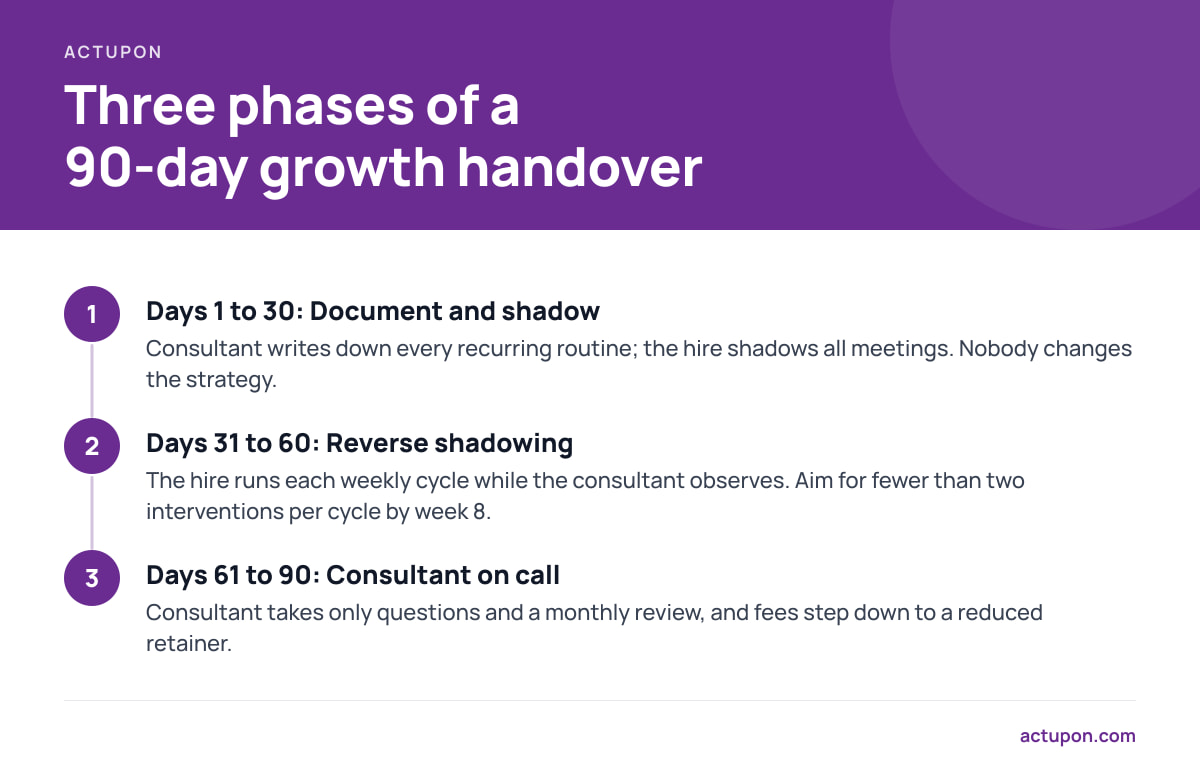
Days 1 to 30: Document and shadow
The consultant writes down every recurring task as a weekly, monthly or quarterly routine, with the tool, the owner and the decision rule. Examples: "Pause any ad set above $X cost per lead after 3 days," or "Review churned accounts every second Friday." The hire shadows every meeting and takes notes. Nobody changes the strategy during this month.
Days 31 to 60: Reverse shadowing
The hire now runs each weekly cycle. The consultant sits in and speaks only when asked or when about to prevent real damage. Count the interventions each week. By week 8 you want fewer than two per cycle.
Days 61 to 90: Consultant on call
The consultant leaves the routine and takes only questions and a monthly review. Fees should step down to match: a reduced retainer in month 3, then either zero or a smaller standing arrangement.
Pro Tip: Make the consultant's final payment depend on the hire running one complete monthly cycle without help, including the reporting and the budget reallocation. Consultants hand over well when the handover is what they get paid for, and you will learn what was never documented while someone who knows the answer is still reachable.
What Must Be in Writing Before the Consultant Rolls Off
Verbal handovers decay within weeks. Before the last invoice is paid, get these items confirmed in writing:
- Account ownership. Ad accounts, analytics properties, email platforms, tag managers and CRM admin rights should sit under your company's login. If any of them live under the consultant's agency or personal account, fix that first.
- Data and tracking documentation. You need a list of what is tracked, how conversions are defined, and any known gaps. Undocumented tracking is where most post-handover reporting disputes start.
- Playbooks and test history. Keep the record of what was tried and failed. A new hire who repeats a failed test is spending your money to relearn it.
- Vendor and contractor contracts. Know who the freelancers, tool vendors and agencies are, who signed the contracts, and when they renew.
- Intellectual property. Check that creative, copy, scripts and landing pages are assigned to you under the consulting agreement. If the contract is silent, get an assignment letter now.
- Post-engagement availability. Agree on how many hours of questions the consultant will answer after the engagement ends and at what rate.
If You Are the Consultant Being Hired: Negotiating the Move to Full-Time
Some readers of this page are the consultant, and the client has just asked whether you would join as an employee. The advice is the same in reverse, with a few added points.
Check how you are classified now. The IRS uses three categories of evidence (behavioral control, financial control and the relationship of the parties) to decide whether someone is an employee or an independent contractor. In the UK, HMRC publishes a check for employment status for tax. If you already work set hours, use their tools and take daily direction, you may be an employee in all but name, which strengthens your hand in the negotiation.
Convert your income honestly. If you invoiced $180,000 over 100 billable days, your effective day rate was $1,800, but a salary pays for roughly 230 working days. Subtract what you paid for your own health insurance, retirement, software and unpaid time off. That net figure is your real floor, and it will be lower than the headline number.
Negotiate scope as well as salary. Ask for budget authority, a title that matches the work (head of growth rather than manager), tooling spend, and a named person you report to. Otherwise you risk becoming the in-house consultant who is blamed for results but cannot approve a $2,000 test.
When Going In-House Is the Wrong Move, and the Hybrid That Works Instead
Bringing everything in-house can cost you results if your consultant's value comes from outside the routine.
- Network-driven growth. If partnerships, introductions or press relationships come through the consultant, a new employee starts with none of them.
- Cross-client pattern recognition. A consultant who sees many companies spots channel shifts months before a single-company employee would.
- Thin workload. If the job is 15 hours a week, a full-time hire will either invent work or leave.
- Early-stage uncertainty. If you are still testing which channel works at all, fixed salary cost is a bad fit for exploratory spend.
The hybrid is a full-time operator plus a small consulting arrangement, usually a monthly review of metrics and a quarterly strategy session. It costs more than going fully in-house, as the table above shows, and it is often the setup with the lowest chance of a stall in year one. If your finances allow only one, hire the operator and buy the review back in six months if results flatten.
Hand Over Growth Work Without Losing the Results
The risk in every handover is that results slip while the fee stops. ActUpon runs performance-based growth consulting, where our fees are tied to agreed, measurable business results, and we apply the same structure to handovers. We define the baseline metric with you, work alongside your new hire, and tie our fee to the number holding steady or improving after we step back. We also provide business coaching and mentorship for the person stepping into the role.
We only take on a results-based engagement when the metric can be pulled from your own data and the baseline is agreed in writing before work starts, so if your tracking is a mess, the first step is fixing that. We have no standard price for this because the fee is set by the outcome you define, and you should read the fee terms in any engagement, ours included, before you sign.
Frequently Asked Questions
How long should the overlap between a growth consultant and an in-house hire last?
Plan for 60 to 90 days. The first month is documentation and shadowing, the second is the hire running cycles with the consultant observing, and the third is the consultant on call only. Shorter overlaps tend to leave undocumented routines behind.
Is it cheaper to replace a growth consultant with an in-house hire?
Not always. A $150,000 salary costs about $214,000 a year once benefits and payroll costs are included, using the roughly 30 percent benefits share the U.S. Bureau of Labor Statistics reports for private industry as a guide. If your consultant bills under about $17,900 a month, the hire costs more, though it buys full-time attention.
Should I hire the consultant as my in-house head of growth?
It can work, especially because they already know your systems, but check that they want a full-time operating role. Many consultants prefer variety and leave within a year. Negotiate scope, budget authority and a metric-linked bonus upfront, and confirm their employment status with the IRS or HMRC tests if they have been working as a contractor long-term.
What should I get from the consultant before they leave?
Account ownership under your company, tracking and data documentation, playbooks with test history, vendor contract details, and written confirmation that creative and copy are assigned to you. Add an agreed number of post-engagement support hours at a stated rate.
Can I keep a consultant part-time after hiring in-house?
Yes, and it is often the safest setup for the first year. A monthly metrics review plus a quarterly strategy session keeps outside judgment available while the new hire owns the operation. Drop it only when results have held steady for two or three quarters.
Sources
- Employer Costs for Employee Compensation | U.S. Bureau of Labor Statistics
- Independent Contractor (Self-Employed) or Employee? | Internal Revenue Service
- Check employment status for tax | GOV.UK (HM Revenue and Customs)