Coaching for CEOs is not the same as executive coaching for the VPs and directors below them — a CEO has no boss to validate decisions, no real peer in the building, and a board that wants results, not reflection. The coaching that works at this level is structured, tied to specific business metrics, and run by someone willing to challenge the CEO's blind spots rather than just listen. Anything softer is an expensive hobby.
TL;DR:
- Coaching for CEOs differs from standard executive coaching because CEOs have no internal peer to check their thinking — the coach has to fill that gap, not just listen to it.
- Rates run from roughly $200 an hour for an independent coach to $1,000+ for boutique or results-tied engagements; the International Coaching Federation tracks the wider market averages.
- The 70/30 rule (client talks 70%, coach talks 30%) is standard coaching practice but gets broken deliberately at CEO level, where direct advice often beats open-ended questions.
- "CEO syndrome" describes the isolation and filtered feedback that comes with the job — not a diagnosable condition, but a well-documented pattern in leadership research.
- The best CEO coaching arrangements measure success against actual business numbers, not just self-reported confidence or a quarterly satisfaction survey.
Table of Contents
- What "Coaching for CEOs" Actually Means, and Where It Fails
- The 70/30 Rule, and Why Most CEO Coaches Break It
- What CEO Coaching Costs, Rate by Rate
- CEO Syndrome: The Isolation Problem Coaching Is Built to Fix
- The 7 C's of Executive Presence, and Why Most CEOs Only Have Three
- Leadership Coaching vs. Performance Coaching for CEOs: The Real Difference
- How to Pick the Best CEO Coach Without Getting Sold a Personality
- Get Coaching Tied to Your Actual Results, Not Your Calendar
- Frequently Asked Questions
- Sources
What "Coaching for CEOs" Actually Means, and Where It Fails

A CEO is the only person in the company without a manager. That single fact changes what coaching has to do. For a director or VP, a coach helps them manage up, manage down, and navigate office politics inside a structure that still has checks on it. For a CEO, there is no structure above — just a board that meets quarterly and wants outcomes, not process notes. Coaching that treats a CEO like a mid-level leader with a bigger title misses the actual job: making high-stakes calls alone, under incomplete information, with no one in the building who will tell them they're wrong.
The Stanford Graduate School of Business CEO Snapshot Survey, conducted with The Miles Group, found something that should embarrass the consulting industry: nearly all CEOs say they want outside coaching, but most aren't getting it in any structured way. That gap exists because a lot of what's marketed as "CEO coaching" is really leadership coaching with a higher price tag attached — same frameworks, same worksheets, aimed at a founder instead of a regional manager. It rarely holds up once a board starts asking what changed because of it.
The 70/30 Rule, and Why Most CEO Coaches Break It

The 70/30 rule is a basic coaching principle: in a well-run session, the client should be talking roughly 70% of the time and the coach about 30%, mostly through questions that make the client think out loud rather than take instructions. It's the standard taught across much of the coaching industry, including guidance referenced by the International Coaching Federation, and it works well for self-discovery, confidence building, and communication coaching.
70/30. That's the client-to-coach talking ratio most coaching certifications teach as the baseline for a session.
At the CEO level, plenty of good coaches break this ratio on purpose. A CEO weighing a $40 million acquisition doesn't need forty-five minutes of open-ended questions — they need someone who has seen that decision go wrong before and will say so plainly. This is the real trade-off in picking a coach: a pure 70/30 practitioner will protect your autonomy and build your own judgment over time, while a more directive coach-advisor hybrid will get you faster answers but risks making you dependent on them. Neither is wrong. Know which one you're hiring before the engagement starts, not three months in when you realize you're just paying for a second opinion.
What CEO Coaching Costs, Rate by Rate

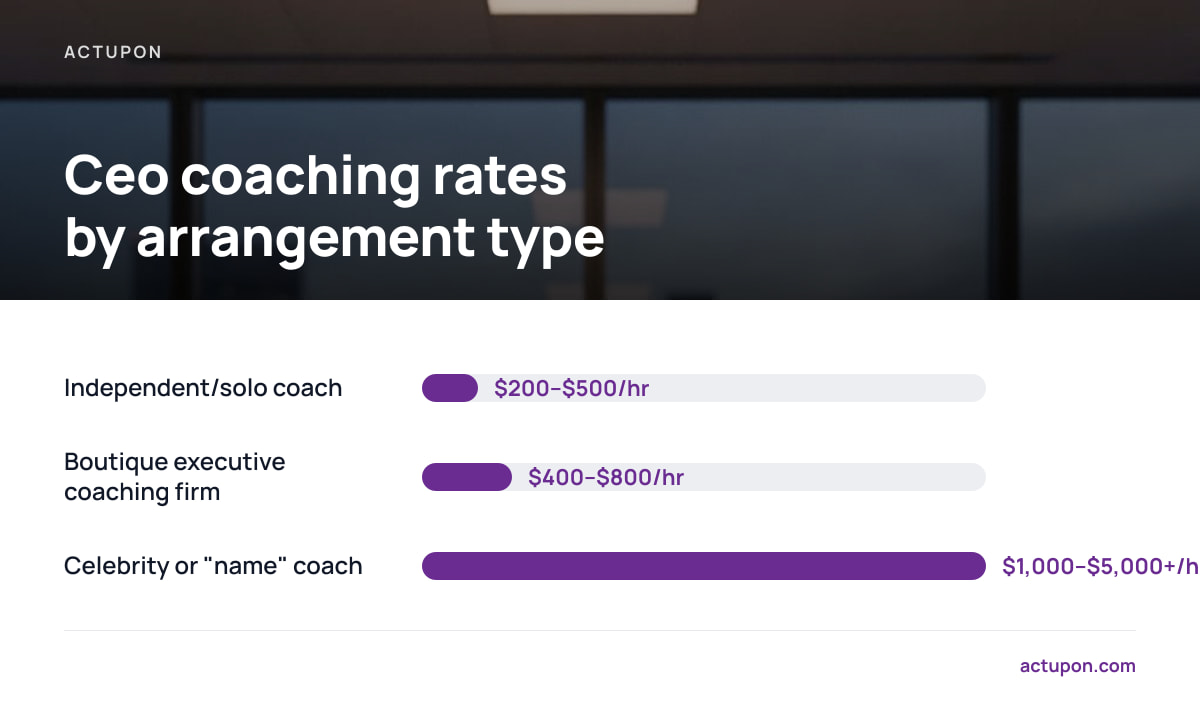
CEO coaching pricing varies more than almost any other professional service, because the market has no licensing requirement and no price floor. An independent coach with a decade of operator experience might charge less than a branded coaching firm selling a certification and a logo.
| Arrangement | Typical Rate | Best For |
|---|---|---|
| Independent/solo coach | $200–$500/hour | First-time founders, early-stage CEOs wanting a sounding board |
| Boutique executive coaching firm | $400–$800/hour | Series B+ companies, coaching tied to a leadership framework |
| Celebrity or "name" coach | $1,000–$5,000+/hour | Public-company CEOs with board-level visibility requirements |
| Performance-based engagement | Retainer + fee tied to agreed metrics | CEOs who want cost justified by measurable business movement, not hours logged |
The International Coaching Federation's industry surveys put average coaching fees well below the executive tier — a reminder that CEO-specific coaching commands a real premium, not because the conversations are longer, but because the stakes behind each decision are bigger. If you're also weighing coaching against broader outside help, it's worth understanding how business consultant fees are typically structured before committing to an hourly coaching retainer that might run longer than expected.
Pro Tip: Ask any CEO coach candidate for the name of a client who fired them, and why. A coach who's never been let go has probably never pushed hard enough to get fired — which tells you more about their value than any client testimonial will.
CEO Syndrome: The Isolation Problem Coaching Is Built to Fix
"CEO syndrome" isn't a clinical term — it's shorthand used in leadership research for a specific failure pattern: a CEO becomes progressively insulated from honest feedback as the company grows, because employees filter bad news, executives manage up instead of reporting accurately, and the CEO starts mistaking silence for agreement. Over time, decisions get made with less real information than the org chart suggests, even though the CEO technically has more access to data than anyone else in the building.
Harvard Business Review has covered the loneliness side of this extensively — CEOs routinely describe the role as isolating in a way other leadership positions aren't, because there's no peer in the organization who shares the same vantage point or the same risk. Coaching exists to break that loop deliberately: a good CEO coach is often the only person in a CEO's professional life with no incentive to tell them what they want to hear.
The 7 C's of Executive Presence, and Why Most CEOs Only Have Three
Executive presence coaching, a common component of CEO-level engagements, usually breaks the trait down into seven components. Most CEOs are strong on two or three and weak on the rest, which is exactly why a generic leadership course rarely fixes the gap.
- Clarity. The ability to say a complex idea in one sentence a board member can repeat back correctly.
- Confidence. Projecting certainty without needing to be right about everything — the two get confused constantly.
- Connection. Reading a room and adjusting tone, which founders who built the company alone often never developed.
- Credibility. Track record and domain depth; usually the easiest of the seven for an experienced CEO.
- Composure. Staying level under a hostile board question or a bad earnings call — the trait coaching struggles hardest to build.
- Conviction. Holding a position under pushback without becoming defensive about it.
- Charisma. The hardest to coach directly, and the one most CEOs overvalue relative to the other six.
Research from the Center for Creative Leadership consistently finds that executive presence is judged more on composure under pressure than on charisma — which cuts against what most CEOs assume is their biggest weakness going into coaching.
Leadership Coaching vs. Performance Coaching for CEOs: The Real Difference
Leadership coaching improves how a CEO thinks, communicates, and makes decisions. Performance coaching ties the engagement to a specific business outcome — revenue growth, a successful fundraise, retention of a key executive team — and measures success against that number, not against a self-assessment survey at the end of a quarter.
For a CEO under active board pressure, performance-tied coaching is the better buy, and it's not close. Leadership coaching is valuable, but it's slow to show up on a P&L, and boards don't fund things that don't show up on a P&L. The exception is a first-time or very early-stage founder who hasn't yet built basic self-awareness or communication skill — for that person, straight leadership coaching for a few months before adding metric-tied accountability is the more honest sequence. Skipping straight to performance coaching with someone who hasn't built the underlying judgment yet usually just produces someone who hits short-term numbers by burning the team out.
How to Pick the Best CEO Coach Without Getting Sold a Personality
Most "best CEO coach" lists online are personality rankings dressed up as research — LinkedIn follower counts and client logos, not outcomes. A few filters cut through that faster than any list can.
- Ask for the measurement framework up front. If a coach can't describe how they'll know the engagement worked six months in, they don't have one — they're planning to decide after the fact.
- Check operator history, not just coaching certifications. A coach who has actually run a P&L will catch things a pure-trained coach won't.
- Confirm they'll push back in writing. Verbal pushback in a session is easy to soften in the moment; ask whether they'll put disagreements in a written summary you can act on later.
- Check whether they understand where your business is actually headed. A CEO navigating AI adoption or crypto exposure needs a coach who isn't guessing at the subject matter — see what AI consulting firms typically charge and cover, since some CEO coaching engagements now blend in that kind of advisory work directly.
- Ask what happens if it isn't working at month three. A clear exit clause, stated upfront, tells you more about a coach's confidence than their sales pitch does.
Get Coaching Tied to Your Actual Results, Not Your Calendar
Most CEO coaching gets sold by the hour and measured by how the CEO feels about the sessions, which is a strange way to spend five or six figures a year. ActUpon runs business coaching and mentorship for CEOs and founders as part of a performance-based consulting model — the fee gets tied to agreed, measurable outcomes rather than a fixed retainer, alongside hands-on help across AI readiness, AI consulting, and crypto/blockchain advisory where it's relevant to the business.
The honest caveat: this model fits a CEO who wants accountability against real numbers, not a CEO who mainly wants a confidential sounding board with no strings attached — that's a legitimate need, just not what performance-based coaching is built for. If that's you, say so upfront and ask for the structure that actually matches it before signing anything.
Frequently Asked Questions
How much does a CEO coach cost?
Independent CEO coaches typically charge $200 to $500 an hour, boutique executive coaching firms run $400 to $800, and high-profile or public-company coaches can exceed $1,000 an hour. Some engagements, including performance-based models, replace or supplement the hourly fee with a structure tied to agreed business results instead.
What is the 70/30 rule in coaching?
It's a baseline for how a coaching conversation should be split, with the client talking roughly 70% of the time and the coach about 30%, mostly through questions rather than direct advice. Many CEO coaches intentionally break this ratio and give more direct input, since high-stakes decisions often call for experience-based guidance rather than open-ended reflection.
What is CEO syndrome?
CEO syndrome is a term used in leadership research to describe the isolation and filtered feedback that comes with being the top executive — decisions get made with less honest input than the org chart suggests, because employees and executives tend to manage up rather than report bad news accurately. It's not a clinical diagnosis, but it's a well-documented pattern coaching is specifically designed to counteract.
What are the 7 C's of executive presence?
They're commonly listed as clarity, confidence, connection, credibility, composure, conviction, and charisma. Most CEOs score well on credibility and confidence but weaker on composure and connection, which is usually the actual gap executive presence coaching needs to close.
Is leadership coaching or performance coaching better for a CEO?
Performance coaching, tied to a specific business metric, is the better fit for a CEO under board pressure because it produces results a board can see on a P&L. Leadership coaching is still valuable for first-time founders who haven't yet built basic self-awareness, and is often worth doing first before adding metric-tied accountability.
What do people on Reddit say about CEO coaching?
Threads in coaching-focused communities tend to agree on two things: a lot of CEO coaching is overpriced relative to what it delivers, and the coaches people recommend most are the ones with real operating experience, not just a coaching certification. The consistent advice is to ask for references from CEOs specifically, not from a coach's broader client list.
Sources
- Global Coaching Study and practice standards | International Coaching Federation
- CEO Snapshot Survey (with The Miles Group) | Stanford Graduate School of Business
- Coverage of executive coaching and CEO isolation | Harvard Business Review
- Research on executive presence | Center for Creative Leadership