A blockchain business consultant is a specialist you hire to decide whether distributed ledger technology solves a real business problem, and then to build it if it does. Good ones try to talk you out of a blockchain first. If one company writes the records and one trusted operator holds the master copy, a normal database is cheaper, faster and legally simpler. You are paying for a diagnosis first and code second.
TL;DR:
- A blockchain business consultant earns their fee by ruling the technology out when a database does the job better and cheaper.
- The test is multiple independent writers, mutual distrust, and no acceptable central operator. Miss any of those three and you are buying complexity.
- Start with a paid diagnostic that ends in a baseline number, then convert to a build or a performance-based fee.
- Audit scope and key management cost more than the contract code, and cutting either is the most expensive saving available.
- US money transmitter rules, SEC securities analysis and the EU's MiCA all shape what you can ship, so ask which one your consultant has actually worked under.
Table of Contents
- What a Blockchain Business Consultant Does
- Do You Need a Blockchain, or a Database?
- Five Ways You Can Buy This, and Which One I'd Pick
- What to Check Before You Sign
- What It Costs, and Why the Audit Is the Line Item People Underestimate
- The Rules That Shape the Work: FinCEN, the SEC and MiCA
- Hiring Local vs Remote: "Crypto Consultant Near Me" Is the Wrong Filter
- Working as a Consultant: Jobs, Rates and Expert Witness Work
- Get a Blockchain Decision in Three Weeks, Not Ninety Pages
- Frequently Asked Questions
- Sources
What a Blockchain Business Consultant Does
A blockchain business consultant answers one question before any code gets written: does this problem need a shared ledger with several independent writers, or does it need a database and a better process? The work splits into three areas that rarely sit inside one person. Strategy covers the should-we-at-all decision. Engineering covers smart contracts, wallet and key management, and integration with the systems you already run. Compliance covers licensing, tax treatment and data protection in every country you operate in.
Many people using the title sell one slice of that. Crypto advisors handle token design, treasury, exchange integration and custody for companies that already hold digital assets. Systems integrators will build whatever you specify, on whichever chain you name. The consultants worth a higher fee will tell you the project should not exist at all. The alternative is a six-figure proof of concept that never reaches production.
Ask any candidate for the written output of their last three engagements: a design document with cost numbers attached, a deployed contract address, and the business metric that moved afterwards. A slide deck is not a work sample.
Do You Need a Blockchain, or a Database?
NIST's Blockchain Technology Overview describes a blockchain as a distributed ledger of linked, cryptographically hashed blocks, and it makes no claim that the structure is permanent. Participants can change the rules if enough of them agree. That matters when "immutable records" is the feature you are being sold.
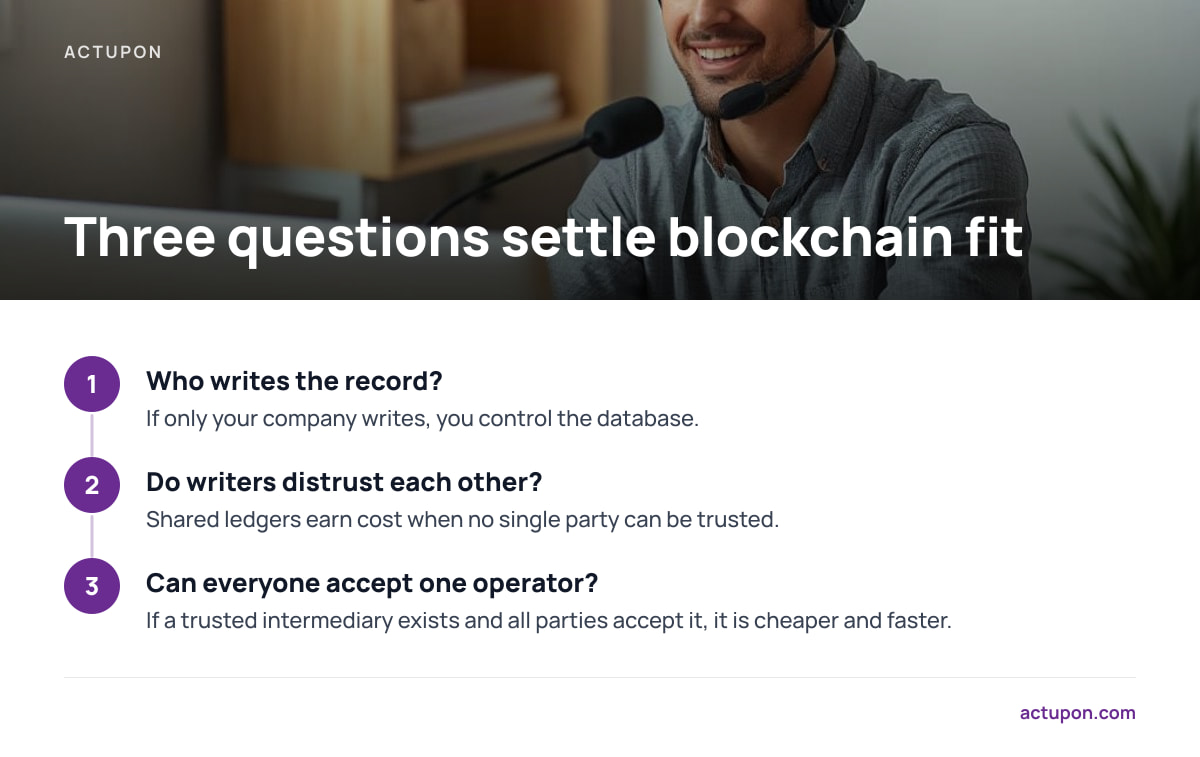
Three questions settle it:
- Who writes to the record? If only your company writes, you control the database. Adding nodes, keys and transaction fees removes none of your actual problems.
- Do the writers distrust each other? Shared ledgers earn their cost when no single party can be trusted to hold the master copy. That is why interbank settlement and trade finance are real use cases and internal HR records are not.
- Can everyone accept one central operator? If a trusted intermediary already exists and all parties accept it, that intermediary is cheaper and faster than consensus.
Three questions settle it. Multiple writers, mutual distrust, no acceptable central operator. Two noes and you need a database, not a blockchain.
Supply chain is the classic wrong answer. Provenance projects usually fail on data entry, not cryptography. Someone at a port or a farm has to type accurate information into a system that gives them no direct benefit, and the ledger faithfully records whatever they typed. A shared database behind one trusted operator solves the same problem for a fraction of the cost. Blockchain earns its place when the parties genuinely cannot agree who keeps the master copy, or when you need settlement across borders without a correspondent bank in the middle.
Five Ways You Can Buy This, and Which One I'd Pick
| Engagement | Typical shape | Best when | Main failure mode |
|---|---|---|---|
| Paid diagnostic | 2 to 4 weeks, fixed fee | You cannot yet state what the current process costs per transaction | Memo with no owner and no baseline number |
| Proof of concept | 6 to 12 weeks, fixed fee | You need to test one workflow with real users and real data | It runs on test data and never reaches production |
| Production build | 3 to 9 months, milestone billing | The diagnostic produced a number worth chasing | Scope creeps into custom infrastructure nobody asked for |
| Retainer or fractional lead | Monthly, rolling | You need ongoing custody, vendor and roadmap decisions | You pay for status meetings that produce no decisions |
| Performance-based | Fee tied to an agreed metric | You can name the baseline and the target today | The metric is unmeasurable, or easy to game |
I would pick the paid diagnostic every time, with one condition: it has to end with a number. "Settlement currently takes 4.2 days and costs $38 per transaction" is a baseline you can hold a consultant to. "We explored blockchain" is a receipt for money you will not get back.
Performance-based pricing looks attractive until you try to define the metric. It works when both sides can point at a number you already track, and it falls apart when the goal is a feeling. I would take that structure on a build once a diagnostic has produced a baseline.
What to Check Before You Sign
- A live contract address. Anyone can talk about decentralization. Ask for a deployed contract you can open in a block explorer, plus who audited it and what it cost the business to run.
- Who actually writes the code. Some advisory firms subcontract every line. That is workable if you know it up front, because you are then buying a specification and project management. Price it that way.
- The upgrade path. The Ethereum Foundation's developer documentation notes that a deployed contract cannot be changed unless an upgrade mechanism was designed in from the start. The first version is the one you live with, so review it as such.
- The key management plan. Who holds the private keys, on what hardware, and how many people can sign? One person holding a hot wallet key is an operational risk no audit removes.
- The audit scope in writing. Name the auditing firm, the contract version under review, and what happens to the fee if the audit finds a critical issue.
- The exit clause. Your contracts, keys, repository and deployment scripts at the end. If the consultant keeps any of it, you are renting your own system.
Pro Tip: Ask for a load test instead of a demo. Have the consultant run your expected transaction volume against a staging environment and report the fee at the 95th percentile of network congestion, not at today's quiet-hour rate. Fees on Ethereum and its layer 2 networks move with demand, so a business case built on a calm Tuesday will not survive a busy launch week. Get that percentile number in writing before you commit to a per-transaction cost.
What It Costs, and Why the Audit Is the Line Item People Underestimate
Nobody publishes a rate card, and the spread is wide. Independent consultants usually quote a day rate or a fixed fee for a defined deliverable. Large firms quote a blended team rate for the same work, which can run several times higher once partners are on the call. The structural choice matters more than the hourly number: time-and-materials, fixed fee against a scope, or a fee tied to an agreed outcome.
The bill tracks risk more than headcount. A payment workflow that custodies customer funds needs external audit, on-chain monitoring, incident response and a custody arrangement that a loyalty-point contract does not. Audit quotes scale with the value the contract will hold, so budget the audit as a share of the money at risk rather than capping it to save cash in month one. Cutting the audit on a contract holding funds is the most expensive saving available.
Whichever structure you choose, get the payment terms, the scope boundary and the termination rights into one document before work starts. Our walkthrough of a consulting agreement example lists the clauses that cause disputes in this kind of engagement.
The Rules That Shape the Work: FinCEN, the SEC and MiCA
FinCEN's 2013 guidance draws the cleanest line in US federal crypto regulation. A business that accepts convertible virtual currency as payment for goods and services is not a money transmitter. A business that exchanges it for a fee is. Which side of that line you sit on changes what you are allowed to build and what you must register as.
The SEC's framework for investment contract analysis applies the Howey test factors to digital assets, which decides whether a token sale is a securities offering. That determination comes before design work.
In the EU, the Markets in Crypto-Assets Regulation has applied to most crypto-asset services since 30 December 2024, with national transition periods for firms that were already operating. Ask your consultant which of these regimes they have built under. Reading a regulation and shipping a compliant onboarding flow are different skills. Our rundown of crypto law maps where the lines sit by jurisdiction.
Hiring Local vs Remote: "Crypto Consultant Near Me" Is the Wrong Filter

The distance filter costs you candidates without buying anything. What you need is jurisdiction coverage, overlap with your working hours, and someone who has shipped inside your sector. A consultant two time zones away who has built three payment flows is worth more than one in your city who has built none.
Locality does matter in three cases: regulated activity, expert witness work, and anything involving physical custody of hardware such as signing devices or mining equipment. If you are setting up payments rather than a ledger, our guide to accepting crypto payments as a business covers the parts that depend on where you are incorporated and where your customers bank.
Working as a Consultant: Jobs, Rates and Expert Witness Work
If you are reading this because you want the job rather than the service, the entry routes are engineering, security auditing, compliance and trading operations. Employers hiring for blockchain business consultant jobs screen for a shipped system and a named regulation, and a certification alone rarely clears that bar. Day rates typically track the same bands as other senior technology consulting, with a premium for people who have held keys to production funds.
Cryptocurrency expert witness work is a different discipline. Courts need someone who can explain a wallet, a token standard or a transaction trace to a jury without overstating what the evidence shows. In US federal courts, expert testimony is admitted under the Daubert standard, which puts the methodology and the report itself on trial. If you want that work, keep contemporaneous notes on every engagement, because your reasoning will be cross-examined years later.
Get a Blockchain Decision in Three Weeks, Not Ninety Pages
If you want a straight answer on whether your project needs a chain, ActUpon runs a diagnostic that ends with a cost number and a build-or-don't-build call, backed by crypto and blockchain advisory from people who have shipped production systems rather than written about them. Fees are tied to agreed, measurable results, so the scope and the metric get fixed in writing before work starts. Where the real problem turns out to be payments, a hosted BTCPay Server setup through the sister service is usually cheaper than commissioning a custom integration.
The honest limit: results-based pricing only works when you can define the outcome. If your brief is "explore blockchain," there is nothing to measure and the engagement is not a fit. Before you sign with anyone, including ActUpon, get the fee structure, the audit scope and the exit plan into one document, and read the spec sheet yourself.
Frequently Asked Questions
What does a blockchain business consultant charge?
Independent consultants usually quote a day rate or a fixed fee for a defined deliverable, while large firms quote a blended team rate that runs several times higher for the same scope. Performance-based engagements tie part of the fee to a metric you already track, such as cost per transaction or settlement time. The audit and key management costs often exceed the development invoice, so budget for them from the start.
Do I need a blockchain for supply chain traceability?
Usually not. Traceability projects fail on data entry, because the party typing the information gets no direct benefit from doing it accurately. If one operator can be trusted to hold the master copy, a shared database is cheaper and faster. A ledger earns its cost when several parties write to the record and none of them trusts the others to keep it.
How do I tell a real blockchain consultant from a token promoter?
Ask for a deployed contract address you can open in a block explorer, the audit report for that contract, and the business metric that changed afterwards. Anyone selling a token rather than solving a process problem will struggle with that request. A consultant who tells you to skip the blockchain is usually the one with production experience.
Is a crypto consultant the same as a blockchain consultant?
Not quite. Crypto advisory covers the digital assets you already hold or want to accept: custody, treasury, exchange integration and tax treatment. Blockchain consulting covers ledger design, smart contracts and the systems that write to them. Many firms offer both, and you should check which one the person in front of you has actually done.
What is a cryptocurrency expert witness?
An expert witness explains wallets, tokens, transaction traces or exchange records to a court. In US federal courts, admissibility turns on the Daubert standard, which puts the reliability of the methodology and the written report under scrutiny. This work rewards consultants who keep detailed contemporaneous notes, because their reasoning can be challenged years after the engagement ends.
When should I not hire one at all?
When you cannot name the number you want to move. If the goal is a faster settlement cycle, a lower cost per transaction or a drop in fraud losses, a consultant can be held to it. If the goal is to be seen using blockchain, no engagement will produce a result you can measure.
Sources
- Blockchain Technology Overview (NISTIR 8202) | NIST
- Framework for "Investment Contract" Analysis of Digital Assets | U.S. Securities and Exchange Commission
- Application of FinCEN's Regulations to Persons Administering, Exchanging, or Using Virtual Currencies | FinCEN
- Markets in Crypto-Assets Regulation (MiCA) | European Securities and Markets Authority
- Introduction to smart contracts | Ethereum Foundation