A good consulting agreement example is a short written contract that pins down six things: the scope, the fee, who owns the work, what stays confidential, how either side exits, and how you'll know the job is done. Most templates handle the boilerplate and fumble the fee clause. If you pay for outcomes instead of hours, the metric and the baseline matter more than any other paragraph.
TL;DR:
- A working consulting agreement covers scope, fees, deliverables, IP ownership, confidentiality, independence, term and termination, and liability, usually in 3 to 6 pages.
- "Work made for hire" language often transfers nothing for consultants. Use an explicit IP assignment instead.
- Pick the fee model by how measurable the result is: hourly for advice, fixed fee for defined deliverables, performance fees when a number can prove success.
- $100 an hour is only "good" after you account for billable utilization, self-employment tax, and unpaid sales time.
- For results-based pay, the baseline, the metric, the measurement window and audit rights belong in the contract, not in an email.
Table of Contents
- A Consulting Agreement Example, Clause by Clause
- The Best Way to Write a Contract Agreement: Five Steps in Order
- The Seven C's of a Consulting Agreement
- Four Fee Structures, and When Each One Backfires
- Is $100 an Hour Good for Consulting? Do the Math Before You Say Yes
- Where Free Templates Quietly Fail You
- Simple, PDF or Editable Doc: Which Format to Start From
- Get a Consulting Agreement Where the Fee Clause Is the Whole Point
- Frequently Asked Questions
- Sources
A Consulting Agreement Example, Clause by Clause
Skip the 40-page template. A working agreement for a typical engagement runs three to six pages and has the same skeleton every time. Here is that skeleton, with the mistake people make in each clause.
| Clause | What it must say | Common mistake |
|---|---|---|
| Parties and date | Legal names of both entities, not brand names | Signing as "Acme" when the contracting entity is "Acme Holdings LLC" |
| Scope of services | Specific activities and named deliverables | "Provide strategic advice as needed" |
| Fees and payment | Rate or formula, invoice timing, late terms, expenses | Leaving expense approval unstated |
| Term | Start date, end date or renewal rule | Auto-renewal buried in the last page |
| Independent contractor status | Consultant controls how work is done | Writing "contractor" while managing them like staff |
| IP ownership | Who owns deliverables and pre-existing tools | Relying on "work for hire" alone |
| Confidentiality | What is covered, for how long, and exclusions | An indefinite term that no court will like |
| Termination | Notice period, payment owed on exit | No notice period, so exit becomes a dispute |
| Liability and indemnity | A cap, usually tied to fees paid | No cap at all |
| Governing law | Which jurisdiction's courts decide disputes | Silence, which invites a fight over venue |
For a results-based deal, the fee clause deserves the most attention. Here is a realistic example:
"Client shall pay Consultant 15% of Incremental Revenue for twelve months beginning on the Start Date. Incremental Revenue means monthly gross revenue from the Online Store, as reported in Client's accounting system, above the Baseline of $80,000 per month, calculated on the first of each month for the prior month. Total fees under this clause shall not exceed $90,000. Client grants Consultant read-only access to the relevant reports and the right to verify calculations once per quarter."
Run the numbers. If monthly revenue reaches $100,000, incremental revenue is $20,000, the fee is $3,000 a month, and the year totals $36,000. The cap, the baseline and the audit right do the real work in that paragraph. Our guide to business results and how to measure them explains how to choose a metric that survives scrutiny.
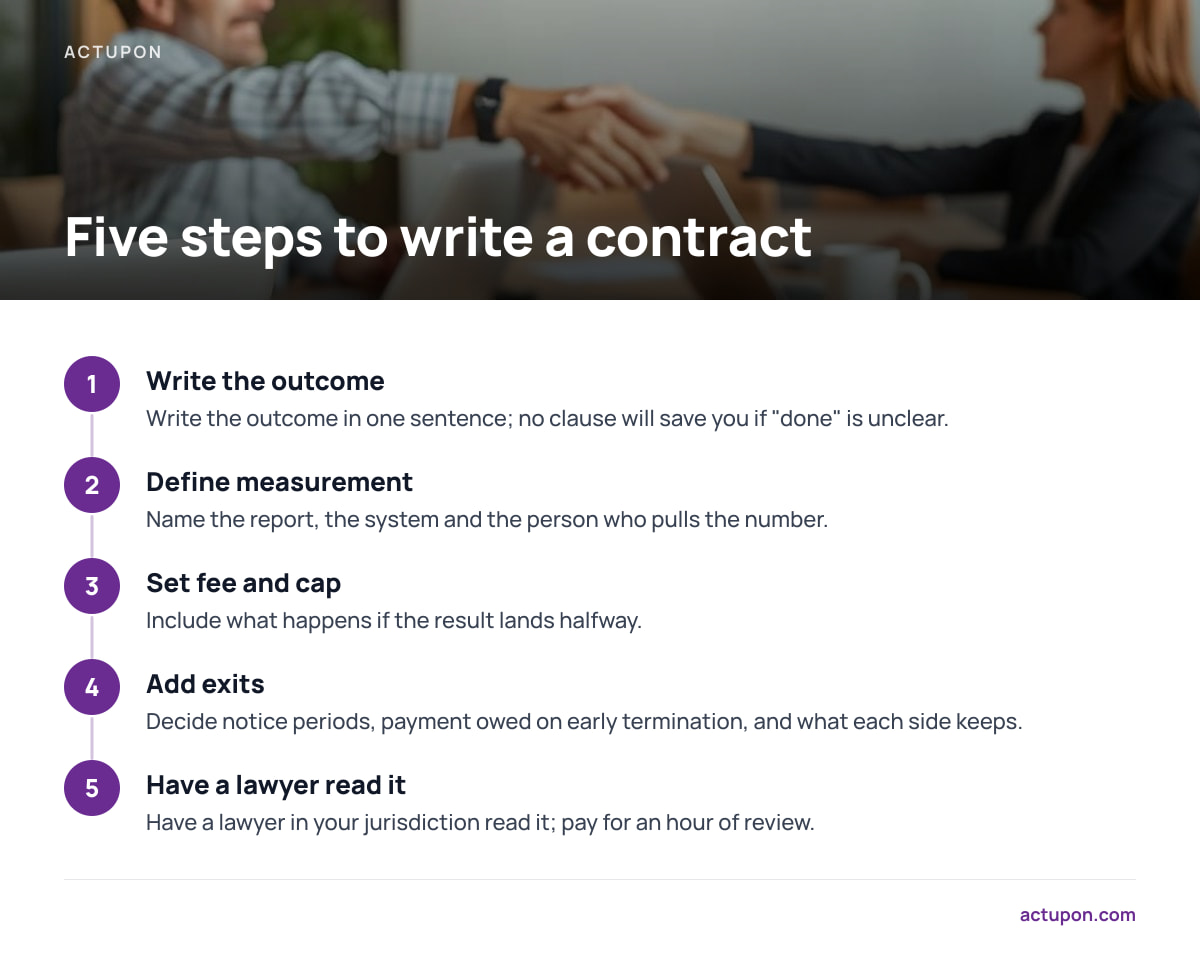
The Best Way to Write a Contract Agreement: Five Steps in Order
The best way to write a contract is to decide the money and the proof first, then add protection. Most people start with boilerplate and run out of patience before the fee clause. Reverse that.
- Write the outcome in one sentence. If you can't say what "done" looks like, no clause will save you.
- Define how it gets measured. Name the report, the system and the person who pulls the number.
- Set the fee and the cap. Include what happens if the result lands halfway.
- Add the exits. Decide notice periods, payment owed on early termination, and what each side keeps.
- Have a lawyer in your jurisdiction read it. Pay for an hour of review, not a drafting job. A review costs a fraction of a dispute.
I would take a plain three-page contract that both sides understand over a polished template nobody has read. Ambiguity is where consulting relationships break.
The Seven C's of a Consulting Agreement
No official "7 C's of consulting" exists. The phrase appears in different forms in training materials, and none is a recognized standard. For agreements, this version covers what actually goes wrong:
- Clarity. Scope in specific verbs and nouns: "audit," "implement," "train 12 staff," not "support."
- Compensation. The formula, timing and cap, including who pays expenses.
- Confidentiality. What is protected, what is excluded, and how long it lasts.
- Control. The consultant decides how the work gets done. This protects both sides on contractor status.
- Copyright and IP. Who owns deliverables, and who keeps tools that existed before the engagement.
- Changes. A written process for scope changes, so "quick extra favor" doesn't become unpaid work.
- Cancellation. Notice periods and payment on exit.
If a draft is missing any of these, fix that before you sign.
Four Fee Structures, and When Each One Backfires
"What are the four types of agreements?" has two common answers. Contract-law courses often list bilateral, unilateral, express and implied agreements. Others list valid, void, voidable and unenforceable, which describe legal status, not type. For a consulting buyer, the useful four are the fee models.
| Model | Best for | Where it backfires |
|---|---|---|
| Hourly or time-and-materials | Open-ended advice, diagnostics | Rewards slowness; costs have no ceiling |
| Fixed fee | Defined deliverables like an audit or a build | Scope creep, so one side eats the overrun |
| Retainer | Ongoing access, coaching | Paying monthly for undefined output |
| Performance-based | Results measurable in revenue, cost or volume | A disputed baseline or unmeasurable outcome |
My pick: performance-based whenever a number can prove success, hourly when the work is investigative, and never a retainer without a named monthly deliverable. A retainer with no deliverable is a subscription to hope. For more on how each model prices out, see how business consultant fees really work.
Pro Tip: Attach a one-page measurement exhibit, signed by both sides, that names the exact report or query that produces the number, the date range it covers, and who pulls it. Then add one sentence: "If the reporting system changes, the calculation method does not." Disputes over performance fees rarely come from the percentage. They come from a quiet change in how revenue gets counted.
Is $100 an Hour Good for Consulting? Do the Math Before You Say Yes
It depends on whether you're the buyer or the consultant, and on utilization. As a buyer, $100 an hour is modest for specialized work. A junior generalist might be worth it, while a niche expert at $100 is probably a bargain or inexperienced. As a consultant, the headline rate misleads you.
$100 an hour at 50% billable utilization is $100,000 a year in revenue, before the 15.3% U.S. self-employment tax rate, insurance and software costs.
The 50% matters because sales calls, proposals, admin and gaps between clients are unpaid. Few independents bill more than half the hours they work, especially early on. A consultant who nets a comfortable income usually needs a rate well above $100, or a fee model that doesn't depend on hours at all.
That is also the case for results-based pay: it ties your price to the outcome, not the clock. A consultant who triples a client's leads in two weeks shouldn't earn less than one who takes two months.
Where Free Templates Quietly Fail You
Free templates are fine as a checklist. They fail in three specific places.
"Work made for hire" often doesn't work
Many templates declare deliverables "work made for hire." Under U.S. law, the U.S. Copyright Office explains that a work by an independent contractor qualifies only if it was specially commissioned, fits one of nine statutory categories, and is covered by a signed written agreement.
Under 17 U.S.C. § 101, a consultant's work product counts as "made for hire" only if it fits one of nine listed categories. A strategy deck or a codebase usually doesn't.
So add an explicit assignment: "Consultant assigns all right, title and interest in the Deliverables to Client upon payment in full." Carve out the consultant's pre-existing tools and methods, or you'll fight about them later.
The "independent contractor" label isn't self-executing
Calling someone a contractor doesn't make them one. The IRS looks at behavioral control, financial control and the type of relationship. In the UK, HMRC's off-payroll working rules (IR35) put the status decision on medium and large private-sector clients. If you dictate hours, tools and methods, the contract wording won't protect you.
Jurisdiction and cross-border blind spots
Most downloadable templates assume one U.S. state's law. For cross-border work, name the governing law and the forum explicitly. Parties can also choose to incorporate the UNIDROIT Principles of International Commercial Contracts, a non-binding set of rules, as the contract's reference framework. Engagements involving token payments or blockchain work add further issues. Read Crypto Law Explained before you draft those.
Simple, PDF or Editable Doc: Which Format to Start From
You'll see searches for a simple consulting agreement example, a PDF, a free version and a doc. The format question has a practical answer.
- Start from an editable document. You need to change names, fees and scope, and a PDF fights you on every edit.
- Send a PDF for signature. It freezes the text, so nobody changes a clause after both sides agree.
- Keep it simple. A one-page letter agreement works for a short, low-risk job under a few thousand dollars. Anything with performance fees, IP transfer or access to your systems deserves the full skeleton above.
- Free is fine as a starting point. It is not fine as a final document. A free template doesn't know your jurisdiction, your fee model or your industry.
Engagements involving AI or data work need extra clauses on data handling and model ownership. Our pieces on picking a machine learning consulting company cover what to ask before you sign.
Get a Consulting Agreement Where the Fee Clause Is the Whole Point

Most consulting disputes come from the same place: nobody agreed in writing what "success" means. ActUpon is a business consulting firm that works on performance-based terms, with fees tied to agreed, measurable business results. Before any work starts, we put the metric, baseline, measurement window, cap and audit rights on paper, which is the exact clause most templates leave vague. The same approach covers our growth consulting, AI consulting, crypto and blockchain advisory, and coaching work. If you're unsure whether your business is ready for AI, we offer an AI readiness check first.
There's a limit, and we'll say it plainly. Performance-based pricing only works when a result can be measured and you can give us the data to verify it. If your outcome is fuzzy or your reporting is a mess, we'll tell you, and we may suggest a fixed-fee diagnostic first. Fee terms are set per engagement, not on a rate card, and nothing here is legal advice, so have a lawyer in your jurisdiction review any contract before you sign.
Frequently Asked Questions
What should a consulting agreement include?
At minimum: the parties, scope of services, fees and payment terms, term, independent contractor status, IP ownership, confidentiality, termination, liability limits and governing law. If fees depend on results, add the metric, baseline, measurement window, cap and audit rights.
What is the best way to write a contract agreement?
Start with the outcome and the money, not the boilerplate. Write the deliverable in one sentence, define how it will be measured, set the fee and cap, add exit terms, and get a local lawyer to review the draft.
Is $100 an hour good for consulting?
It can be, but only after you account for utilization. At 50% billable time, $100 an hour produces about $100,000 in annual revenue, before taxes, insurance and business costs. Specialized consultants usually charge more, or use fixed or performance-based fees instead.
What are the four types of agreements?
Contract-law courses often list bilateral, unilateral, express and implied agreements. Some sources instead list valid, void, voidable and unenforceable, which describe legal status. For consulting, the four that matter in practice are hourly, fixed-fee, retainer and performance-based fee structures.
What are the 7 C's of consulting?
There is no official or standardized list, and versions vary by author. For agreements, a practical set is clarity, compensation, confidentiality, control, copyright and IP, changes and cancellation.
Can I use a free consulting agreement template?
Yes, as a checklist or starting draft. Check the IP clause, the independent contractor language and the governing law, because free templates often get those wrong for your situation. Have a lawyer review it before you sign anything involving significant money.
Sources
- Works Made for Hire (Circular 30) | U.S. Copyright Office
- Independent Contractor (Self-Employed) or Employee? | Internal Revenue Service
- Understanding off-payroll working (IR35) | HMRC, GOV.UK
- UNIDROIT Principles of International Commercial Contracts 2016 | UNIDROIT