An AI readiness check is a short, scored review of whether one specific AI use case can run on your data, people and rules today. Score the use case, not the company: you can be unready for an agent that reads contracts and fully ready for one that sorts support tickets. Most free quizzes grade company-wide "maturity," which says little about whether to start.
TL;DR:
- Run the check on one named use case with one measurable baseline. A company-wide score does not predict whether any single pilot works.
- Score five dimensions from 0 to 3: baseline, data, ownership, risk and rules, and process fit. A total of 12 or more is a go, 8 to 11 means fix gaps while piloting narrowly, and under 8 means stop.
- A zero on data or ownership vetoes the project no matter what the total says.
- Test data with 100 real records. If fewer than 80 are usable without manual cleanup, you have a data project, not an AI project.
- Use NIST, ISO/IEC 42001 and the EU AI Act as reference points for the risk dimension. Skip quizzes that end in a sales call.
Table of Contents
- What an AI Readiness Check Measures, and What It Misses
- The Five Dimensions of an AI Readiness Check
- How to Run an AI Readiness Check in One Week
- Reading the Score: Go, Fix First, or Stop
- Frameworks, Templates and Quizzes: Which to Use
- When a Low Score Is Misleading, and a High One Is Too
- Common Mistakes That Make the Check Worthless
- Get an AI Readiness Check That Ends in Go, Fix, or Stop
- Frequently Asked Questions
- Sources
What an AI Readiness Check Measures, and What It Misses
A readiness check answers one question: if you started this project on Monday, what would stop it? It looks at the inputs (data, ownership, rules, process) and ignores the model. Models are a purchase decision. Inputs are where projects die.
The failure rate is the reason to bother. A 2024 RAND Corporation report on why AI projects fail, built on interviews with experienced practitioners, opens with the estimate that more than 80 percent of AI projects fail. Its causes are mostly organizational: unclear problem definitions, missing data, and teams chasing technology instead of a business problem. None of that shows up in a model benchmark.
A check cannot tell you whether the AI will perform well. Only a pilot answers that. A readiness check tells you whether a pilot is worth running and what to fix first. Be wary of anyone who claims more.
The Five Dimensions of an AI Readiness Check
Score each one from 0 to 3 for a single use case. Be stingy. A 3 means you could prove it to a skeptical board member today.
| Dimension | The question | A 3 looks like | A 0 looks like |
|---|---|---|---|
| Baseline | What number does this move, and what is it today? | Current cost, time or error rate measured over 30+ days | "We want to be more efficient" |
| Data | Can the AI read what it needs, in usable form? | 80+ of 100 sampled records usable with no cleanup | Data lives in inboxes, PDFs and one person's memory |
| Ownership | Who loses sleep if this fails? | A named owner with budget who will change the process | A committee, or "IT" |
| Risk and rules | What can go wrong, and who has agreed to it? | Data classified, vendor terms read, review step defined | Nobody has checked what leaves the building |
| Process fit | Where does the output go, and who fixes errors? | A human checkpoint and a handoff already mapped | The AI output ends up in a spreadsheet nobody opens |
Why the baseline comes first
Without a baseline you cannot tell whether the pilot worked, and you cannot argue for budget afterward. If a support team says AI will "reduce handle time," ask for the current handle time by ticket type. If nobody has it, measuring it is the first task, and it costs nothing but a few weeks.
Why ownership is a veto
Technology problems get solved. Ownership problems get discussed. When no single person will change a workflow to use the output, the output gets ignored, and the pilot "succeeds" in a deck and fails in operations. Score ownership honestly and treat a 0 as a stop.
How to Run an AI Readiness Check in One Week
You do not need a six-week engagement or a 200-question survey. A focused week covers it if the use case is already chosen.
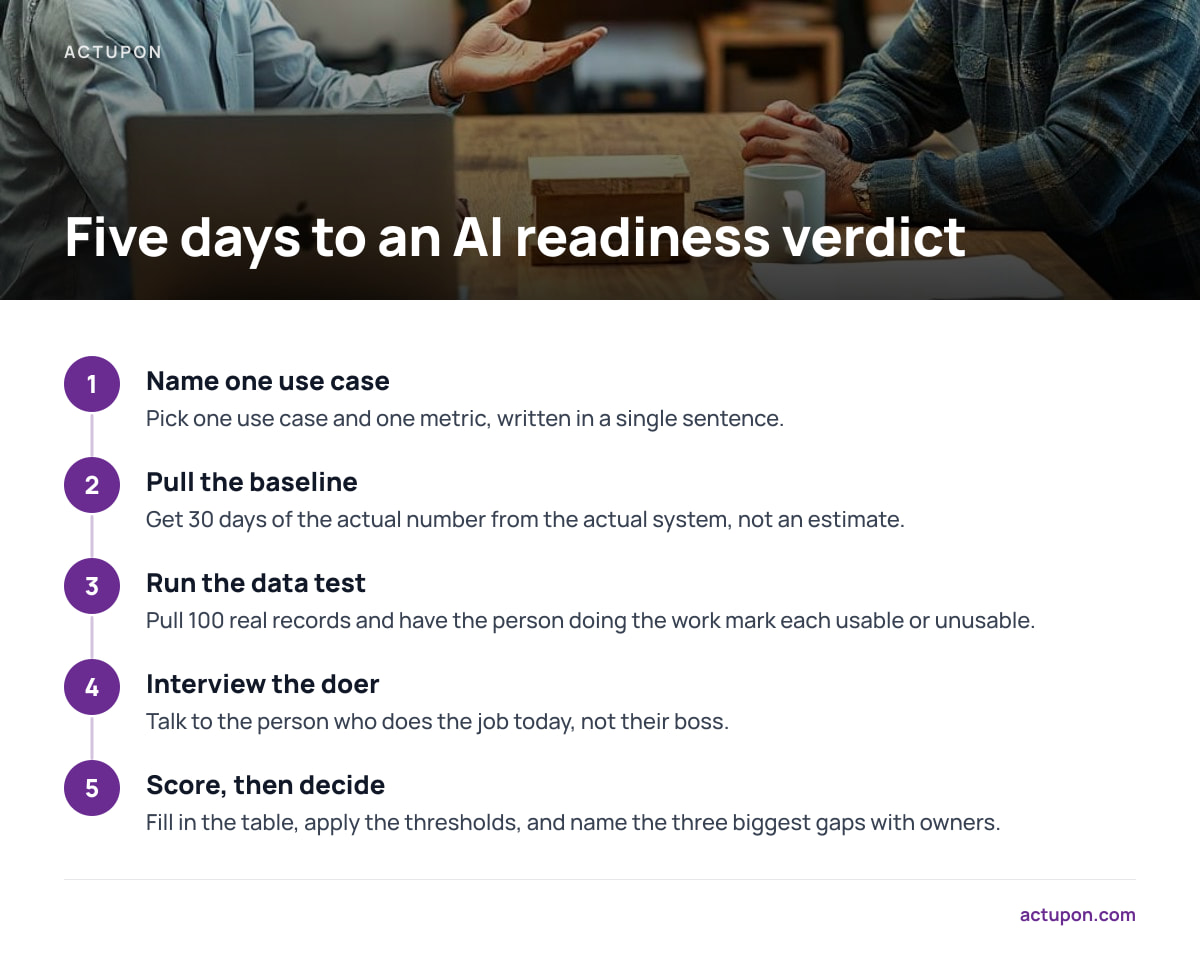
- Day 1: Name one use case and one metric. "Reduce first-response time on inbound quote requests from 9 hours to under 2." Write it in one sentence. If it takes a paragraph, it is two projects.
- Day 2: Pull the baseline. Get 30 days of the actual number from the actual system, not a manager's estimate.
- Day 3: Run the 100-record data test (below).
- Day 4: Interview the person who does the job today, not their boss. Ask where the work goes wrong, which exceptions eat their time, and what they would never trust a machine to decide.
- Day 5: Score, then decide. Fill in the table, apply the thresholds, and write down the three biggest gaps with an owner for each.
The 100-record data test
Pull 100 real records from the exact source the AI would read: tickets, invoices, CRM notes, whatever it is. Have the person who does that work by hand mark each one usable or unusable.
Pull 100 real records. If fewer than 80 are usable without a human cleaning them first, you have a data project, not an AI project.
The 80 percent line is a rule of thumb, not a published standard. It works because it forces the check onto real data. A data inventory tells you where data lives but nothing about its condition.
Pro Tip: Give the 100-record sample to someone outside the team that owns the data. Owners tend to excuse their own messy fields because they know the workarounds. A newcomer marks a record unusable if they cannot interpret it cold, and that is exactly the position a model is in.
Reading the Score: Go, Fix First, or Stop

Add the five scores for a total out of 15.
- 12 to 15: Go. Start a pilot with a fixed end date and a kill criterion written in advance, such as "if first-response time has not dropped 30 percent by day 60, we stop."
- 8 to 11: Fix while you pilot narrowly. Run a small pilot on the cleanest slice of the data while the weakest dimension gets fixed. Do not scale until it is a 2 or better.
- Under 8: Stop. Spend the money on measurement, data cleanup or process mapping. That work pays off with or without AI.
Two overrides apply. A 0 on data or ownership ends the project regardless of the total, because strength elsewhere does not compensate. And a total of 15 on a use case with a trivial payoff is still a bad project. Readiness says you can do it, not that you should.
Frameworks, Templates and Quizzes: Which to Use
Most of what ranks for this topic falls into three buckets: governance frameworks, spreadsheet templates and online quizzes. They answer different questions.
Governance frameworks
Use these to score the risk dimension, not the whole check. The NIST AI Risk Management Framework organizes AI risk work into four functions: Govern, Map, Measure and Manage. It is voluntary and free, which makes it a sensible checklist for a mid-sized company. ISO/IEC 42001:2023 is the certifiable management-system standard for AI. Pursue certification only if customers or regulators ask for it.
If you operate in or sell into Europe, the European Commission's AI Act overview matters now. The Act's AI literacy duty and its ban on certain practices began applying on February 2, 2025, so "we have not checked" is a weak position for any company using AI there.
Templates and quizzes
A template is fine if it forces you to enter real numbers. A quiz is fine as a conversation starter in a leadership meeting. Both fail the same way: they grade your general posture, so nearly everyone lands in the middle with a "maturity level" and a suggestion to buy help. A check that cannot output "stop" is a lead form. Large consultancy frameworks have the opposite problem: they are built for enterprise budgets, which we cover in our piece on what big-firm AI consulting is and who it fits.
When a Low Score Is Misleading, and a High One Is Too
The obvious reading of a bad score is "we are not ready for AI, so wait." That is often wrong, because readiness belongs to a use case. A manufacturer with chaotic ERP data may score 4 on demand forecasting and 13 on summarizing inbound supplier emails. Waiting on the whole program because of the first would be a mistake.
The reverse trap is the high score built on enthusiasm. Teams tend to rate ownership generously because the sponsor is excited, and rate data generously because they have not looked at it. Anything you scored 3 without evidence, rescore as 1. A customer-facing build such as a voice or chat assistant needs particular scrutiny on process fit, because errors reach customers directly. We cover that in hiring a conversational AI consultant.
My position: for companies under a few hundred employees, skip the company-wide assessment entirely. Pick the one process where a delay or error costs you real money, and check only that. If it passes, you have learned more than any maturity score would show you.
Common Mistakes That Make the Check Worthless
- Scoring a vision instead of a task. "AI across sales" cannot be scored. "Draft first replies to inbound leads" can.
- Letting the vendor run the assessment. Their incentive is a yes. Run it yourself or hire someone whose fee does not depend on you buying a tool.
- Skipping the people who do the work. Frontline staff know which fields are always blank and which exceptions break every rule.
- No exit criterion. If nothing could make the check say stop, it is a formality. Our guide to applied AI consulting covers what to buy and what to skip once you have an answer.
Get an AI Readiness Check That Ends in Go, Fix, or Stop
If you would rather not run this alone, ActUpon does an AI readiness check built on this same logic: one use case, a measured baseline, real records tested, and a written verdict you can act on. We are a hands-on consulting firm, and we tie our fees to agreed, measurable results instead of hours. That means our incentive is to find the project that pays, which sometimes means telling you not to build the one you came in with.
One limit applies. Results-linked fees only work when a baseline can be measured, so if your numbers do not exist yet, the first piece of work is building them, and that is scoped separately. A readiness check also cannot guarantee a model will perform. It tells you whether a pilot deserves your money. Ask us for the scope and fee structure before you commit; there is no price list because the terms depend on the outcome we agree on.
Frequently Asked Questions
What is an AI readiness check?
It is a structured review of whether a specific AI use case can succeed given your current data, ownership, risk controls and workflow. The output should be a decision: go, fix first, or stop. A check that only produces a "maturity level" is not much use.
How long does an AI readiness check take?
One focused week is enough for a single use case if the use case is already chosen. Most of the time goes to pulling a 30-day baseline and testing real data records. Company-wide programs take months and usually tell you less.
Should I use an AI readiness quiz or a template?
A quiz works as a starting conversation but is too general to decide anything. A template is useful if it makes you enter measured numbers such as baseline cost and the share of usable records. Whichever you pick, make sure it can return a "stop" result.
Which frameworks should I reference for the risk part of an assessment?
The NIST AI Risk Management Framework is a free, voluntary guide organized around Govern, Map, Measure and Manage. ISO/IEC 42001:2023 is the certifiable standard for AI management systems. If you operate in the EU, check your obligations under the AI Act.
What score means I am ready for AI?
Using the five-dimension method here, 12 or more out of 15 is a go, 8 to 11 means pilot narrowly while fixing gaps, and under 8 means stop. A zero on data or ownership overrides the total. The thresholds are a practical rule of thumb, not an industry standard.
Sources
- The Root Causes of Failure for Artificial Intelligence Projects and How They Can Succeed | RAND Corporation
- AI Risk Management Framework | NIST
- ISO/IEC 42001:2023 Artificial intelligence management system | ISO
- Regulatory framework for AI (EU AI Act) | European Commission