Applied AI consulting is the work of putting AI into a live business process with an owner, a metric, and a cutoff date. General AI strategy decides where to place bets; applied work builds, tests, and hands over a working system. Judge the consultant on whether the process changed. The slide count does not matter.
TL;DR:
- Applied AI consulting is judged on a live process metric; slide count is irrelevant.
- Start with one workflow, one baseline, and one stop rule.
- Generative AI is a model family; applied AI is the deployment discipline.
- Budget for integration, human review, and handover before you budget for model access.
- Salary and review data need a title check because broad benchmarks hide the AI premium.
Table of Contents
- What Applied AI Consulting Means, and Where Strategy Ends
- What an Artificial Intelligence Consultant Actually Does
- How AI Is Applied in Business: Four Patterns That Pay
- Applied AI vs Generative AI: The Difference That Changes the Budget
- What Applied AI Consulting Costs, and What Salary Data Says
- How to Vet an Applied AI Consulting Company and Read Reviews
- Where Applied AI Projects Fail, and the Numbers to Watch
- A 30-Day Scoping Plan for Small Teams
- Get an Outcome-Linked AI Engagement Without the Big-Firm Overhead
- Frequently Asked Questions
- Sources
What Applied AI Consulting Means, and Where Strategy Ends

Applied AI means AI used inside an operating workflow. The invoice queue, the claims triage desk, the sales pipeline: if the model stops, a named business process breaks. That is the line between applied AI and a demo. A demo can impress a board; an applied system has to survive a Monday morning.
Applied AI consulting is buying implementation work: process mapping, data plumbing, model choice, integration, testing, change management, and handover. Strategy is choosing where to bet. Most small companies need one workflow fixed, measured, and owned. An 80-page AI strategy rarely helps. If you are still choosing the bet, read AI strategy consulting before you sign an implementation contract.
An artificial intelligence consultant is an outside specialist who diagnoses where AI fits, designs the solution, manages the build or vendors, and measures the result. The title should signal process judgment; it does not guarantee coding skill. A consultant who cannot name the queue, the baseline, and the error cost is selling vocabulary.
What an Artificial Intelligence Consultant Actually Does
Selects the workflow. A useful consultant starts with a queue that costs money: invoice entry, support triage, lead qualification, claims review. The first deliverable is a short list ranked by volume, cycle time, and error cost.
Checks the data. Before anyone talks about models, the consultant samples the data, checks permissions, and looks for missing fields. Bad input data turns an AI project into an expensive cleanup job.
Chooses build or buy. Sometimes a vendor tool is enough. Sometimes a custom model is justified. The consultant should show the cost of each path, including maintenance and staff time.
Owns integration. Applied AI has to sit inside the workflow your team already uses. If the model lives in a separate dashboard nobody opens, adoption will be near zero.
Sets the measurement. The baseline should be written before the pilot starts. Pick one primary metric and one guardrail metric.
Hands over the system. A good consultant trains the team, writes the runbook, and documents what to do when the model is wrong. A dependency on the consultant is a red flag.
Applied AI consulting jobs often list model frameworks. The better job descriptions name a business process and a metric. If you are hiring internally, write the scorecard around ownership: who fixes the queue when the model is wrong? Data and AI consultant breaks down that role in more detail.
How AI Is Applied in Business: Four Patterns That Pay
Document extraction. Invoices, claims, contracts, and onboarding forms are high-volume queues with clear error costs. A model that pulls fields and routes exceptions can cut cycle time without changing the core system.
Triage and routing. Support tickets, sales leads, and compliance alerts need fast sorting. Applied AI can classify and route, but you still need escalation rules and a human review path for edge cases.
Forecasting and replenishment. Demand forecasts, staffing forecasts, and inventory replenishment are classic applied AI problems. The value comes from better decisions. A prettier dashboard does not create value.
Sales and service copilots. A copilot that drafts a reply or summarizes an account can save time. It becomes applied AI only when it sits in the workflow with quality checks and a clear handoff to a person.
These are applied AI examples because each one has a queue, a baseline, and a cost of error. A chatbot on a marketing site may be useful, but it rarely changes a profit and loss line by itself. Applied AI earns its budget when it moves a number the business already tracks.
Applied AI vs Generative AI: The Difference That Changes the Budget
Applied AI is the deployment category. Generative AI is one family of models inside it. A fraud classifier and a document extraction pipeline are applied AI; neither needs a chatbot. A customer support assistant built on a large language model is applied AI only when it sits in the support workflow with escalation rules and quality checks.
The budget follows the use case. Generative AI adds evaluation sets, retrieval, guardrails, and human review. Classic applied AI adds data labeling, integration, and model monitoring. The EU AI Act assigns obligations by use case and risk. Whether the model is generative does not change those obligations. Compliance work follows the application.
Do not let a vendor sell you a model category when you need a process fix. Ask what decision changes, what data feeds it, and what happens when the output is wrong. If those answers are vague, the label will not save the project.
What Applied AI Consulting Costs, and What Salary Data Says
Fees come in four shapes: fixed-fee scoping, fixed-fee pilot, monthly advisory retainer, and performance-based fees tied to a metric. Hourly billing is the worst fit for applied work because it rewards more hours and less handover. Ask for a pilot with a cap and a stop rule.
| Engagement | Typical fee model | What you should demand |
|---|---|---|
| Readiness check | Fixed fee | Baseline, data inventory, go or no-go memo |
| Pilot | Fixed fee with a cap | One workflow, one metric, stop date |
| Build | Fixed fee or milestone | Acceptance tests, handover documents |
| Advisory | Monthly retainer | Named senior time, no junior swap |
| Performance-based | Base plus bonus, or share of verified gain | Written measurement formula, audit right |
The salary question needs a title check. The U.S. Bureau of Labor Statistics does not track “AI strategy consultant.” Its closest broad category, management analysts, had a median annual wage of $99,410 in May 2023. Employer postings for AI strategy roles in large US markets often list base pay from $120,000 to $180,000, with senior leads above $200,000. The BLS number includes all management analysts; AI specialists are a narrower group.
The U.S. Bureau of Labor Statistics put the median annual wage for management analysts at $99,410 in May 2023. That benchmark covers all management analysts; it does not cap AI strategy pay.
How to Vet an Applied AI Consulting Company and Read Reviews
Ask for the metric formula. “Improve efficiency” is not a metric. Ask how the gain will be measured, who owns the data, and what counts as success at day 30.
Ask who is in the room. Senior sales people often disappear after signature. Get the name of the delivery lead and the share of hours that person will work.
Read reviews for handover language. Applied AI consulting reviews are noisy. Employee review sites measure whether staff like the firm; client references measure whether the system worked. Look for comments about training, documentation, and what happened after launch.
Check the data exit. Your data should leave with you. Ask about retention, access, deletion, and export formats before the pilot starts. If your data is locked into the firm's tool, that setup creates lock-in.
Test with a paid readiness check. A short fixed-fee review should produce a baseline, a data inventory, and a go or no-go recommendation. If the first step is a large transformation program, the firm is selling scope.
A founder-led applied AI firm can be a good fit for a small team because the person who sold the work may do it. Ask who will be in the room in week six as well as week one. If the answer changes after signature, walk. For a broader comparison of firm types, see AI consulting firms.
Where Applied AI Projects Fail, and the Numbers to Watch
Most failures start before the model. There is no baseline, no owner, or no stop rule. The NIST AI Risk Management Framework tells teams to map, measure, manage, and govern AI risks. That sounds formal; in practice it means write down what the system is for, what can go wrong, and who fixes it.
Baseline gap. If you cannot state current cost per invoice, support handle time, or forecast error, you cannot prove a gain. Fix the baseline before you buy a tool.
Owner gap. A model without a process owner becomes everyone’s side project. Name one person who can change the workflow and one person who can stop the pilot.
Data gap. Check permission, retention, and quality first. The OECD AI Principles put accountability and transparency on the organizations deploying AI as well as on the model vendor.
Stop-rule gap. A pilot with no end date becomes a subscription. Set a date and a kill criterion. If the model does not beat the baseline by the agreed margin, stop.
Track four numbers during the pilot: error rate on a sample your team has checked, cycle time from input to decision, cost per transaction, and escalation rate to a human. If two of those get worse while one gets better, the process is the problem.
A credible applied AI pilot has one workflow, one baseline, and one stop rule.
A 30-Day Scoping Plan for Small Teams
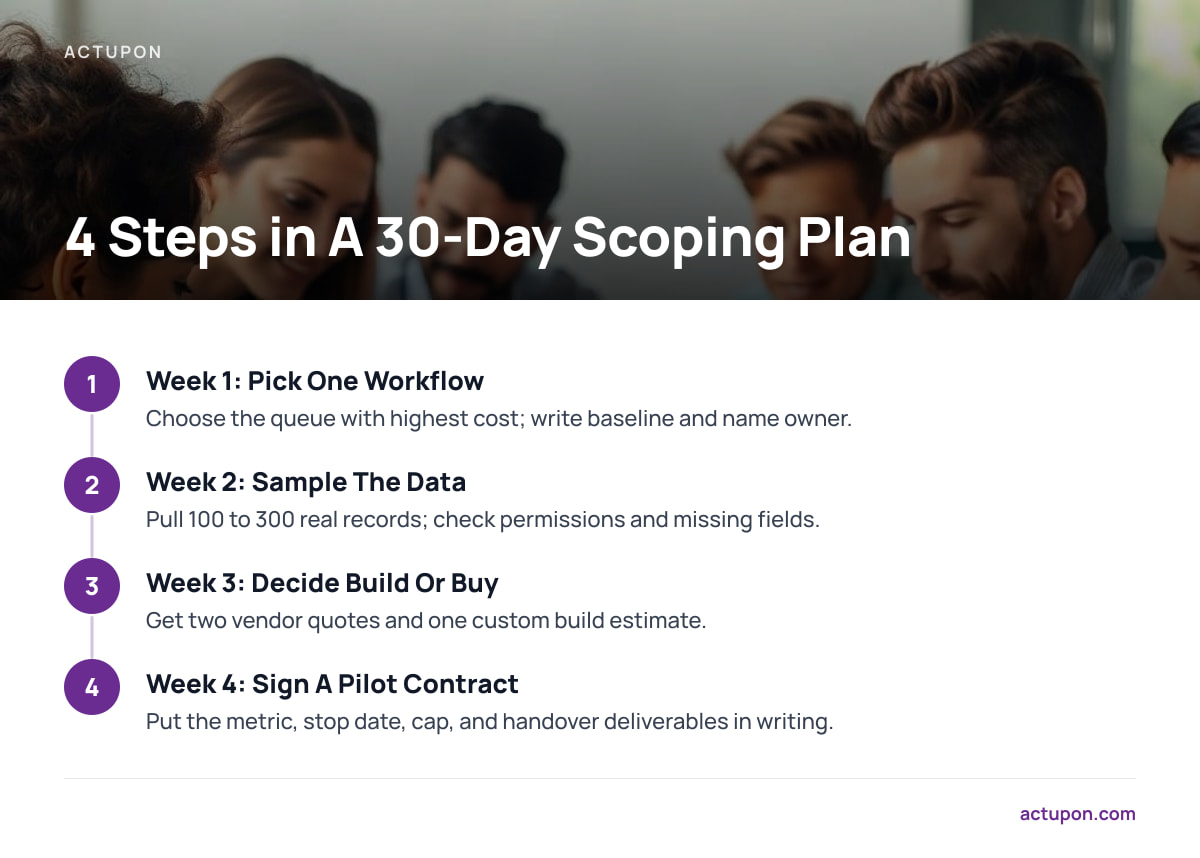
Week 1: pick one workflow. Choose the queue with the highest cost per week. Write the current baseline in one sentence and name the process owner.
Week 2: sample the data. Pull 100 to 300 real records. Check permissions, missing fields, and how often a human disagrees with the current process. Do not skip this step.
Week 3: decide build or buy. Get two vendor quotes and one custom build estimate. Compare total cost for 12 months, including integration and staff time. Then choose the cheapest path that meets the error tolerance.
Week 4: sign a pilot contract. Put the metric, the stop date, the cap, and the handover deliverables in writing. A pilot without a stop rule is a budget leak with a dashboard.
Pro Tip: Do not start with a model. Start with the queue that costs you the most per week. Calculate the cost of one wrong decision in that queue. If the model cannot reduce that cost or the time to handle it, stop. This test saves more money than any model benchmark. If you are pre-revenue or early, first-time founders covers what to skip.
Get an Outcome-Linked AI Engagement Without the Big-Firm Overhead
ActUpon runs AI readiness checks and applied AI consulting for small and mid-sized teams that want a working process and a handover. The engagement starts with one workflow, a written baseline, and a stop rule. Fees are tied to agreed business results where the metric can be measured; the readiness check is a fixed-fee scope quoted after a 30-minute call. We cap the pilot before work starts so the downside is a capped number you chose.
We are not a staff augmentation shop. If you need twenty developers for a year, we are the wrong call. If you need one process fixed and a team trained to run it, start with the readiness check. One honest limit: if you cannot name a baseline metric and a process owner, we will tell you to fix that first. We will not sell a model into a broken workflow.
Frequently Asked Questions
What is an artificial intelligence consultant?
An outside specialist who finds where AI fits a business process, designs the solution, manages the build or vendor, and measures the result. The role should include process ownership and handover as well as model advice.
What does applied AI mean?
Applied AI means AI used inside a real workflow with a baseline and a cost of error. A model demo becomes applied AI only when a named process depends on it and someone owns the result.
How is AI applied in business?
Common applications include document extraction, triage and routing, forecasting, and sales or service copilots. Each one has a queue, a baseline, and an error cost you can measure.
How much does an AI strategy consultant make?
The BLS broad benchmark for management analysts was a median of $99,410 in May 2023. US postings for AI strategy roles often list base pay from $120,000 to $180,000, with senior leads above $200,000.
How should I read Applied AI consulting reviews?
Look for comments about handover, measurement, and who did the work. Employee review sites measure staff satisfaction; client references measure whether the process changed. Ask for two references with numbers.
Should I hire a founder-led applied AI firm?
It can work for a small team because the person who sold the work may do it. Ask for a named delivery lead and a written handover plan. If the founder disappears after signature, the model will not save the project.
Sources
- AI Risk Management Framework | NIST
- OECD AI Principles | OECD
- EU AI Act | European Commission
- Occupational Outlook Handbook: Management Analysts | U.S. Bureau of Labor Statistics