A crypto compliance audit for startups should test whether your company is legally allowed to do what it already does: licensing status, AML and sanctions controls, token classification, tax reporting and custody records. It audits the business and its legal exposure, which a smart contract security audit never touches. If you hold customer funds or issue a token, buy the compliance audit first and the code audit second.
TL;DR:
- A compliance audit checks your legal right to operate. A smart contract audit checks whether your code can be exploited. They are different purchases.
- Start with the regulatory perimeter: your licensing status depends on where your customers are and what you do with their funds, not where you incorporated.
- AML, KYC, sanctions screening and Travel Rule handling are where startups most often fail, because they are operational controls that need evidence.
- Token classification, marketing claims, custody and tax reporting each need a written position, not a verbal one.
- A useful report ranks gaps by severity, names an owner and a deadline for each, and gets re-tested after fixes.
Table of Contents
- What a Crypto Compliance Audit for Startups Actually Tests
- Start With the Perimeter: Which Regulators Think You Are Theirs
- AML, KYC and Sanctions: Where Startups Get Hit First
- Token Classification and Marketing Claims
- Custody, Key Management and Customer Funds
- Tax Reporting and Records
- How to Run the Audit, and What the Report Should Look Like
- Get a Crypto Compliance Gap Review Tied to Results You Can Check
- Frequently Asked Questions
- Sources
What a Crypto Compliance Audit for Startups Actually Tests
A compliance audit asks one question: can you prove that your company is permitted to operate the way it does? A smart contract security audit asks whether your code can be exploited. Startups routinely buy the second and assume it covers the first. It does not, and a clean code review will not help when a regulator asks for your customer due diligence files.
The audit looks at six areas: licensing, financial crime controls, token status, custody, tax reporting, and the paper trail that connects them. It reviews policies, but mostly it samples real behavior. Did you actually screen that wallet? Who approved that exception? Where is the record?
This article covers only the crypto audit scope. For the broader question of what outside advisers do for early-stage companies and what they cost, see our page about consultants for startups.
| Audit area | What the auditor asks | Evidence you should be able to produce |
|---|---|---|
| Licensing | Which regulators treat us as in scope? | Written perimeter memo, license or registration, or counsel's exemption analysis |
| AML and sanctions | Do we know who our users are and who they pay? | KYC files, screening logs, risk assessment, suspicious activity procedure |
| Token status | Could our token be a security or regulated asset? | Classification analysis, issuance documents, marketing archive |
| Custody | Who controls keys and customer funds? | Key ceremony records, access lists, segregation proof |
| Tax | What do we report and to whom? | Transaction ledgers, cost-basis method, reporting calendar |
| Governance | Who is accountable for compliance? | Named officer, board minutes, training records |
Start With the Perimeter: Which Regulators Think You Are Theirs
Your incorporation address decides much less than founders hope. Regulators generally look at where your customers are and what you do with their assets.
In the United States, FinCEN's 2019 guidance on convertible virtual currency says administrators and exchangers of virtual currency are generally money transmitters under the Bank Secrecy Act. That means registration as a money services business, plus an AML program. State money transmitter licenses are a separate layer, and they are the slow, expensive part.
In the European Union, Regulation (EU) 2023/1114, known as MiCA, requires authorization for crypto-asset service providers and sets rules for issuers of certain tokens. Transitional arrangements differ by member state, so check the one you rely on instead of assuming a grace period.
The audit should produce a written perimeter memo. It lists each jurisdiction where you have users, the activity you perform there (exchange, transfer, custody, issuance, payment acceptance), and the regulator's position. Where the answer is "we think we are exempt," the memo needs counsel's reasoning attached.
If your only crypto activity is accepting payments for your own goods, your perimeter is usually much smaller. Our guides on how to accept crypto payments as a business and on crypto payment gateways and hidden costs explain why the choice of processor changes who holds the funds.
AML, KYC and Sanctions: Where Startups Get Hit First
Financial crime controls are the most common failure point because they depend on daily behavior, not on a document. The Financial Action Task Force applies its standards to virtual asset service providers and expects a risk-based approach. In practice, an auditor samples files and checks that your process was followed.
What the sample test checks
- Risk assessment. A written assessment of your customer types, geographies, products and transaction channels. Generic templates copied from another company fail here.
- Customer due diligence. Identity verification at onboarding, with enhanced checks for higher-risk users. The auditor pulls 25 or 50 files and looks for gaps.
- Sanctions screening. Evidence that you screen users and counterparties, including wallet addresses, and that you act on hits. Logs matter more than the tool you bought.
- Transaction monitoring. Alerts, who reviewed them, how long it took, and what happened next.
- Suspicious activity handling. A procedure for escalation and reporting, with a named person who owns it.
The Travel Rule
FATF Recommendation 16, the Travel Rule, applies to virtual asset transfers at a threshold of USD/EUR 1,000, which is lower than the US funds transfer threshold of $3,000.
If you send or receive transfers on behalf of customers, the auditor checks whether you collect and pass on originator and beneficiary information. In the EU, the Transfer of Funds Regulation (EU) 2023/1113 brought this into law for crypto transfers, and it applies alongside MiCA. A common finding is that a startup built the data collection but cannot transmit it to counterparties who use a different protocol.
Token Classification and Marketing Claims
If you issue a token, the audit needs a written classification analysis. In the US, that means whether it could be an investment contract under the Howey test. Under MiCA, it means whether it falls into a regulated category such as an e-money token or asset-referenced token, or is an unregulated "other" crypto-asset with its own white paper duty. Other jurisdictions have their own tests, and a token can be several things at once.
Classification is only half of it. Auditors also read your marketing, because regulators do. Phrases such as "earn," "yield," "guaranteed returns," or "the team will grow the value" can undo a careful legal analysis. The audit should collect every public statement from your website, social accounts, Discord and founder interviews, and compare them with the classification memo.
Pro Tip: Archive your marketing before the audit starts, including deleted posts and community chat moderation logs. Auditors who find a risky claim in a screenshot you did not know existed will rate the whole marketing control as failed. Finding it yourself first lets you fix the process, not just the post.
Custody, Key Management and Customer Funds

Custody is where compliance and security overlap, and where an audit has the most to say about your actual risk. The question is simple: who can move customer funds, and can you prove it?
- Key control. Document who holds keys or signing authority, how many approvals a transfer needs, and what happens when a key holder leaves. A single founder holding the only seed phrase is a finding.
- Segregation. Customer assets should be separated from company operating funds, with records that reconcile on-chain balances to internal ledgers.
- Third-party custodians. If a provider holds assets for you, the audit reviews your contract, their licensing and what happens if they fail.
- Incident response. A tested plan for a compromised key or a frozen account, with current contact lists.
A self-hosted payment processor can reduce your custody footprint, because payments settle directly to a wallet you control. You still need to document who controls that wallet.
Tax Reporting and Records
Founders tend to defer tax until it hurts. The auditor checks that you can produce a complete transaction history, apply a consistent cost-basis method, and identify what you must report about users.
The OECD Crypto-Asset Reporting Framework sets a standard for automatic exchange of information on crypto-asset transactions between tax authorities, and many jurisdictions are implementing it. If you operate as a platform or intermediary, you must collect self-certifications from users and report their activity. Build that data capture early, because retrofitting it onto a live product is painful.
Your own tax position needs the same discipline. Treasury holdings, token sales, payments received in crypto and employee token compensation each have a treatment that someone should have written down.
How to Run the Audit, and What the Report Should Look Like
Scope it to your actual activities, not to a generic checklist. A startup that only accepts payments needs a lighter review than one that runs an exchange, and paying for the heavy version wastes runway.
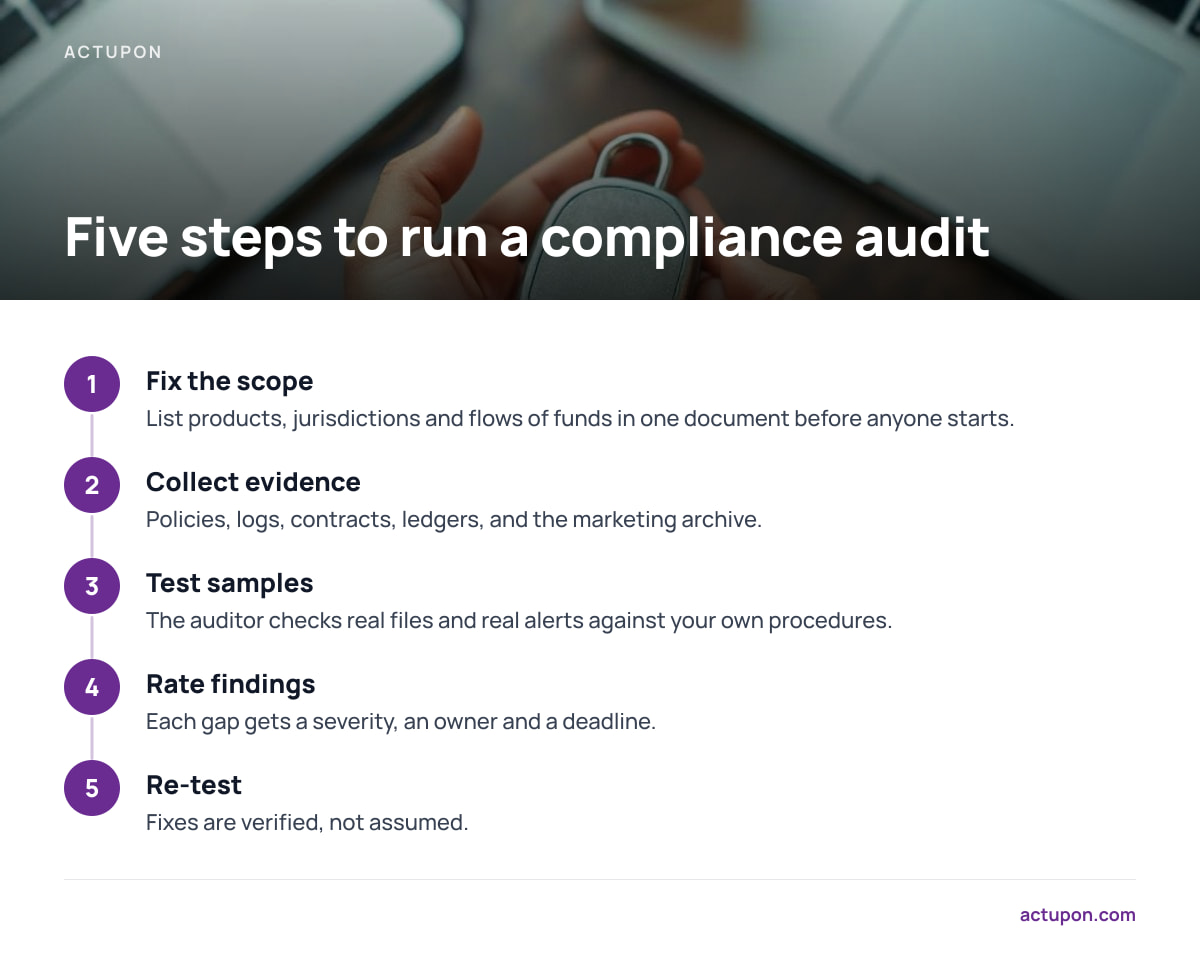
- Fix the scope. List products, jurisdictions and flows of funds in one document before anyone starts.
- Collect evidence. Policies, logs, contracts, ledgers, and the marketing archive.
- Test samples. The auditor checks real files and real alerts against your own procedures.
- Rate findings. Each gap gets a severity, an owner and a deadline.
- Re-test. Fixes are verified, not assumed.
A good audit report fits on the first page: how many findings are critical, how many are open, and who owns each.
Pick an auditor who is independent of whoever built your controls. If the same adviser wrote your AML policy and then reviews it, the audit tells you what you already believe. For a view on how to tell good advice from lucky outcomes, see our piece on attributing results to consultant performance.
Get a Crypto Compliance Gap Review Tied to Results You Can Check
If your startup handles crypto, the most useful first step is a scoped review of the six areas above, with a ranked list of fixes you can act on within weeks. ActUpon runs crypto and blockchain advisory as hands-on work. We map your perimeter, test your controls against real files, and help you build the missing evidence. Fees can be tied to agreed, measurable outcomes, such as closing named critical findings by a set date.
We are a consultancy, not a law firm, so we do not issue legal opinions or licensing determinations. Where your perimeter memo needs counsel's sign-off, we prepare the facts and you take them to a licensed lawyer in the right jurisdiction. If you only need to accept payments without holding customer funds, our sister service Myntli offers hosted BTCPay Server, which may be all the setup you need.
Frequently Asked Questions
How much does a crypto compliance audit for a startup cost?
Cost depends on scope, jurisdictions and how much evidence already exists, so there is no reliable flat figure. A payments-only startup needs a much lighter review than an exchange or token issuer. Ask for a fixed scope and a written list of what is excluded before you agree to a price.
Is a smart contract audit the same as a compliance audit?
No. A smart contract audit reviews code for vulnerabilities. A compliance audit reviews licensing, AML controls, token status, custody and tax reporting. If you issue a token or hold customer funds, you generally need both.
When should a crypto startup run its first compliance audit?
Before you take customer funds, launch a token, or enter a new jurisdiction. Running it after launch means any gap is already a live exposure. A lighter pre-launch review is cheaper than remediation after a regulator or banking partner raises questions.
Does MiCA apply to startups outside the European Union?
It can, if you offer crypto-asset services or tokens to users in EU member states. Where your customers are matters, not where you are incorporated. Have counsel confirm your position for each member state you serve.
What is the Travel Rule and does my startup need to follow it?
The Travel Rule is FATF Recommendation 16, which requires originator and beneficiary information to accompany virtual asset transfers above USD/EUR 1,000 between regulated providers. If you transfer assets on behalf of customers, you likely need a process for it. The exact obligations depend on your jurisdiction and activity.
Sources
- Updated Guidance for a Risk-Based Approach to Virtual Assets and VASPs | Financial Action Task Force
- Application of FinCEN's Regulations to Certain Business Models Involving Convertible Virtual Currencies (FIN-2019-G001) | FinCEN
- Regulation (EU) 2023/1114 on Markets in Crypto-assets (MiCA) | EUR-Lex, European Union
- Crypto-Asset Reporting Framework and amendments to the Common Reporting Standard | OECD