Yes, a bank can close your account for crypto. Your account agreement lets it end the relationship for nearly any reason, usually with notice, and accepting crypto is not a legally protected activity. The payment itself is rarely the trigger. Banks act on off-ramp patterns they cannot explain: deposits from unfamiliar exchanges, transfers from unhosted wallets, and volume that does not match your profile. Document your flows and the account is much easier to keep.
TL;DR:
- A bank can close a business account for accepting crypto or stablecoins because no law gives you a right to a particular bank account, and the account agreement usually allows closure for any reason.
- Most closures follow off-ramp behavior (third-party deposits, volume spikes, unscreened wallet addresses), not the act of accepting a crypto payment.
- If a bank files a suspicious activity report, it is legally barred from telling you, so a closure letter often gives no reason.
- To protect cash flow, disclose crypto flows at onboarding, convert through a business-named account, and keep a second bank in place before you need it.
- Crypto receipts are taxable income at fair market value when received, and the IRS can see public blockchains and exchange records, so keep a clean ledger.
Table of Contents
- Can a Bank Close Your Business Account for Crypto? Yes, and It Rarely Has to Say Why
- What Triggers a Closure: Off-Ramp Flows Matter More Than Invoices
- What the Law Protects, What It Doesn't, and What Is Changing
- How to Withdraw Crypto to a Bank Account Without Raising Flags
- What Happens When a Token Is Delisted, or Your Crypto Account Is Frozen
- Can the IRS See Your Wallet? What Your Business Has to Report
- A Banking Setup That Survives a Closure Notice
- Get a Second Opinion on Your Crypto Banking Plan Before the Notice Arrives
- Frequently Asked Questions
- Sources
Can a Bank Close Your Business Account for Crypto? Yes, and It Rarely Has to Say Why
In the United States, nothing in federal law gives a business a right to hold an account at a specific bank. The deposit agreement you signed almost always lets either side end the relationship, and many agreements set notice at around 30 days. Check yours, because the number varies. If the bank suspects something, it can freeze the account or close it immediately.
Crypto is not a protected category the way race or religion is under anti-discrimination law. A bank that decides stablecoin revenue is outside its risk appetite is making a business decision, and courts rarely second-guess those. If you are still deciding which rails to accept at all, the main guide on picking business payment rails by finality covers that choice. This article covers only what your bank can do about it.
My position: assume closure is possible and build for it. The owners who get burned are the ones who treated the bank as a utility.
What Triggers a Closure: Off-Ramp Flows Matter More Than Invoices
Banks do not see your crypto invoices. They see what lands in the account. A customer paying you in USDC is invisible to the bank until you convert and wire the proceeds. That conversion is where risk teams start asking questions.
| What the bank sees | Why it raises a flag | What to do |
|---|---|---|
| Deposits from an exchange account in a personal name | Third-party funds, source unclear | Convert through an exchange account in the company's legal name |
| A sudden jump in wires from an exchange | Volume does not match the profile you gave at onboarding | Tell the bank your expected monthly crypto volume up front |
| Funds linked by blockchain analytics to mixers or sanctioned addresses | Possible sanctions or laundering exposure | Screen sender addresses before you convert |
| Money in and out within hours, little commerce behind it | Looks like pass-through or unlicensed transmission | Keep invoices that match receipts, and hold funds for a defined period |
| Converting crypto for customers who are not paying you | May make you a money services business | Do not do it without a license |
Most of these fixes cost nothing. They are paperwork and sequence.
A bank that files a suspicious activity report is legally barred from telling you, which is why many closure letters say only that the bank is "exercising its right to close."
That prohibition comes from the Bank Secrecy Act, which FinCEN administers. Asking what you did wrong will not get you out of a closure. You prevent one by leaving no gaps to fill.
What the Law Protects, What It Doesn't, and What Is Changing
The law that helps you is narrower than most crypto commentary suggests. Here is where the lines sit.
Accepting crypto for your own goods is generally not a regulated activity
FinCEN's 2019 guidance on convertible virtual currency draws its line at transmitting value for other people. Taking payment for your own goods or services is not that, while processing payments on behalf of other merchants is. Your activity can still look riskier than it is if the bank does not understand it.
Regulators have softened toward bank crypto activity, but that does not give you a right to an account
In March 2025 the FDIC withdrew its earlier requirement that supervised banks notify it before engaging in crypto-related activities. In August 2025 the White House issued an executive order on fair banking aimed at politicized debanking. Both direct or relax regulators. Neither gives you a private claim against a bank that closes your account, and I would not plan around either one.
Global standards push banks toward case-by-case judgment
The Financial Action Task Force has said for years that wholesale "de-risking," meaning cutting off whole categories of customers, is inconsistent with a risk-based approach. Banks are supposed to follow that standard, and it is useful when you appeal a closure. You cannot enforce it yourself.
Rules outside the US vary. The EU's MiCA framework governs issuers and crypto-asset service providers, and says nothing on whether your bank must keep you. For the wider picture, see crypto law explained.
How to Withdraw Crypto to a Bank Account Without Raising Flags
Withdrawing crypto to a bank account means selling it for fiat on a regulated exchange or off-ramp and sending the proceeds by ACH or wire. A wire usually lands the same day. ACH typically takes one to three business days.
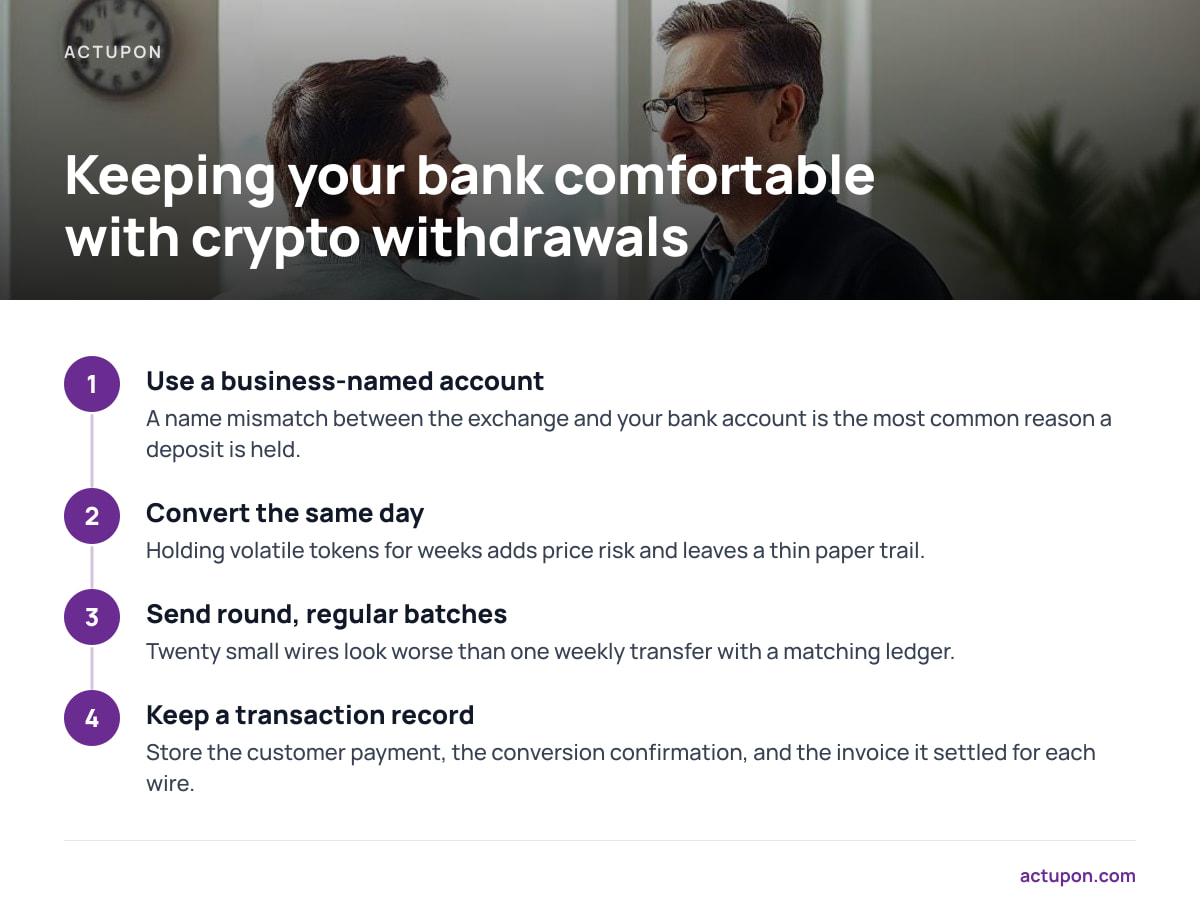
The sequence that keeps a bank comfortable:
- Use an account in the business's legal name. A name mismatch between the exchange and your bank account is the most common reason a deposit gets held.
- Convert the same day you receive payment. Holding volatile tokens for weeks adds price risk and leaves a thin paper trail.
- Send round, regular batches. Twenty small wires from the same source look worse than one weekly transfer with a matching ledger.
- Keep a transaction record. For each wire, store the original customer payment, the conversion confirmation, and the invoice it settled.
If you hold stablecoins, the issuer matters as much as the bank does. Our guide on vetting a stablecoin issuer covers what to check on reserves and redemption terms before you let balances sit.
What Happens When a Token Is Delisted, or Your Crypto Account Is Frozen
If an exchange delists a token
Your coins do not disappear. If they are on-chain in a wallet you control, you still own them, but liquidity and price usually drop. If they are on the exchange, the platform normally announces a withdrawal or sell-off window, and the notice sets the terms. Read it the day it arrives. After the window closes, policies differ by platform. For a business, the practical lesson is to accept only assets with deep liquidity and convert quickly.
If a crypto account is frozen
Freezes come from a compliance review, a stale KYC file, a suspicious-activity flag, or a legal order. Here is the order I would work in:
- Ask which category applies. Support can often say "compliance review" or "legal hold" even when it cannot say more.
- Refresh your documents. Upload current corporate registration, beneficial-owner details, and proof of address before you are asked twice.
- Supply source-of-funds evidence. Send invoices, contracts, and the customer payments behind the deposits.
- Escalate in writing. Ask for a named reviewer and a timeline. Keep every reply.
- Hire counsel if a court order is involved. Support cannot lift a legal hold. Only the issuing authority can.
Can the IRS See Your Wallet? What Your Business Has to Report
The IRS cannot read your mind, but it can read blockchains. Public ledgers are visible to anyone, and the agency pays for analytics tools that link addresses to identities once any address touches a regulated exchange. The tie to you is usually your exchange account, not your wallet.
Under the IRS's digital asset guidance, crypto you receive for goods or services is ordinary income measured in US dollars at fair market value on the day you receive it.
Brokers must report customer proceeds to the IRS on Form 1099-DA, starting with transactions in 2025. The return also asks about digital asset activity. If you accept crypto, log the dollar value at receipt for each payment, then track gain or loss when you sell. That log also answers your bank when it asks where the money came from.
Pro Tip: Give your bank a one-page crypto flow memo before you open or renew the account. Name your off-ramp provider, the assets you accept, your expected monthly volume, and the account the proceeds will land in. Risk teams approve what they were told. Closures usually follow surprises, so the memo moves you from "unexplained activity" to "documented activity" before anyone reviews a transaction.
A Banking Setup That Survives a Closure Notice
Here is what I would run if I took crypto or stablecoin payments.
- Two banks, opened before you need them. Keep the second one live with a small balance and regular activity. Opening an account under pressure takes weeks and looks worse.
- One crypto-aware primary. Ask any bank directly whether it accepts business customers with crypto revenue. If the first answer is vague, read that as a no.
- A processing layer that limits what touches your bank. A hosted BTCPay Server from Myntli lets you take Bitcoin payments without a payment processor holding your funds. It does nothing for the fiat conversion step, which is where banks look.
- A written rule on what you will not do. No conversion for outside parties, no personal wallets in the flow, no unscreened counterparties.
I would pick this over hoping for regulatory relief. Regulatory sentiment shifts every few years, and a closure notice can arrive on any Tuesday.
Get a Second Opinion on Your Crypto Banking Plan Before the Notice Arrives

If your bank relationship is fragile, ActUpon can review the structure with you: which assets you accept, how they convert, which banks fit, and how the flow looks to a compliance officer. Our crypto and blockchain advisory is hands-on, and for growth work we offer performance-based consulting where fees are tied to agreed, measurable results. We scope the arrangement up front instead of publishing a rate card.
We are business consultants, not a law firm or a bank, so we cannot guarantee an outcome with any bank, and we will tell you when a question needs a licensed attorney. Start with a plain review of your flows. If the gaps are small, you will know after one conversation.
Frequently Asked Questions
Can a bank close my business account just because I accept crypto?
Generally yes. In the US no law gives you a right to a specific bank account, and most deposit agreements let the bank close it for any reason, often with notice. Closure for crypto is a risk decision, and documentation and a backup bank matter more than legal arguments.
How do I withdraw crypto to a bank account?
Sell the crypto for fiat on a regulated exchange or off-ramp, then send the proceeds by ACH or wire to a bank account in the same legal name. Wires usually land the same day and ACH in one to three business days. Keep the original customer payment, the conversion record, and the invoice together.
What happens to my money if a crypto is delisted?
Your tokens remain yours if they sit in a wallet you control, though liquidity and price usually drop. On an exchange, the platform normally posts a withdrawal or sell-off window, and the terms are in that notice. Read it as soon as it arrives and move or convert before the deadline.
Can the IRS see my crypto wallet?
The IRS can read public blockchains and uses analytics to link addresses to identities, usually through exchange KYC records. Brokers report customer proceeds on Form 1099-DA starting with 2025 transactions. Crypto received for goods or services is taxable income at its US dollar value when received.
How do I unfreeze a crypto account?
Find out which category the freeze falls under, such as compliance review or legal hold. Then refresh your corporate and beneficial-owner documents, supply source-of-funds evidence, and escalate in writing for a named reviewer. If a court or agency order caused the freeze, you will need an attorney because support cannot lift it.
Sources
- Digital assets | Internal Revenue Service
- Financial Crimes Enforcement Network | U.S. Department of the Treasury
- Financial Action Task Force | FATF
- Federal Deposit Insurance Corporation | FDIC