An AI implementation consultant puts an AI system to work inside your operations. That means connecting it to your data, getting your staff to use it, and measuring it against a business number. A strategy deck is not the deliverable. The distinction that matters is between someone who advises on what AI could do and someone accountable for what it does after go-live. Hire for the second, and tie at least part of the fee to a measurable result.
TL;DR:
- An implementation consultant owns go-live and adoption. A strategy consultant owns the plan. Know which one you are paying for.
- Start with one workflow and one metric. Projects scoped as "AI transformation" rarely reach production.
- Paid-on-results pricing is the strongest filter for competence, but it only works if you have a measurable baseline.
- A competent implementer can map the plan to the NIST AI Risk Management Framework and explain your data exposure in plain English.
- Skip hiring anyone if you have no clean data, no internal owner, or no process worth automating yet.
Table of Contents
- What an AI Implementation Consultant Actually Delivers, and What They Don't
- Implementation, Strategy, or Vendor: Which One Are You Actually Talking To?
- Five Signs You Need an Implementer, and Three Signs You Don't
- What a Real Engagement Looks Like, Phase by Phase
- Pricing an AI Implementation Consultant: Hourly, Fixed-Fee, or Paid on Results
- Questions That Expose a Weak AI Implementation Consultant
- Governance Isn't Optional Anymore: Standards and Rules Your Implementer Should Know
- Get an AI Rollout You Only Pay For When It Moves a Number
- Frequently Asked Questions
- Sources
What an AI Implementation Consultant Actually Delivers, and What They Don't

The job is narrow: take one business process, put an AI system into it, and make sure people still use it ninety days later. That covers integration with your existing tools, data preparation, prompt or model configuration, access controls, staff training, and a measurement plan that compares the new workflow against the old one.
What an implementation consultant should not be selling you is a vision. If the proposal opens with market sizing, an "AI maturity curve," or a twelve-month roadmap with no production deployment before month six, you are buying strategy with an implementation label on it. Strategy has its place, and our breakdown of what AI strategy consulting includes and what to skip covers when it's worth paying for. But strategy and implementation are different purchases, and mixing them up is how companies end up with expensive documents and no working software.
The failure point in most AI projects isn't the model. It's the last mile. The data turns out to be messier than the demo assumed. Nobody owns the tool after launch. The people doing the work were never asked whether it helped them. A good implementer spends most of their time on those three problems, not on choosing between models.
Implementation, Strategy, or Vendor: Which One Are You Actually Talking To?
Three kinds of people will answer when you search for help with AI. They overlap in their marketing and differ sharply in what they're accountable for.
| AI implementation consultant | AI strategy consultant | Software vendor's "solutions" team | |
|---|---|---|---|
| Main deliverable | A working system in production, with adoption and metrics | A roadmap, use-case prioritization, business case | Their product, configured for you |
| Accountable for | Results after go-live | Quality of the recommendation | Contract renewal |
| Tool-neutral? | Should be. Ask. | Usually | No |
| Typical timeline to first live use | Weeks | Often none in scope | Weeks, but limited to their platform |
| Best when | You know the problem and need it solved | You don't yet know where AI fits | You've already chosen the platform |
| Biggest risk | Overbuilding a custom solution | Paying for slides | Lock-in and scope shaped around the product |
If you already know which process is costing you money, skip the strategy engagement and hire an implementer. If you genuinely can't name a process, a short readiness assessment beats a long strategy project. You need a ranked list of two or three candidates, not a fifty-page report.
For a wider view of how firms package this work, see what to actually pay for from an artificial intelligence consulting firm.
Five Signs You Need an Implementer, and Three Signs You Don't
Hiring outside help makes sense when the bottleneck is execution rather than ideas. These are the conditions where an implementer pays for themselves.
- You have a repetitive, high-volume process. Examples include support tickets, invoice matching, quote preparation, and first-pass document review. Volume is what turns small per-task savings into real money.
- You've already run a pilot that stalled. A pilot that worked in a demo but never reached daily use is the classic implementation gap. Someone needs to own integration and adoption.
- Your team is curious but has no bandwidth. Your best operator already has a full-time job. Asking them to also become your AI lead on the side is how projects die quietly.
- Data sits in three or more systems that don't talk to each other. Connecting a CRM, an accounting package, and a shared drive is unglamorous work. It's also usually where the value is.
- You face regulatory or client scrutiny. If clients ask how you use AI on their data, you need documented controls, not reassurance.
And here's when you should keep your money:
- No internal owner. If nobody on your side will own the tool after the consultant leaves, it will decay. Fix that before you hire anyone.
- No baseline. If you don't know how long the process takes today or what it costs, you can't tell whether the AI helped. Spend two weeks measuring first.
- The process itself is broken. Automating a bad process gives you a fast bad process. Fix the workflow, then add AI.
What a Real Engagement Looks Like, Phase by Phase
A credible implementation has a short discovery phase, an early production deployment, and a defined handover. Here's the shape to expect. Push back hard on anything much longer before real users touch it.
Weeks 1–2: Baseline and Scope
The consultant measures the current process: volume, cycle time, error rate, cost per unit. They also identify the data involved, who touches it, and what's sensitive. The output is a one-page scope with a single target metric and a written definition of "done."
Weeks 3–6: Build and Controlled Launch
The system gets built against real data and tested with a small group of actual users, not a sandbox audience. Access permissions, logging, and a human-review step for high-stakes outputs go in now, not later.
Weeks 7–10: Rollout and Adoption
Wider rollout, training built around the specific workflow, and weekly measurement against the baseline. This is the phase most consultants underprice and most clients skip. It's also where the return is won or lost.
Handover
Documentation, an internal owner trained to maintain and adjust the system, and a clear list of known limitations. You should be able to fire the consultant at this point without the system breaking.
A disciplined implementer will also structure the risk work around a recognized framework. The NIST AI Risk Management Framework is voluntary, free, and widely used outside the United States. It gives a shared vocabulary for identifying and handling AI risk across the system's lifecycle.
Govern, Map, Measure, Manage. Those four functions are the entire spine of the NIST AI Risk Management Framework, and any implementer worth hiring should be able to show where each one appears in their plan.
Pricing an AI Implementation Consultant: Hourly, Fixed-Fee, or Paid on Results

How you pay shapes what you get. Each model rewards the consultant for a different behavior, so pick the one that rewards the behavior you want.
| Pricing model | What it rewards | Works well when | Watch out for |
|---|---|---|---|
| Hourly / day rate | Time spent | Scope is genuinely unknown and short | Open-ended discovery that never ends |
| Fixed project fee | Finishing the defined scope | Scope is clear and stable | "Done" defined as delivered, not used |
| Retainer | Ongoing availability | You need continuous tuning after launch | Paying for access you don't use |
| Performance-based | Moving an agreed business number | You have a baseline and a clear metric | Metrics that can be gamed or that the consultant doesn't control |
Our position: if you can measure the outcome, tie part of the fee to it. A consultant who will put money at risk against a reduction in handling time or an increase in qualified leads has already told you something about their confidence. One who refuses every form of results-linked pricing has also told you something.
Performance-based pricing is not magic, though. It needs a clean baseline, a metric both sides agree on in writing, and a measurement period long enough to rule out noise. A hybrid usually works best: a modest fixed fee covers build costs, and the rest depends on results. If you want the same lens applied to broader growth work, our guide to how to pick a business growth consulting firm walks through it.
Pro Tip: Define the success metric as something the consultant can influence but can't fully manipulate. Pair it with a guardrail metric. "Average ticket resolution time" alone invites closing tickets prematurely. "Resolution time, provided reopen rate doesn't rise above its current level" doesn't. Write both numbers into the contract before kickoff.
Questions That Expose a Weak AI Implementation Consultant

You can sort competent implementers from repackaged generalists in a single call. Ask these and listen for specifics.
- "Show me something you put into production that's still running." Not a demo, not a pilot. Ask how many people use it today and what number it moved.
- "Where does our data go, and who can see it?" You want a plain answer covering which systems process it, whether it's retained, and whether it's used to train someone else's model. "It's secure" is not an answer.
- "What happens when the model is wrong?" Good implementers design for errors. Expect human review on consequential outputs, confidence thresholds, and logging.
- "What would make you tell us not to do this?" If they can't name a condition under which they'd walk away, they're selling, not advising.
- "Who maintains this after you leave, and what will it cost us?" Model API fees, license costs, and maintenance time should be estimated up front.
- "Which tools are you paid to recommend?" Referral and reseller arrangements are common. They aren't automatically bad, but you need them disclosed.
If the person you're talking to is better at helping your leadership team think than at shipping systems, that may still be valuable. It's just a different role. The difference between a coach and a consultant matters here more than most buyers realize.
Governance Isn't Optional Anymore: Standards and Rules Your Implementer Should Know
You don't need a compliance department to deploy AI responsibly. You do need an implementer who knows which rules apply to you and builds controls in from day one rather than bolting them on later.
- EU AI Act. The European Commission's AI regulatory framework sorts AI systems by risk level. Obligations scale with that risk and phase in over several years. It reaches beyond EU-based companies: if your AI system is placed on the EU market or its output is used in the EU, it can apply to you. Hiring, credit decisions, and certain safety-related uses fall into the high-risk categories with the heaviest requirements.
- ISO/IEC 42001. This is the international management-system standard for AI, published by the International Organization for Standardization. Most small and mid-sized firms don't need certification. Its structure is still a sensible checklist for policies, roles, and risk assessment.
- OECD AI Principles. The OECD AI Principles are a useful plain-language reference for transparency, accountability, and human oversight. Many national policies draw on them.
- Existing data protection law. GDPR and similar regimes already govern personal data flowing through AI tools. No AI-specific law is needed for these obligations to bite.
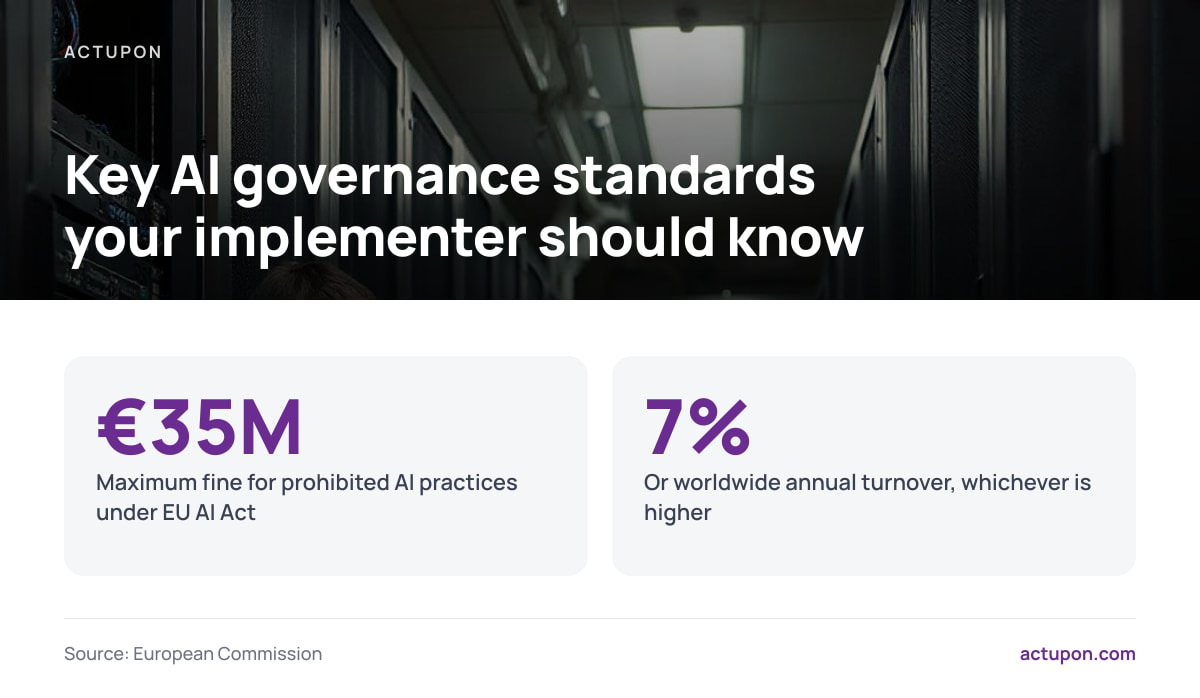
Fines for prohibited AI practices under the EU AI Act can reach €35 million or 7% of worldwide annual turnover, whichever is higher.
Most of your use cases won't come anywhere near that tier. The point is that an implementer who has never classified a system's risk level is learning on your project. Ask them to classify yours during the first call.
Get an AI Rollout You Only Pay For When It Moves a Number
Everything above comes down to one problem: AI projects fail when nobody is accountable for the result after launch. ActUpon is built around fixing that. We start with an AI readiness check that measures your baseline and names the one process worth automating first. Then we do the hands-on implementation work: integration, controls, training, and adoption. Where the outcome is measurable, we tie our fee to the agreed result rather than to hours logged. There's no long report.
The honest limit: paid-on-results only works when there's a real baseline and a metric we can both verify. If your data can't support that yet, we'll say so and either price the groundwork differently or tell you to fix the foundations first. Pricing is set per engagement once the metric is agreed, so check the terms in writing. Hold every consultant to that standard, including us.
Frequently Asked Questions
What does an AI implementation consultant do?
An AI implementation consultant deploys an AI system into a specific business process and makes sure it gets used. The work covers data integration, configuration, access controls, staff training, and measuring results against a baseline. The deliverable is working software in daily use, not a strategy document.
How is an AI implementation consultant different from an AI strategy consultant?
A strategy consultant helps you decide where AI fits and builds the business case. An implementation consultant takes a defined use case into production and owns adoption afterward. If you already know which process to fix, you usually need implementation, not strategy.
How long should an AI implementation project take?
For a single, well-scoped workflow, real users should be working with the system within roughly four to six weeks. Wider rollout and adoption typically take a few more weeks after that. Be wary of proposals with no production deployment in the first several months.
Should I pay an AI consultant based on results?
Results-linked pricing is a strong signal of a consultant's confidence and aligns their incentives with yours. It only works when you have a measurable baseline and a written metric both sides agree on. A hybrid of a modest fixed fee plus a results-based component is often the most practical structure.
Do small businesses need to worry about the EU AI Act?
Possibly. The EU AI Act can apply to companies outside the EU if their AI system is placed on the EU market or its output is used there. Most small-business use cases fall into lower-risk categories, but uses like hiring or credit decisions carry heavier obligations, so have your implementer classify each system early.
Sources
- AI Risk Management Framework | National Institute of Standards and Technology
- ISO/IEC 42001:2023 Information technology — Artificial intelligence — Management system | International Organization for Standardization
- AI Act: Regulatory framework on AI | European Commission
- OECD AI Principles | OECD.AI