Stablecoin issuer failure plays out in two different ways. Algorithmic issuers like Terra collapse to zero, taking your money with them, because nothing backs the token. Fiat-backed issuers like USDC and USDT do hold reserves, but if the issuer goes bankrupt those reserves become a general asset of the estate, and you become an unsecured creditor at the back of the line despite the "backed" label.
TL;DR:
- Two failure modes exist: algorithmic collapse (Terra) wipes holders out, fiat-backed bankruptcy (USDC, USDT) makes them unsecured creditors.
- Under US bankruptcy law, stablecoin reserves are an asset of the issuer, not a segregated trust for token holders.
- Proof-of-reserve attestations confirm reserves exist on a date; they do not give you a legal claim on those reserves.
- The SVB/USDC event in March 2023 froze redemption for days, even though USDC eventually recovered.
- The EU's MiCA regulation now requires asset-referenced stablecoin issuers to segregate reserves and offer a direct redemption right.
- For business treasuries, the test is not "is it backed" but "what is my exact legal claim if the issuer fails tomorrow."
Table of Contents
- Two Kinds of Failure, and Why the Difference Matters
- The Bankruptcy Problem Most Holders Miss
- Three Real Failures to Learn From
- What Redemption Actually Requires, Even When the Issuer Is Solvent
- What Regulators Are Doing About It
- How to Protect Your Business Funds
- Get a Stablecoin Strategy That Survives an Issuer Failure
- Frequently Asked Questions
- Sources
Two Kinds of Failure, and Why the Difference Matters
When a stablecoin issuer fails, your outcome depends almost entirely on one question: did the issuer promise to back the token with a real asset, or did it promise to keep the price stable through code? These are not the same product, and they fail differently.
Algorithmic stablecoins like TerraUSD held no reserves. They maintained their peg through arbitrage mechanics with a sister token, LUNA. When confidence broke in May 2022, both tokens collapsed together. UST fell from $1 to roughly $0.13 in days, taking around $40 billion in market value with it, according to Reuters reporting on the collapse. If you held UST when its issuer "failed," you recovered nothing, because there was nothing to recover.
Fiat-backed stablecoins like USDC (Circle) and USDT (Tether) do hold reserves, usually cash, short-dated US Treasuries, and money market instruments. Those reserves are what is supposed to make $1 redemption possible. Whether you can actually get those dollars when the issuer fails is a separate question, and it is where most holders get hurt.
The rest of this article assumes you hold, or are considering holding, fiat-backed stablecoins in your business treasury. That is the realistic case for a working business. It is also the case where the legal answer is least intuitive.
The Bankruptcy Problem Most Holders Miss
Most stablecoin marketing avoids this. In US bankruptcy law, the reserves backing a fiat-backed stablecoin are an asset of the issuer, not a segregated trust for token holders. If Circle, Tether, Paxos, or any similar issuer enters Chapter 11, your USDC or USDT does not give you a direct claim on the reserves.
You become an unsecured creditor, behind employees, secured lenders, taxing authorities, and trade creditors. Payment comes pro rata from whatever is left, after years of legal proceedings. There is no FDIC insurance and no SIPC protection. The token is, legally, an IOU from a company that may or may not be solvent.
In US bankruptcy law, holders of even fully-backed stablecoins become unsecured creditors. The 1:1 claim is marketing, not law.
This is not hypothetical. Circle disclosed in March 2023 that roughly $3.3 billion of its USDC reserves sat at Silicon Valley Bank. When SVB was closed by regulators on March 10, 2023, USDC lost its peg and traded down to about $0.87 before recovering. Circle could not redeem USDC 1:1 for USD until the Federal Reserve set up the Bank Term Funding Program, which let Circle access its trapped funds. Circle's transparency disclosures document the sequence. Holders were made whole only because the banking system was patched under them. Their legal claim had not changed.
Proof of Reserves Is Not a Legal Claim
Attestation reports and proof-of-reserve audits do not change your legal position either. Tether publishes regular attestations from BDO. Circle has had full audits from Big Four firms. Those reports confirm the reserves exist on a given date. They do not give you a trust, a custodial account, or a bankruptcy priority. They do not stop the issuer from lending against the reserves, from holding them at a bank that fails, or from being slow to redeem when under stress.
Reserves on a spreadsheet are not reserves in your pocket.
Three Real Failures to Learn From
Theory is cheap. The history is short and the lessons are specific.
Terra / Luna, May 2022
Algorithmic stablecoin. Approximately $40 billion in value erased in days. Holders received nothing back, because there were no reserves to back the claims. The issuer (the Luna Foundation Guard) had assembled a Bitcoin reserve worth roughly $3 billion at peak, but it was far short of the UST float, and it was liquidated during the run.
USDC and SVB, March 2023
Fiat-backed, fully reserved, audited stablecoin. Circle held a meaningful portion of its reserves at a single commercial bank. When that bank failed, redemption stalled and the token depegged by 13 cents. No legal claim on Circle's reserves existed; redemption resumed only because the Federal Reserve intervened.
Tether's Reserve Scrutiny, 2021 to Present
Tether has held reserves that include commercial paper, secured loans, and other non-cash instruments, disclosed in quarterly attestations on Tether's transparency page. The company has never faced a public redemption crisis on the scale of UST or USDC, but the legal structure is the same as Circle's: holders are unsecured creditors of iFinex Inc., the parent company.
What Redemption Actually Requires, Even When the Issuer Is Solvent
Even when everything works, redemption is not the same as using a debit card.
Minimums and Fees
Tether enforces a $100,000 minimum on direct USDT-to-USD redemption and charges fees. Circle accepts much smaller redemption amounts for verified institutional accounts, but the process takes 1 to 3 business days and requires full KYC. If you hold $5,000 in USDC and need dollars in two hours, you are not redeeming with Circle. You are selling on a crypto exchange, where the price is whatever the market will give you.
Banking Hours and Banking Risk
Redemption only works when the banking system is open and the issuer's bank is healthy. Weekends, holidays, and bank outages all delay it. The SVB event showed that even a multi-day banking disruption is enough to break the peg and freeze your access.
Freezing Is Possible
USDC and USDT issuers can, and do, freeze tokens at the smart contract level when served with law enforcement orders. This has happened in sanctions cases and theft investigations. The same legal control that lets Circle freeze a thief's tokens lets it freeze yours, if the order names your address.
Pro Tip: Before you park more than one week of payroll in any stablecoin, ask the issuer in writing for the redemption terms that apply to your account: minimum amount, fee, settlement time, and the legal entity that owes you the dollar. If they will not give you that in writing, your position is weaker than the marketing implies.
What Regulators Are Doing About It
Regulation is moving fast, and it is starting to change the legal answer.
MiCA in the EU
The EU's Markets in Crypto-Assets Regulation took effect for stablecoins in June 2024, with full application from late 2024. Under MiCA's rules on asset-referenced and e-money tokens, issuers of regulated stablecoins must hold reserves segregated from their own assets, keep them in low-risk instruments, and honor a holder's right of redemption at par value. This is a meaningful change: it puts EU-regulated stablecoin holders closer to depositors than to unsecured creditors.
NYDFS in the United States
In the US, the most active regulator is the New York State Department of Financial Services. Paxos, Gemini, and a short list of others issue stablecoins under NYDFS supervision, which requires audited reserves, monthly attestations, and capital buffers. NYDFS-supervised issuers are stronger than offshore ones, but the underlying federal bankruptcy treatment still applies if the issuer itself fails.
The Rest of the Picture
The UK has brought qualifying stablecoins into the Financial Services and Markets Act framework. Singapore's MAS regulates them under the Payment Services Act. No major jurisdiction has yet created a stablecoin equivalent of FDIC deposit insurance, and no jurisdiction has solved the cross-border problem: a USDC holder in Singapore makes a claim under Delaware law, not Singapore law. Crypto Law Explained: What's Legal, Who Regulates, What's Next walks through the broader regulatory map, and MiCA Regulation: What It Covers, Who It Skips, What to Do Next covers the EU regime in detail.
How to Protect Your Business Funds
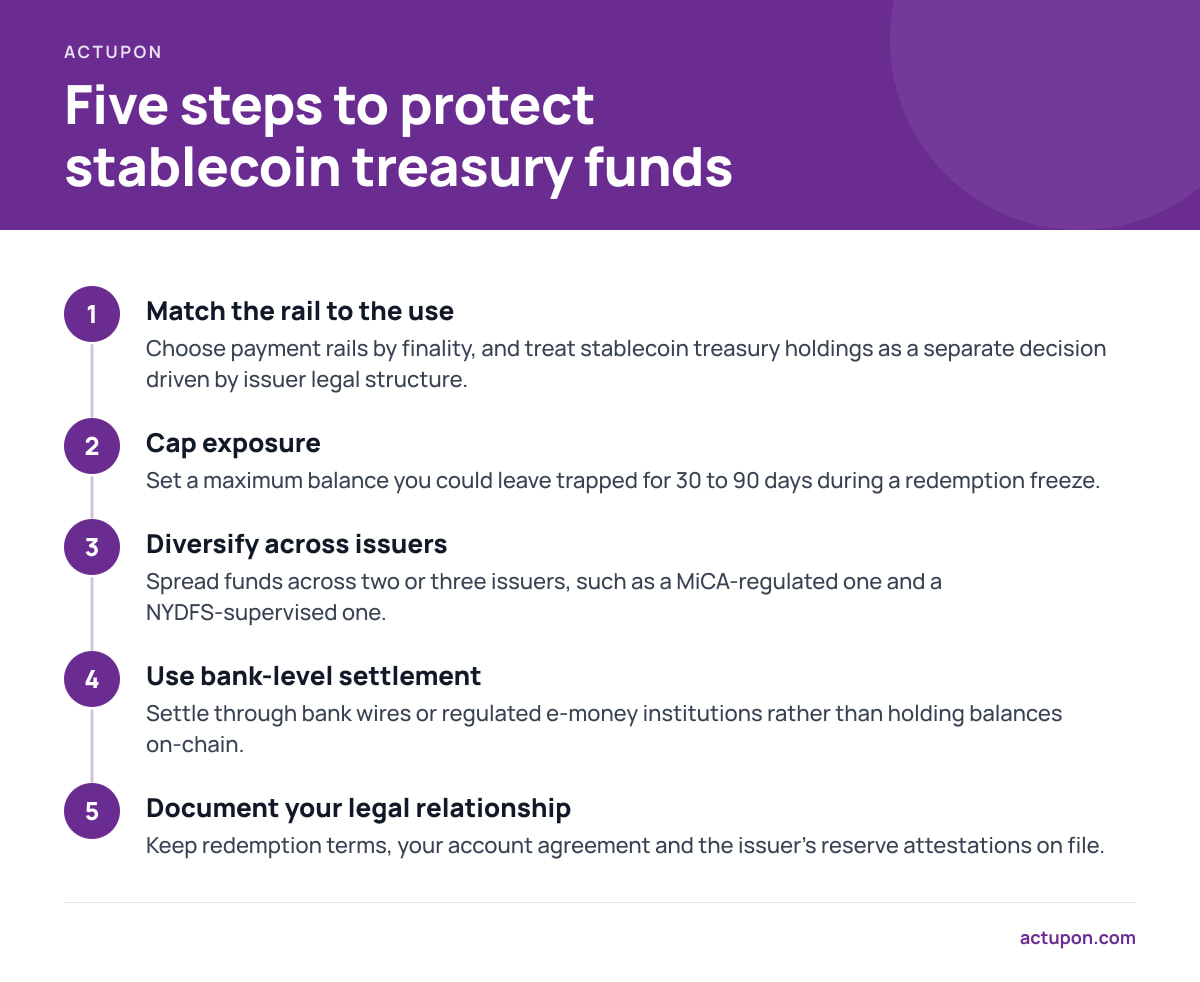
Match the Rail to the Use
If you need a stablecoin for a payment that settles in seconds across borders, the rail matters, and the issuer's legal structure is one factor among several. For the broader logic of choosing payment rails by finality rather than speed, see Business Payments: Pick Rails by Finality, Not Speed. If you are holding stablecoins as treasury, that is a different decision, and the issuer's legal structure is the dominant factor.
Cap Exposure at a Number You Can Lose
Pick a maximum balance, in dollars, that you would be willing to leave trapped for 30 to 90 days during a redemption freeze. Anything above that ceiling should leave the issuer. Treat the ceiling as if the issuer does not exist tomorrow, because one day that will be true.
Diversify Across Two or Three Issuers
Do not let a single issuer become a single point of failure for your operating cash. Spread across an EU-regulated issuer (MiCA), a NYDFS-supervised issuer, and possibly Tether for working capital only. The legal claims you stack are different, which is the point.
Use Bank-Level Settlement Where Possible
Where the transaction allows, settle through bank wires or regulated e-money institutions rather than holding balances on-chain. Stablecoins should be a transit instrument, not a treasury account.
Document Your Legal Relationship
Keep the issuer's redemption terms, your account agreement, and the issuer's reserve attestations on file. If you ever have to prove what you were owed, the file does the arguing for you.
Get a Stablecoin Strategy That Survives an Issuer Failure
If your business holds more than a small float in stablecoins, the question is no longer whether to hold them, but which ones, in which legal wrapper, against which risks, and with what ceiling. ActUpon does exactly this kind of work: hands-on crypto, payments, and treasury consulting for companies that want the answers written down and acted on, not left as a marketing claim. Engagements are scoped to your situation, and fees are tied to the deliverables you agree to up front, which means you pay for the strategy you actually need, not a stack of slides. One honest limit: consulting tells you what to do and helps you do it. It does not insure your balance. Diversification, capped exposure, and bank-level settlement do that, and they remain your call.
Frequently Asked Questions
Is USDC or USDT FDIC-insured?
No. Neither USDC nor USDT is a bank deposit. The reserves backing them are not insured by the FDIC, the SIPC, or any equivalent. Holders are creditors of the issuer, not depositors.
Can a stablecoin be frozen?
Yes. Issuers can freeze tokens at the smart contract level in response to law enforcement orders, sanctions, or theft investigations. USDC, USDT, and other major stablecoins have all been frozen in specific cases.
Did anyone lose money in the SVB/USDC event?
Holders of USDC temporarily held tokens worth less than $1. Circle could not process redemptions until the Federal Reserve's Bank Term Funding Program released its trapped SVB deposits. Holders were eventually made whole, but only because the banking system was patched, not because they had a legal claim that forced the outcome.
Are all stablecoins equally risky?
No. Algorithmic stablecoins like Terra can collapse to zero. Fiat-backed stablecoins can depeg but have historically recovered. EU MiCA-regulated issuers now have segregated reserves and a direct redemption right, which is structurally stronger than an offshore issuer's general reserves.
Should a small business hold treasury in stablecoins?
It depends on the amount, the jurisdiction, and the use case. Most businesses are safer holding operating cash in a bank account and using stablecoins only as a transit instrument for cross-border payments. Treasury-style holdings in stablecoins require active management of issuer risk, exposure ceilings, and documentation.
Sources
- Reuters coverage of the Terra/LUNA collapse and stablecoin markets | Reuters
- Circle's USDC reserve and transparency disclosures | Circle Internet Financial
- Tether transparency and reserve attestations | Tether Operations Limited
- Markets in Crypto-Assets Regulation (MiCA), Regulation (EU) 2023/1114 | EUR-Lex, Publications Office of the European Union