Business results are the measurable changes in revenue, profit, cash, customers, or cost that a company can point to after it acts. They are not effort, meetings, or deliverables. The distinction that matters: an output is something you produced, while a result is something that changed on your income statement or in your customer base. If you can't tie an action to a number that moved, you have activity, not results.
TL;DR:
- A business result is a measured change in revenue, profit, cash, or customers. A report, a launch, or a busy calendar is not.
- Most companies track what they did instead of what changed. Fix that by naming one baseline number before you start anything.
- Pick three goals: grow revenue, protect margin, and keep customers. Everything else is a supporting metric.
- Three report types cover almost everything: financial, operational, and performance. Run all three against the same targets.
- Tie any outside help to the result, not the hours. If a consultant won't, ask what they're afraid of.
Table of Contents
- Business Results vs. Business Outcomes, and Why the Difference Costs You Money
- How to Measure Business Results: Baseline, Target, Deadline
- What Are the Top 3 Goals for Your Business Success?
- What Does It Mean to Be a Results-Oriented Person?
- What Are the Three Main Types of Business Reports?
- How Do I Get My Business on Google Search Results?
- A Quick Note on "Business Result" the Textbook
- Pay for Business Results, Not Hours: How ActUpon Works
- Frequently Asked Questions
- Sources
Business Results vs. Business Outcomes, and Why the Difference Costs You Money
Search for this topic and you'll find pages that treat "results," "outcomes," and "outputs" as the same thing. They aren't, and the confusion is expensive.
- Outputs. The things you made or did: a new website, a 40-page strategy deck, 200 outbound emails, a training day.
- Outcomes. The behavior change those outputs were meant to cause: more qualified leads, shorter sales cycles, fewer cancellations.
- Results. The financial or commercial number that moved because of the outcome: revenue up 12%, gross margin up 3 points, churn down from 2.1% to 1.4% a month.
Most teams report outputs because outputs are easy to count and impossible to argue with. "We shipped the campaign" is true. "The campaign grew revenue" might not be. Boards and owners who accept the first sentence are paying for effort.
If a project can't name the number it will move before it starts, it has no result to report when it ends.
How to Measure Business Results: Baseline, Target, Deadline

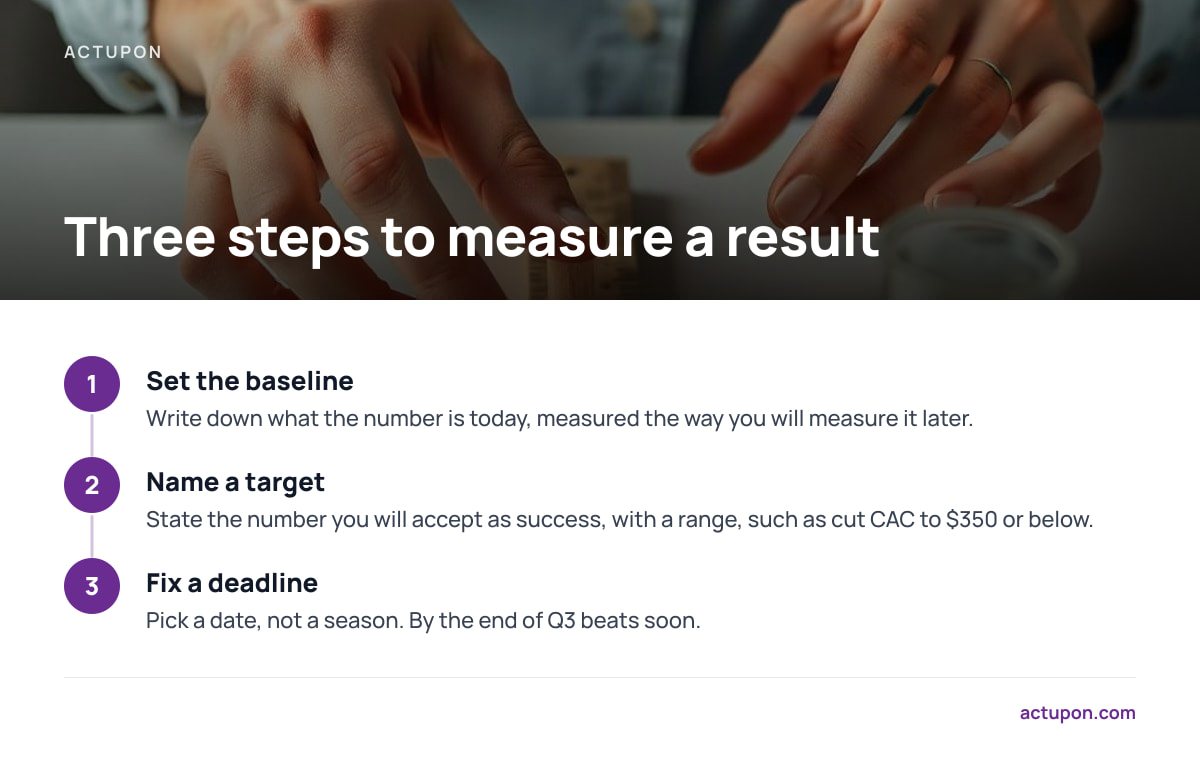
Measuring results is less complicated than the pages ranking for this term suggest. You need three things written down before any work begins.
- A baseline. What the number is today, measured the way you will measure it later. "Customer acquisition cost is $480" is a baseline. "Marketing is expensive" is a mood.
- A target. The number you will accept as success, with a range. "Cut CAC to $350 or below" works.
- A deadline. A date, not a season. "By the end of Q3" beats "soon."
Then pick a comparison you can defend. Comparing this quarter to last quarter is weak if your business is seasonal. Comparing to the same quarter last year is stronger. Comparing against a control, such as one region that got the change and one that didn't, is strongest.
The trap of the obvious metric
Revenue is the obvious result, and it's often the wrong one to judge by itself. A company can grow revenue 20% while margin shrinks, cash tightens, and the extra sales come from discounting. If you only watch the top line, you will celebrate a quarter that made you poorer. Pair every revenue figure with a margin or cash figure. EBITDA, earnings before interest, taxes, depreciation, and amortization, is a reasonable single check on whether growth is paying for itself.
What Are the Top 3 Goals for Your Business Success?

There are endless lists of goals. Here are the three I'd pick, and the reasoning.
| Goal | The number to watch | Why it earns a top-three spot |
|---|---|---|
| Grow revenue profitably | Revenue growth alongside gross margin | Growth without margin is a subsidy you pay for |
| Protect and recover cash | Cash conversion, days sales outstanding | Profitable companies still fail when cash runs out |
| Keep the customers you win | Retention or churn rate | Replacing a lost customer costs more than keeping one |
Notice what's missing: brand awareness, social following, employee satisfaction. They matter, but they're inputs. They help you hit the three above. If they don't, they're hobbies. A small local operator might swap "revenue" for "booked jobs per week." A listed company might swap "cash" for "free cash flow." The structure holds at any size.
What Does It Mean to Be a Results-Oriented Person?
A results-oriented person judges their own work by what changed, not by how hard it felt. In practice that shows up in four habits:
- They state the target first. Ask them what success looks like and you get a number and a date, not a description of effort.
- They kill their own projects. When the metric isn't moving, they stop, rather than defending the spend.
- They report bad numbers early. Hiding a miss until the quarterly review is the opposite of a results focus.
- They separate what they control from what they don't. They own the controllable inputs and name the outside factors honestly.
There's a cautionary version too. Results orientation without judgment becomes metric gaming: a sales rep who discounts to hit quota, a support team that closes tickets unresolved. The fix is to measure the result and a guardrail together, such as revenue plus margin, or tickets closed plus repeat contacts.
Pro Tip: Before you set any target, ask "how could we hit this number and still be worse off?" Whatever answer comes back, such as discounting, pulling forward next quarter's sales, or cutting service quality, is your guardrail metric. Track it next to the goal from day one. It takes five minutes and catches the most common way a good-looking result turns out to be fake.
What Are the Three Main Types of Business Reports?
The phrase gets used loosely, but three categories cover nearly everything an owner needs.
Financial reports
These show money in and out: the income statement, balance sheet, and cash flow statement. Under US GAAP and IFRS, they follow standard definitions, which is why lenders and investors trust them. The IFRS Foundation sets the international standards used in more than 140 jurisdictions. Financial reports tell you what happened. They are poor at telling you why.
Operational reports
These track how work gets done: production volumes, delivery times, defect rates, utilization, support response times. They explain the financial numbers. If margin dropped, the operational report usually shows the rework, delay, or waste behind it.
Performance reports
These compare results to targets: sales versus quota, projects versus plan, KPIs versus baseline. This is the report most companies skip, and it is the one that answers "did it work?" A performance report without a pre-agreed target is just a list of numbers.
Run all three against the same time period. When the financial report shows a margin drop, the operational report should explain it and the performance report should show whether you saw it coming.
How Do I Get My Business on Google Search Results?
This question gets asked as if visibility were a result. It's an input. Appearing in Google doesn't pay anyone until it produces leads or sales. That said, here is the short, honest answer.
- Claim your Business Profile. Google Business Profile is free and controls how you appear in local results and on Maps. Verify it, fill in every field, and keep hours accurate.
- Make sure your site can be crawled. Google's Search Central documentation explains how to submit a sitemap and check indexing through Search Console.
- Publish pages that answer a real question better than what exists. Thin pages written to catch keywords rarely hold rankings.
- Earn mentions from places that matter in your field. A handful of relevant, credible links beats hundreds of junk ones.
Then measure it like any other result: qualified leads per month from search, cost per lead, and close rate. If traffic doubles and leads don't move, you bought attention, not growth.
A Quick Note on "Business Result" the Textbook
A large share of searches for this phrase, including the PDF, audio, and edition variants, are people looking for the Oxford University Press English course series for business learners. That's a language-learning product, not a guide to company performance. If you landed here looking for course materials, use the publisher's official channels, because circulating copies of paid textbooks and audio is unreliable and often unlicensed. If you're here to improve how your company performs, keep reading.
Pay for Business Results, Not Hours: How ActUpon Works

Everything above points at one problem: most companies buy consulting by the hour and then discover they own a report instead of a result. ActUpon does it the other way around. In its performance-based model, you and ActUpon agree on a measurable business result up front, such as a revenue target, a cost reduction, or a conversion lift. Fees are tied to hitting it. The team works hands-on inside your business rather than handing over a slide deck. If you want to know whether AI belongs in the plan first, an AI readiness check is a sensible starting point, and coaching and mentorship are available if the bottleneck is leadership rather than strategy.
One honest limit: paid-on-results only works when the result can be measured cleanly and you can share the data needed to verify it. If your baseline is unreliable or you can't open your numbers to an outside party, we'll say so before taking the work, and an hourly or advisory arrangement may fit better. Pricing depends on the agreed target, so ask for terms rather than expecting a rate card.
Frequently Asked Questions
What is the difference between a business result and a business outcome?
A business outcome is the change in behavior or capability you were aiming for, such as more qualified leads or faster delivery. A business result is the financial or commercial number that moved because of it, such as revenue, margin, or cash. Outcomes explain the how; results prove the payoff.
How do I measure business results if I have no baseline?
Build one now. Pull the last 6 to 12 months of the number you care about, check how it was calculated, and note any seasonal swings. A rough baseline measured consistently beats a precise one measured differently each time.
Which single metric best shows business results?
No single metric is safe on its own. Revenue hides margin problems, and profit can hide cash problems. If you must pick one, pick a profitability measure like EBITDA or operating margin, and pair it with a customer retention figure.
How long does it take to see business results from a change?
It depends on the cycle of the thing you're changing. Pricing or cost changes can show up within one billing cycle, while sales process or marketing changes often need one to two full sales cycles. Set the deadline based on how long your customers take to buy, not on how impatient you are.
Are Oxford's Business Result books about company performance?
No. Those are English-language course materials for business learners, published by Oxford University Press. They cover communication skills for the workplace and don't teach you how to measure or improve company results.
Sources
- IFRS Standards overview | IFRS Foundation
- Google Search Central documentation | Google
- Google Business Profile | Google
- Financial Accounting Standards Board | FASB