Deep learning consulting is paid expert help designing, training, and deploying neural-network systems for problems like image recognition, speech, and language. The distinction that matters is between a consultant who ships a model that moves a business metric and one who hands you an impressive prototype. Most companies should confirm that simpler methods fail first. Judge any engagement by the result, not the architecture.
TL;DR:
- Deep learning is the right tool for images, audio, and language. For ordinary spreadsheet-style business data, simpler models often win and cost far less.
- A real engagement covers problem framing, data work, modeling, deployment, and monitoring. The model is the smallest part of the bill.
- Hourly billing rewards slow work. Tie fees to a business metric you can measure, not to model accuracy.
- AI consultant pay runs from six-figure salaries to four-figure day rates. Those numbers show what you should expect to pay and what you should demand in return.
- Vet a consultant by asking what they would do if deep learning is the wrong answer. A good one has a ready reply.
Table of Contents
- Deep Learning Consulting Explained: Where It Fits and Where It Doesn't
- What a Deep Learning Consultant Actually Delivers, Phase by Phase
- Deep Learning vs. Simpler Models: A Decision Table
- How Deep Learning Consulting Is Priced, and Why Hourly Rewards the Wrong Thing
- How Much AI Consultants Get Paid, and What That Means for Your Budget
- Who the "Big 5" Consultants Are, and When a Boutique Wins
- How to Vet a Deep Learning Consultant, From "Near Me" Searches to Hard Questions
- Is ML a Good Career? Becoming a Consultant, and Who Runs DeepLearning.AI
- Get Deep Learning Help Where You Only Pay When the Number Moves
- Frequently Asked Questions
- Sources
Deep Learning Consulting Explained: Where It Fits and Where It Doesn't
Deep learning is a subset of machine learning that uses multilayer neural networks. It is the technology behind modern image recognition, speech transcription, and large language models. A deep learning consultant helps you decide whether to use it, builds or adapts the system, and gets it running in production.
Here is the contrarian part. Most business problems are not image, audio, or language problems. They are spreadsheet problems: churn, pricing, demand forecasting, lead scoring. On that kind of tabular data, a 2022 NeurIPS study by Grinsztajn and colleagues found that tree-based models still outperformed deep learning on typical tabular datasets. If a consultant pitches a neural network for your churn model before looking at your data, they are selling a tool, not solving a problem.
That is why the first deliverable of good deep learning consulting is often a recommendation against deep learning. If you want the wider picture of how this differs from general ML work, our guide to machine learning consulting costs and hiring covers it.
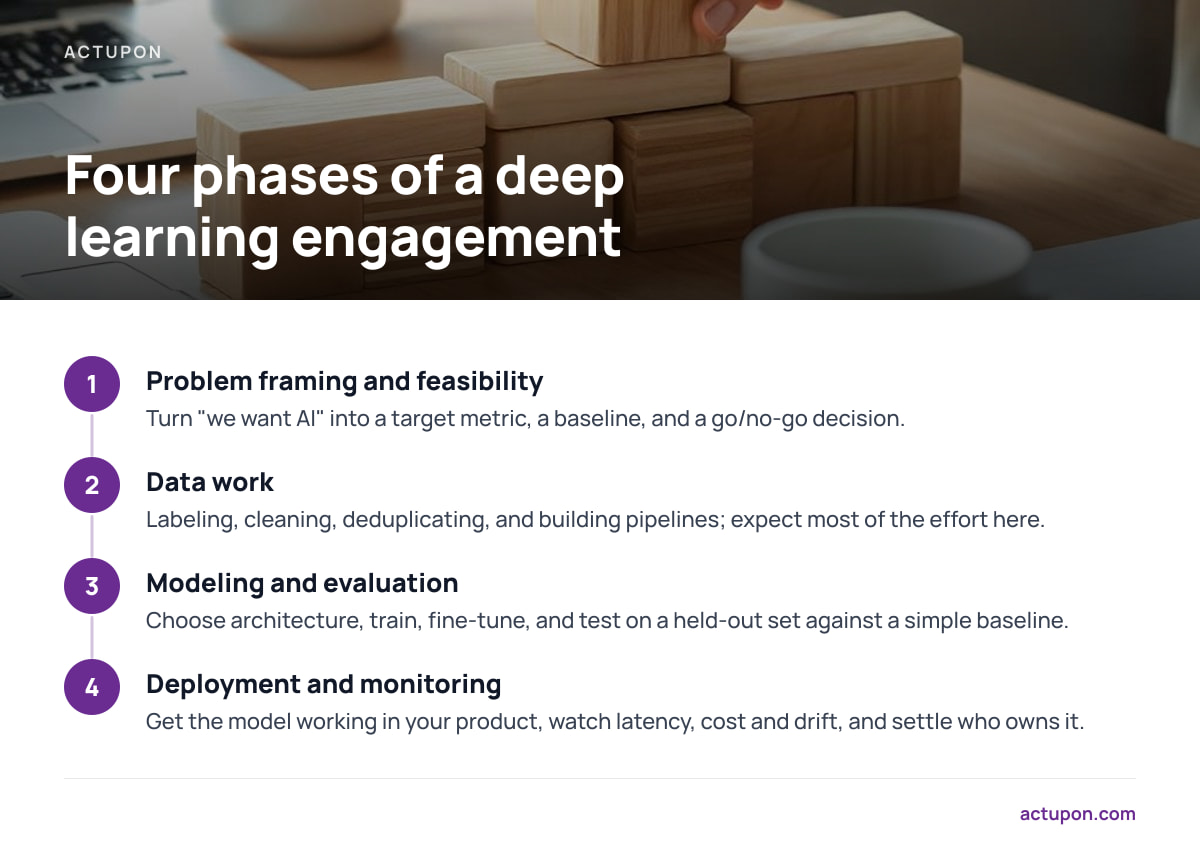
What a Deep Learning Consultant Actually Delivers, Phase by Phase

The work breaks into stages, and the stages are not equal in cost or risk.
Problem framing and feasibility
This is where a consultant converts "we want AI" into "we want to cut manual invoice review time by 40%." You should leave this phase with a target metric, a baseline, and a go/no-go decision. Skip it and everything downstream is guesswork.
Data work
Expect most of the effort here. Labeling, cleaning, deduplicating, and building pipelines routinely outweigh the modeling itself. Label quality. Noisy labels cap model accuracy no matter how large the network is. Data volume. Deep models usually need more examples than classical ones, though fine-tuning a pretrained model can cut that need sharply.
Modeling and evaluation
This covers architecture choice, training, fine-tuning, and testing against a held-out set that mirrors real conditions. Insist on comparison against a simple baseline. If the neural net beats logistic regression by half a point, you have bought complexity for nothing.
Deployment and monitoring
A model that works in a notebook but not in your product has produced zero value. Latency and cost. Inference costs on GPUs add up quickly at scale. Drift. Real-world data shifts, and accuracy decays without monitoring. Ask who owns the model after the consultant leaves.
Most of a deep learning project's cost sits in data and deployment, not in the model itself.
Deep Learning vs. Simpler Models: A Decision Table
Use this before you sign anything.
| Your problem | Likely best approach | Why |
|---|---|---|
| Churn, pricing, lead scoring on tabular data | Gradient-boosted trees or regression | Cheaper, faster, easier to explain |
| Reading documents, invoices, contracts | Pretrained language or vision models | Unstructured data suits deep learning |
| Defect detection from photos or video | Deep learning (computer vision) | Pixels are what neural nets handle best |
| Call transcription, voice interfaces | Pretrained speech models | Building from scratch rarely pays |
| Demand forecasting with limited history | Statistical or classical ML first | Small data punishes big models |
Our pick: start with the cheapest approach that could plausibly work, and escalate only when a measured baseline fails. For a broader view of the consultant landscape, see our piece on data and AI consultants and when you need one.
How Deep Learning Consulting Is Priced, and Why Hourly Rewards the Wrong Thing

There are four common models, and they push the consultant's incentives in different directions.
| Fee model | How it works | Incentive it creates |
|---|---|---|
| Hourly or day rate | You pay for time | Slower, broader work |
| Fixed project fee | Set price for a defined scope | Cutting corners to protect margin |
| Monthly retainer | Ongoing access | Staying busy, not finishing |
| Performance-based | Fees tied to agreed, measurable results | Hitting the number you care about |
Hourly billing is the default, and it is the weakest fit for deep learning. Research is uncertain, so hours balloon, and nobody on the other side of the table is paid to stop.
Performance-based pricing fixes this, with one condition: the metric must be a business result, not a model score. "95% accuracy" is not a result. "Chargebacks down 20% over two quarters" is. A model can score beautifully and change nothing.
Pro Tip: Before agreeing to any results-based fee, write down the baseline and the measurement method in the contract, including who owns the data used to measure. Most disputes over outcome-based pay are arguments about the baseline, not the result.
How Much AI Consultants Get Paid, and What That Means for Your Budget
You asked how much AI consultants get paid, so here is the honest range. The U.S. Bureau of Labor Statistics reports six-figure median annual pay for both management analysts and computer and information research scientists, the two closest official categories to an AI consultant. The research-scientist category pays notably more.
Independents are a different story. Day rates we see quoted for senior deep learning specialists commonly run from roughly $1,000 to well over $4,000, depending on specialty, track record, and whether the work is advisory or hands-on. That range is a market impression, not an official statistic, so treat it as a rough guide.
What this means for you:
- A cheap quote is a warning. Real deep learning skill is scarce and priced accordingly.
- A high rate is not proof of quality. Pay for evidence: shipped systems you can verify.
- Rate matters less than duration. A $3,000 day rate for four days beats a $150-an-hour engagement that drifts for six months.
If you are weighing firms rather than individuals, our breakdown of what you're really paying for with AI consulting companies goes deeper.
Who the "Big 5" Consultants Are, and When a Boutique Wins
The phrase "Big 5" originally meant the five largest accounting and consulting networks. It became the Big Four after Arthur Andersen collapsed in 2002 following the Enron scandal. Today people use it loosely to mean the global accounting-and-advisory giants, sometimes alongside the three big strategy houses.
For deep learning work, we would not default to them. Large firms are strong on governance, change management, and enterprise-wide programs. Hands-on model building at mid-market scale is rarely where their margin is, and your project may be staffed by whoever is available. A specialist boutique or an independent usually puts senior people on the actual work. Pick a giant if you need organization-wide rollout and regulatory sign-off. Pick a boutique if you need a working system.
How to Vet a Deep Learning Consultant, From "Near Me" Searches to Hard Questions
Searching "AI consulting near me" is fine for meetings, but proximity matters far less than proof. Deep learning work is almost always done remotely.
Ask these questions:
- "What would you do if deep learning is wrong for this?" A good answer names a simpler alternative.
- "What was the baseline on your last project, and what moved?" Vague answers mean vague results.
- "Who owns the model, code, and data pipelines at the end?" The answer should be you.
- "How do you handle risk and compliance?" Look for familiarity with the NIST AI Risk Management Framework, and if you operate in Europe, the EU AI Act, which sets risk-based obligations for AI systems.
If you are earlier in the journey, an AI consulting firm guide will help you decide what to buy first.
Is ML a Good Career? Becoming a Consultant, and Who Runs DeepLearning.AI
Yes, with caveats. BLS projects employment for computer and information research scientists to grow much faster than average, and demand for people who can ship models is real. The caveat is that entry-level roles are competitive, and the pure "train a model" skill is being commoditized by pretrained models. Durable value sits in two places: data engineering and deployment, and the ability to connect a model to a business outcome.
To become a machine learning consultant, the path most people take is:
- Build depth first. Two to five years in applied ML or data engineering, shipping real systems.
- Specialize. Pick vision, language, or a vertical like logistics or finance.
- Collect proof. Case studies with measured outcomes beat certificates.
- Learn to sell and scope. Consulting fails more often on scoping than on technique.
As for the question people ask about DeepLearning.AI: Andrew Ng founded it and remains its best-known leader. Executive titles change, so check the company's own site for the current one rather than trusting a stale search snippet.
Get Deep Learning Help Where You Only Pay When the Number Moves

Everything above points to one problem: buyers pay for effort and get activity. ActUpon works the other way. Our performance-based consulting ties fees to agreed, measurable business results, and we start with an AI readiness check that tells you whether you need deep learning, a simpler model, or neither. You get hands-on help rather than a long report, and you know the target metric before any money is committed.
We don't publish a flat price, because fees depend on the result we agree to chase. Here is the caveat: outcome-based pricing only works when the result can be measured cleanly. If your goal is vague, or your data cannot show a baseline, we will tell you so, and we may propose a fixed-scope readiness engagement first. Check any proposal, ours included, for how the metric is defined and who verifies it.
Frequently Asked Questions
What does a deep learning consultant do?
A deep learning consultant frames the business problem, assesses your data, builds or fine-tunes neural-network models, and deploys them into production with monitoring. A good one also tells you when a simpler model is the better choice. The goal is a measurable business outcome, not a model for its own sake.
Who is the CEO of DeepLearning.AI?
Andrew Ng founded DeepLearning.AI and is the person most associated with its leadership. Executive titles can change, so check the company's official website for the current one. Treat any third-party listing with caution.
How much do AI consultants get paid?
U.S. Bureau of Labor Statistics data shows six-figure median annual pay for the closest official categories, management analysts and computer and information research scientists. Independent specialists often quote day rates from about $1,000 to over $4,000, depending on skill and scope. Those day rates are market estimates, not official figures.
Who are the big 5 consultants?
The "Big 5" was originally the five largest accounting and consulting networks. It became the Big Four after Arthur Andersen collapsed in 2002. Today the phrase is used loosely for the global advisory giants, and for deep learning projects a specialist boutique often delivers more hands-on work.
Is ML a good career?
Yes, demand is strong and the U.S. Bureau of Labor Statistics projects much faster than average growth for research scientists in this field. The risk is that basic model training is being commoditized by pretrained models. Skills in data engineering, deployment, and tying models to business results hold their value longest.
How do I become a machine learning consultant?
Build two to five years of applied experience shipping real systems, then specialize in a domain such as vision, language, or a specific industry. Document case studies with measured outcomes, since they carry more weight than certificates. Finally, learn to scope and price work, because most consulting failures start with a poorly defined project.
Sources
- Why do tree-based models still outperform deep learning on typical tabular data? | Grinsztajn, Oyallon, Varoquaux (NeurIPS 2022)
- Management Analysts, Occupational Outlook Handbook | U.S. Bureau of Labor Statistics
- Computer and Information Research Scientists, Occupational Outlook Handbook | U.S. Bureau of Labor Statistics
- AI Risk Management Framework | National Institute of Standards and Technology (NIST)
- European approach to artificial intelligence (AI Act) | European Commission
- DeepLearning.AI | DeepLearning.AI