A data and AI consultant fixes how your business collects, cleans and uses its data. Then they apply AI, such as forecasting, automation or generative tools, where it actually pays off. Most companies that hire one think they are buying AI. Most of the work, and most of the failures, sit in the data. Hire for the data problem first, and the AI part gets cheaper and far more likely to ship.
TL;DR:
- A data and AI consultant spends most of a typical small-business engagement on data plumbing (sources, cleanup, definitions) and a minority on the AI itself.
- Gartner predicted at least 30% of generative AI projects would be abandoned after proof of concept by the end of 2025, with poor data quality a leading cause.
- If you cannot pull a clean customer and revenue list in under an hour, you need data work before you need an AI model.
- The pay is high. U.S. government figures put median pay for both management analysts and data scientists around or above $100,000 a year.
- No single license exists for AI consultants. ISO/IEC 42001, the NIST AI RMF and the IAPP's AIGP are the credentials and frameworks worth knowing.
Table of Contents
- What a Data and AI Consultant Actually Does, and Why the Data Comes First
- Data Consultant vs. AI Consultant: Which One Your Problem Actually Needs
- The One-Hour Test That Tells You Whether You're Ready for AI
- What a Good Engagement Looks Like, and the Red Flags to Walk Away From
- Is a Data and AI Consultant a High-Paying Job?
- Certifications for AI Implementation: Which Ones Actually Mean Something
- How to Become an AI Consultant With No Experience: The Path That Works
- Get AI Work You Pay For Only When It Moves Your Numbers
- Frequently Asked Questions
- Sources
What a Data and AI Consultant Actually Does, and Why the Data Comes First

AI consulting means advising a business on where artificial intelligence can cut costs, raise revenue or reduce risk, and then helping it get there. In practice that covers choosing tools, connecting them to your systems, and changing how people work. A pure AI consultant focuses on models and use cases. A data and AI consultant also owns the unglamorous layer underneath: where your data lives, whether it can be trusted, and who is allowed to use it.
That second layer is where projects live or die. An AI system only knows what your data tells it. Suppose your CRM has three spellings of the same customer, your invoicing tool disagrees with your bank feed, and nobody agrees on what counts as an "active" client. In that situation, any AI built on top will produce confident, polished nonsense.
Gartner predicted that at least 30% of generative AI projects will be abandoned after proof of concept by the end of 2025, citing poor data quality, inadequate risk controls, escalating costs or unclear business value.
That prediction comes from a Gartner press release from July 2024. Data quality sits first on its list of causes. A consultant who skips straight to the demo is betting your budget against those odds.
What AI Data Specialists Do Day to Day
AI data specialists, the people doing the hands-on data half of the job, spend their time on a predictable set of tasks:
- Mapping sources. They list every system holding business data (CRM, accounting, e-commerce, spreadsheets, email inboxes) and record what each one is trusted for.
- Cleaning and deduplicating. They merge duplicate records, standardize formats and fix the fields that feed decisions, such as dates, currencies and customer IDs.
- Defining metrics. They write down exactly what "revenue," "churn" or "qualified lead" means, so that a dashboard and an AI model are counting the same thing.
- Building pipelines. They automate the flow of data from source systems into one place, so reports stop depending on someone's Friday-afternoon export.
- Setting access and governance. They decide who can see customer data, what gets sent to third-party AI tools, and what must never leave the building.
Only after those steps does the AI work start: picking a use case, testing a model or tool, and measuring whether it beats the old way.
Data Consultant vs. AI Consultant: Which One Your Problem Actually Needs
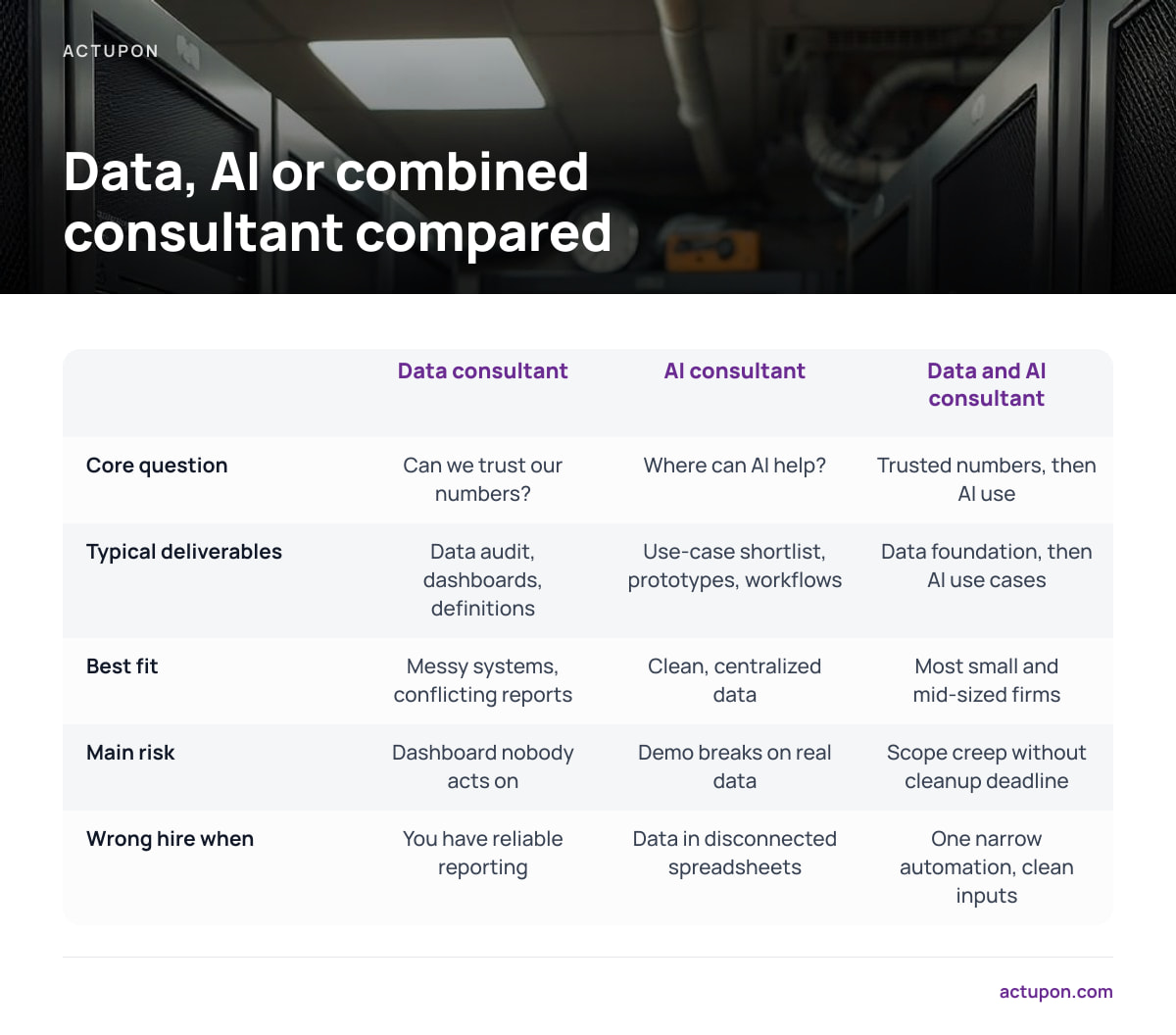
Business owners often hire the wrong specialist because the job titles blur together. The table below separates them by what they deliver.
| Data consultant | AI consultant | Data and AI consultant | |
|---|---|---|---|
| Core question | Can we trust our numbers? | Where can AI help? | Can we trust our numbers, and what should AI do with them? |
| Typical deliverables | Data audit, cleaned database, dashboards, metric definitions | Use-case shortlist, tool selection, prototypes, automation workflows | Both, in sequence: data foundation first, then one or two AI use cases in production |
| Best fit | Messy systems and conflicting reports | Clean, centralized data and a clear target process | Most small and mid-sized firms, whose data is "fine" until someone tests it |
| Main risk | Ends at a dashboard nobody acts on | Ships a demo that breaks on real data | Scope creep if the data cleanup has no deadline |
| When it's the wrong hire | You already have reliable reporting | Your data lives in five disconnected spreadsheets | You need one narrow automation and your inputs are already clean |
Our position is that most companies under a few hundred employees should hire the combined role, with a hard rule that data work gets a fixed budget and deadline. A pure AI consultant is the right call only when your data is already centralized and someone internal owns its quality. That is rarer than people assume. For more on scoping the strategy side, see our breakdown of AI strategy consulting and what to skip.
The One-Hour Test That Tells You Whether You're Ready for AI

Before you sign anything, run this test yourself. Ask someone on your team to produce one file within an hour. It should list every customer from the last 12 months, with total revenue per customer, first purchase date and current status.
Watch what happens. If the file arrives on time and the total matches your accounting system within a percent or two, your data is in workable shape. You can reasonably hire for AI use cases. If it takes a day, or needs three people and a phone call to the bookkeeper, or the totals disagree, you have a data problem. No AI tool will paper over it.
If you can't produce a clean customer list in an hour, you don't have an AI problem yet. You have a data problem wearing an AI costume.
Pro Tip: Give the same test to any consultant you are considering, and ask them how they would fix whatever broke. A strong data and AI consultant will ask about your source systems and metric definitions before mentioning a single AI tool. If the first answer is a chatbot or a named software platform, they are selling a product, not solving your problem.
What a Good Engagement Looks Like, and the Red Flags to Walk Away From

A well-run data and AI engagement for a small or mid-sized business has a recognizable shape. Lengths vary, but the order should not.
Phase 1: Audit and Baseline
The consultant maps your data sources, runs a version of the one-hour test, and agrees with you on one or two business numbers to move. Examples include quote turnaround time, cost per support ticket, or forecast accuracy. Without a baseline number recorded at this stage, nobody can prove the project worked.
Phase 2: Fix the Foundation
Duplicates get merged, definitions get written down, and the key data flows get automated. This phase should have a fixed scope. "Clean all the data" never ends. "Make customer, order and invoice data reconcile" does.
Phase 3: One AI Use Case, Into Production
One use case gets picked, tested against the baseline, and put into daily use. Good candidates include automated invoice matching, demand forecasting, lead scoring or drafting first-response emails. It has to be in production, not sitting as a prototype in a slide.
Red Flags
- A roadmap with no numbers. A 40-page AI strategy that never names a metric is a report, not a result.
- Tool-first recommendations. If the consultant resells or earns commission on the platform they recommend, their advice is not neutral.
- No data phase at all. Skipping straight to AI on unexamined data is how projects end up in Gartner's abandoned 30%.
- Hourly billing with no endpoint. Open-ended hours reward slow work. Ask for fixed scope or fees tied to outcomes.
If you are comparing several providers, our guide to choosing among AI consulting firms covers pricing models and selection criteria in more depth.
Is a Data and AI Consultant a High-Paying Job?
Yes. Consulting is a high-paying field, and data and AI consulting sits near the top of it. The U.S. Bureau of Labor Statistics groups most business consultants under management analysts. BLS figures for management analysts show a median annual pay of roughly $100,000, well above the median for all occupations.
The technical side pays similarly or better. BLS data on data scientists also puts median pay above $100,000 a year. The agency lists data science among the fastest-growing occupations in the country. A consultant who combines both skill sets, business diagnosis and hands-on data work, can usually command the upper end of either range.
A few honest caveats apply to anyone eyeing these salaries:
- Medians hide a wide spread. Junior analysts at large firms earn far less than the median. Independent consultants with a track record can earn far more. Some independents also earn nothing in a slow quarter.
- Independent rates are not salary. An hourly consulting rate has to cover unbilled time, sales, software, insurance and gaps between clients. Half your working hours may not be billable.
- The premium follows results. Consultants who can point to a measured outcome, such as "cut invoice processing time by half," charge more than those who can only list tools they know.
Certifications for AI Implementation: Which Ones Actually Mean Something
There is no single license required to call yourself an AI consultant, and no regulator controls the title. There are, however, recognized certifications and frameworks for AI implementation and governance. Knowing them helps both buyers and aspiring consultants separate real expertise from a weekend course.
- ISO/IEC 42001. Published by the International Organization for Standardization in 2023, ISO/IEC 42001 is the first international standard for AI management systems. Organizations can be certified against it. Individuals can take lead implementer or lead auditor training from accredited training providers. It is the closest thing to a formal "AI implementation" certification.
- NIST AI Risk Management Framework. The NIST AI RMF is a voluntary U.S. framework organized around four functions: Govern, Map, Measure and Manage. It is not a certification. However, a consultant who can apply it to your business is speaking a language auditors and enterprise customers recognize.
- IAPP AI Governance Professional (AIGP). The AIGP credential from the IAPP covers AI governance, risk and regulation. It suits consultants who handle compliance-heavy clients.
- Cloud provider AI certifications. The major cloud platforms each run AI and machine learning certifications. They prove someone can build on that specific platform. They do not prove someone can diagnose a business problem.
For a buyer, the honest ranking is simple. A verifiable past result beats any certificate. If two candidates both have results, the one fluent in ISO/IEC 42001 or the NIST AI RMF is the safer bet for anything touching customer data.
How to Become an AI Consultant With No Experience: The Path That Works
Courses and certificates help, but clients pay for proof. If you are starting from zero, the fastest credible route looks like this:
- Learn the data basics first. Learn SQL, spreadsheet modeling and how to reconcile two systems that disagree. Most AI consulting work is this, and most aspiring AI consultants skip it.
- Pick one industry you already know. A former restaurant manager who understands food costs will beat a generalist when pitching to restaurants. Domain knowledge is the edge that tutorials cannot copy.
- Do one project for free or cheap, with a measured outcome. Automate a real workflow for a real small business. Record the time or cost before and after. One documented result is worth more than ten certificates.
- Add a governance credential once you have clients. AIGP or ISO/IEC 42001 training makes sense once you are handling client data. Before that, it is credential collecting.
- Search the right job titles. Data and AI consultant jobs often appear under "analytics consultant," "AI solutions consultant," "data strategy consultant" or "automation consultant." Agencies that sell AI automation are a common entry point. Many of them hire junior staff to build workflows.
The mistake to avoid is marketing yourself as an "AI strategist" before you have shipped anything. The market is crowded with people who can describe AI. It is short of people who can make a messy business's data usable.
Get AI Work You Pay For Only When It Moves Your Numbers
The core problem this article describes is AI projects stalling on bad data and open-ended billing. ActUpon tackles it from both ends. Our AI readiness check runs the data audit first, including the one-hour test, and tells you plainly whether you need data cleanup, an AI use case, or neither yet. From there, our AI consulting can run on a performance basis. Fees are tied to an agreed, measurable business result, such as processing time, cost per transaction or revenue, rather than hours logged.
The honest limit: paid-on-results only works when there is a number to measure. If your data cannot yet produce a reliable baseline, that cleanup comes first, and it is scoped and priced as its own piece of work. Pricing depends on the outcome agreed, so there is no list price here. Ask ActUpon to put the target metric and the fee in writing before any work starts, and hold every consultant, including us, to that standard.
Frequently Asked Questions
What is the difference between a data consultant and an AI consultant?
A data consultant makes your business data accurate, connected and usable, typically through audits, cleanup, pipelines and dashboards. An AI consultant identifies and builds AI use cases such as forecasting, automation or generative tools. A data and AI consultant does both in sequence, which suits most small and mid-sized firms whose data needs work before AI can run on it.
Where do I find data and AI consultant jobs?
These roles are often listed as analytics consultant, AI solutions consultant, data strategy consultant or automation consultant, not only as "data and AI consultant." Consulting firms, AI automation agencies and the internal analytics teams of mid-sized companies are the most common employers. Searching all of those titles widens the pool considerably.
Can I become an AI consultant with no experience?
Yes, but clients pay for proof rather than certificates. Learn core data skills such as SQL and spreadsheet modeling, pick an industry you already understand, and complete one real project with a measured before-and-after result. That documented outcome will open more doors than any course.
How long does a data and AI consulting engagement take?
It depends on how messy your data is and how narrow the goal is. A focused engagement typically runs through three phases: audit and baseline, foundation fixes, and one AI use case put into production. Insist on a fixed scope for the data cleanup phase, because open-ended cleanup is where timelines quietly balloon.
What is an AI automation consultancy?
An AI automation consultancy focuses on using AI to automate specific workflows, such as invoice processing, email triage, lead routing or report generation. It is narrower than general AI strategy work and usually more measurable, because you can compare the time or cost of the task before and after. It still depends on clean input data to work reliably.
Sources
- Gartner Predicts 30% of Generative AI Projects Will Be Abandoned After Proof of Concept By End of 2025 | Gartner
- Management Analysts: Occupational Outlook Handbook | U.S. Bureau of Labor Statistics
- Data Scientists: Occupational Outlook Handbook | U.S. Bureau of Labor Statistics
- ISO/IEC 42001:2023 Artificial intelligence — Management system | International Organization for Standardization
- AI Risk Management Framework | National Institute of Standards and Technology
- Artificial Intelligence Governance Professional (AIGP) | IAPP