An enterprise blockchain consultant helps a company decide whether a shared ledger solves a real business problem. If it does, they design, govern and ship it. The distinction that matters is that a good one answers "should we?" before "how do we?" Most enterprise use cases fail that first question, because a well-run database shared through an API usually does the same job for less money.
TL;DR:
- A good enterprise blockchain consultant spends the first weeks testing whether you need a blockchain at all, and is willing to say no.
- Blockchain earns its cost only when several organizations that don't fully trust each other need to share one record. One owner plus trusted users means a database wins.
- Failed projects like ASX's abandoned CHESS replacement and Maersk's shut-down TradeLens failed on governance and adoption, not on cryptography.
- Regulation now shapes design. MiCA, the FATF travel rule and EU data protection guidance all change what you can put on-chain.
- Pay a fixed fee for the feasibility verdict, and tie build-phase fees to measurable results rather than open-ended hours.
Table of Contents
- What an Enterprise Blockchain Consultant Actually Does, and What They Shouldn't
- The First Question: Do You Need a Blockchain at All?
- Where Enterprise Blockchain Has Failed, and Why the Lessons Are About People
- Permissioned or Public: The Architecture Call Your Consultant Should Defend
- Regulation and Data Law: The Part Weak Consultants Skim
- How to Vet an Enterprise Blockchain Consultant: Questions and Red Flags
- How to Pay: Hourly, Fixed Scope or Results
- Get a Straight Yes or No on Blockchain Before You Fund a Build
- Frequently Asked Questions
- Sources
What an Enterprise Blockchain Consultant Actually Does, and What They Shouldn't
An enterprise blockchain consultant is hired to answer a business question. The technology question comes second. The work splits into four stages, and you should know which ones you're buying:
- Feasibility. Is there a multi-party data problem that a shared ledger solves better than a database, an API, or a contract? This should take weeks, not months.
- Architecture. Public or permissioned chain, which consensus model, what goes on-chain versus off-chain, and how the system connects to your ERP, payments and identity systems.
- Governance design. Who runs nodes, who can join, who can change the rules, and who pays for upkeep. This is where most enterprise projects quietly die.
- Delivery and handover. Building, testing, security review and training your team so you aren't renting the consultant forever.
Some things should not be on the invoice. Token launches dressed up as "strategy" don't belong there. Neither does vendor selection where the consultant earns a referral fee from the platform they recommend. A 90-page report that never commits to a yes or no is the third thing to refuse.
If you're comparing advisers across disciplines, the same selection logic applies as in choosing a business growth consulting firm. You are buying a decision and a result, not deliverables by the pound.
The First Question: Do You Need a Blockchain at All?

Blockchain's one real advantage is this. It gives several organizations a shared record that none of them controls alone, and nobody can quietly rewrite it. If you don't have that problem, you're paying for redundancy, slower writes and harder upgrades for no benefit.
The U.S. National Institute of Standards and Technology's Blockchain Technology Overview (NISTIR 8202) walks through the questions to ask before choosing one:
- Do you need a shared, consistent data store?
- Does more than one entity contribute data?
- Do those entities trust each other?
- Does the record need to be tamper-evident?
Answer those honestly and most internal use cases fall out immediately.
| Your situation | What usually wins | Why |
|---|---|---|
| One company owns the data, others just read it | Database plus API | Faster, cheaper, easy to correct mistakes |
| A few partners who already trust a central operator | Shared database run by that operator | Trust already exists, so you don't need to engineer it |
| Many parties, no neutral operator, disputes over records | Permissioned blockchain | Shared control and an audit trail are the actual product |
| Open participation, value transfer, no gatekeeper wanted | Public blockchain | Anyone can verify and transact without permission |
| You need to delete or edit personal records routinely | Database (or off-chain storage with on-chain proofs) | Immutability fights data protection law |
If one organization controls the data and everyone trusts it, a database beats a blockchain on cost, speed and simplicity. Every time.
An enterprise blockchain consultant who can't explain, in one sentence, why your use case sits in the bottom half of that table hasn't earned the architecture phase.
Where Enterprise Blockchain Has Failed, and Why the Lessons Are About People
The most expensive enterprise blockchain failures weren't caused by bad cryptography. They were caused by governance, scope and adoption problems that a sharp consultant should flag in week one.
The Australian Securities Exchange. ASX spent years building a distributed-ledger replacement for CHESS, its clearing and settlement system. In November 2022, after an independent review, ASX paused the project and announced a large pre-tax write-off. The review found the solution design wasn't fit for purpose. The lesson is that ambitious scope plus a hard-to-change architecture plus many dependent market participants makes for slow, costly course correction.
A$245 million to A$255 million. That is the pre-tax write-off range ASX announced when it stepped back from its blockchain-based CHESS replacement in 2022.
Maersk's TradeLens. The shipping giant launched TradeLens as a blockchain platform for global trade documentation. It announced in late 2022 that it would shut the platform down. Maersk said the full global industry collaboration the platform needed had not been achieved. Competitors were reluctant to join a network so closely tied to one large rival. That is a governance failure, not a technical one.
The pattern is consistent. A blockchain is only as useful as the number of independent parties who actually run nodes and write data to it. If your consultant's plan doesn't name those parties, explain why they'll join, and say who pays for the network, you are looking at a database with extra steps.
Permissioned or Public: The Architecture Call Your Consultant Should Defend
Most enterprise projects land on a permissioned chain, where known participants are vetted before they can join. Open-source frameworks hosted under the Linux Foundation's LF Decentralized Trust umbrella are common choices here. Public chains suit cases where open participation or settlement in digital assets is the point.
A good consultant will push you to decide on these trade-offs explicitly:
- Privacy versus verifiability. Permissioned networks keep data among members. Public chains make data visible to anyone unless you add privacy layers, which adds complexity.
- Control versus credibility. If one company controls who joins a permissioned network, partners may treat it as that company's system. That's exactly what hurt TradeLens.
- Upgrade speed. Permissioned networks can change rules by agreement among members. Public chains move on their own schedule, and you inherit it.
- Standards. ISO's technical committee TC 307 develops international standards for blockchain and distributed ledger technologies, including the ISO 22739 vocabulary standard. Ask whether the design references these standards. It's a quick signal of whether the consultant works to shared definitions or invents their own.
My position: start permissioned unless you have a specific reason to need public settlement or open access. Make that reason concrete, such as accepting bitcoin payments from customers. "Decentralization" in the abstract isn't a reason.
Regulation and Data Law: The Part Weak Consultants Skim
Compliance now shapes architecture, especially if your project touches digital assets or personal data. A competent enterprise blockchain consultant should raise these without being asked.
Crypto-asset rules in the EU
The EU's Markets in Crypto-Assets Regulation (MiCA) applied to stablecoin issuers from June 30, 2024, and fully from December 30, 2024. If your project issues tokens or provides crypto-asset services to EU customers, ESMA's MiCA guidance is required reading. Whether a token counts as a crypto-asset under MiCA can change your whole business model.
Anti-money-laundering and the travel rule
The Financial Action Task Force extended its "travel rule" (Recommendation 16) to virtual asset service providers in 2019. Under this rule, originator and beneficiary information has to travel with qualifying transfers. Countries implement it differently, so check the rules in each jurisdiction you operate in.
Personal data on an immutable ledger
Data protection law gives people the right to have personal data corrected or erased. A blockchain is designed to make that hard. The European Data Protection Board's 2025 guidelines on processing personal data through blockchain technologies advise organizations to avoid storing personal data directly on-chain. The usual design answer is to keep personal data off-chain and anchor only hashes or proofs on the ledger. If a consultant proposes writing customer records straight onto a chain, end the meeting.
How to Vet an Enterprise Blockchain Consultant: Questions and Red Flags

You can screen out most weak candidates in one conversation. Ask these questions and listen for specifics.
"Tell me about a client you talked out of using blockchain."
A credible consultant has several of these stories. If every past engagement ended in a build, they're selling builds.
"Who are the other node operators, and why would they join?"
Expect named partner types, a plan for incentives, and a view on who governs the network. Vague answers about "the ecosystem" are a red flag.
"Do you receive fees or referral payments from any platform you recommend?"
You want a plain no, or full disclosure. Independence matters more here than in most fields, because platform choice locks you in for years.
"What does the same system cost as a conventional database?"
If they can't price the non-blockchain baseline, they can't show you the premium you're paying for decentralization.
Pro Tip: Before the architecture phase starts, require a signed letter of intent from at least two outside organizations that would run nodes or write data. Make it a contractual gate. It costs your partners almost nothing if they're serious. If they won't sign, you've learned in two weeks what TradeLens took years and a shutdown to learn.
The difference between advice and accountability matters here too. If you mostly need a sounding board for your leadership team rather than a build, read coach or consultant before you sign anything.
How to Pay: Hourly, Fixed Scope or Results

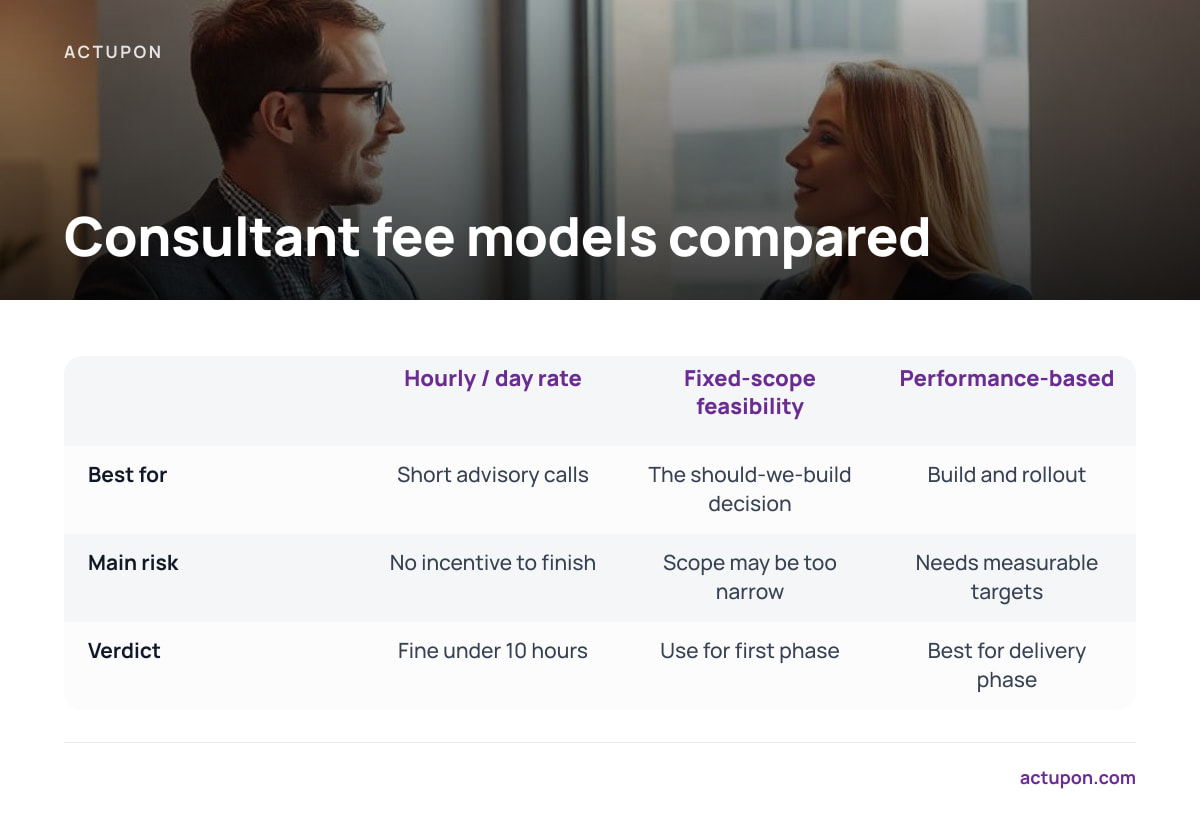
Fee structure tells you how a consultant expects the project to go. Open-ended hourly billing on a blockchain build rewards complexity, and blockchain projects are already complex.
| Fee model | Best for | Main risk | Our verdict |
|---|---|---|---|
| Hourly / day rate | Short advisory calls, second opinions | No incentive to finish or to say no | Fine for under 10 hours, bad for builds |
| Fixed-scope feasibility | The "should we build this?" decision | Scope may be too narrow | Use it for the first phase |
| Monthly retainer | Ongoing governance and roadmap support | Drifts into paying for attendance | Only with written quarterly outcomes |
| Performance-based | Build and rollout tied to business metrics | Needs clearly measurable targets | Best for the delivery phase |
Here's what I'd pick. Pay a fixed fee for a feasibility verdict with a clear yes or no. If the answer is yes, tie the build phase to measurable results. Examples include reconciliation time cut, disputes reduced, settlement days removed, or partner transaction volume reached. A consultant who believes in the use case should be comfortable with that. One who isn't has told you something.
The same principle holds for adjacent technology bets. Our guide to AI strategy consulting applies it to AI projects, where the "do we need this at all?" question is just as underused.
Get a Straight Yes or No on Blockchain Before You Fund a Build
ActUpon runs crypto and blockchain consulting on the model this article argues for. It starts with a short feasibility verdict that includes the database baseline and the partner-onboarding question. If the answer is yes, the build and rollout can be priced on agreed, measurable results instead of hours. If your real need is simpler, such as accepting bitcoin payments without handing them to a third-party processor, our sister service Myntli offers hosted BTCPay Server. That costs far less than any custom chain. Pricing is scoped to each engagement, so ask for the fee and the result metrics in writing up front.
The honest caveat is that paid-on-results only works when the result can be measured. If your project's success depends entirely on competitors agreeing to join a network, no consultant can guarantee that outcome. We will tell you so before you spend money, not after.
Frequently Asked Questions
What does an enterprise blockchain consultant do?
An enterprise blockchain consultant assesses whether a shared ledger solves a real multi-party business problem. If it does, they design the architecture, governance and integrations, and oversee delivery. The best ones spend the first phase testing whether a conventional database would work better.
When does a business actually need blockchain instead of a database?
Blockchain makes sense when several independent organizations need to share one tamper-evident record and no single party is trusted to control it. If one company owns the data and others simply read it, a database with an API is usually cheaper, faster and easier to correct. NIST's Blockchain Technology Overview (NISTIR 8202) sets out the questions to test this.
Should I choose a permissioned or public blockchain for my company?
Most enterprise projects should start with a permissioned blockchain, where known participants are vetted and data stays among members. Public chains suit cases that need open participation or digital-asset settlement, such as accepting cryptocurrency payments. The choice should rest on a specific business requirement, not on decentralization as a general goal.
Can you store personal data on a blockchain under GDPR?
Storing personal data directly on-chain conflicts with the rights to correct and erase data, because blockchains are designed to be immutable. The European Data Protection Board's 2025 guidelines on blockchain advise avoiding on-chain storage of personal data. The usual approach is to keep personal data off-chain and record only hashes or proofs on the ledger.
How should I pay a blockchain consultant?
Pay a fixed fee for a short feasibility study that ends in a clear yes or no. If you proceed, tie the build and rollout to measurable outcomes such as reduced reconciliation time or partner transaction volume. Open-ended hourly billing on a blockchain build rewards complexity and delay.
Sources
- NISTIR 8202: Blockchain Technology Overview | National Institute of Standards and Technology
- ISO/TC 307 Blockchain and distributed ledger technologies | International Organization for Standardization
- Markets in Crypto-Assets Regulation (MiCA) | European Securities and Markets Authority
- Guidelines on processing of personal data through blockchain technologies | European Data Protection Board
- CHESS replacement project announcements | ASX
- TradeLens discontinuation announcement | Maersk